MyWarm
home.co.uk
Helping piece together the retrofit puzzle.
Understanding why insulation, airtightness, moisture, and ventilation must work together.
How to Upgrade Your Home Efficiency Without Costly Retrofit Mistakes
Planning insulation, a heat pump, solar panels, or using schemes such as ECO4, Warm Homes, or the Boiler Upgrade Scheme (BUS)? This guide explains how to approach retrofit properly and avoid the common mistakes that lead to damp, poor performance, and wasted money.
Why Many Home Upgrades Go Wrong
Most retrofit problems are not caused by the technology itself. They happen because upgrades are rushed, poorly designed, or installed in the wrong order.
- Insulation added without improving ventilation.
- Heat pumps installed in homes not ready for low-temperature heating.
- Poor workmanship hidden behind finished walls and plaster.
- Grant funded work prioritising speed instead of long-term quality.
- Existing damp, drainage, or airflow issues ignored before installation.
Good retrofit starts with understanding the building first — not rushing into products or funding.
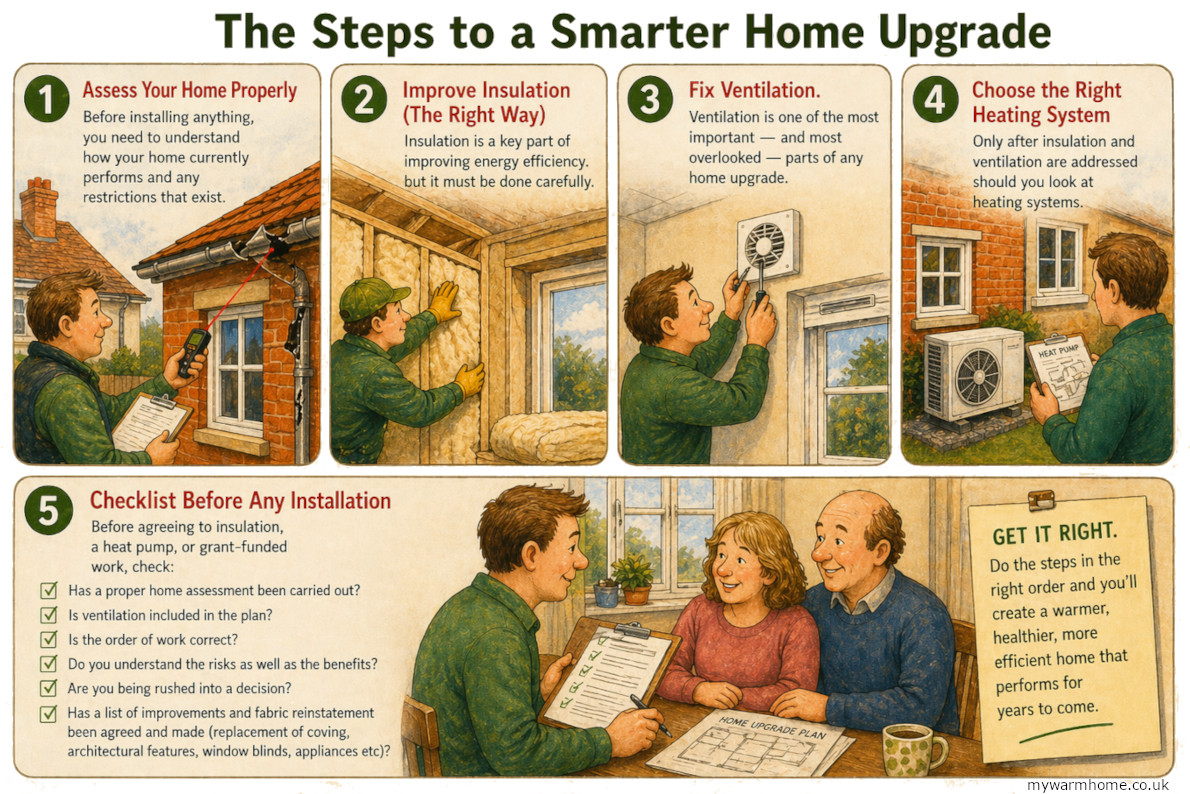
Step 1: Assess Your Home Properly
Before installing anything, you need to understand how the property currently performs and whether any restrictions or defects already exist.
- Construction type (solid wall, cavity wall, timber frame, etc).
- Existing insulation levels and condition.
- Ventilation and airflow throughout the property.
- Signs of condensation, damp, or mould.
- Drainage, gutters, and damp-proof course condition.
- Access requirements such as scaffolding or waste removal.
- Planning restrictions or conservation requirements.
- How neighbouring properties may affect the retrofit.
Without a proper assessment, retrofit decisions are based on guesswork.
Step 2: Improve Insulation the Right Way
Insulation is essential for reducing heat loss and improving comfort, but only when installed correctly and matched to the building.
| Done Properly | Done Poorly |
| Reduces heating demand. | Traps moisture inside the property. |
| Improves comfort levels. | Causes damp and mould growth. |
| Lowers energy bills. | Creates cold bridging problems. |
| Helps heating systems perform efficiently. | Can damage the building fabric. |
Many insulation failures happen because ventilation was never considered as part of the upgrade.
Step 3: Improve Ventilation
As homes become warmer and more airtight, ventilation becomes more important — not less.
Without proper airflow, moisture generated by everyday living remains trapped indoors.
- Condensation on windows.
- Damp patches and mould growth.
- Stale indoor air.
- Reduced indoor air quality.
- Potential respiratory health issues.
Common Ventilation Mistakes
- Extractor fans that are too weak.
- Ducting vented into loft spaces.
- Blocked or sealed background ventilation.
- No airflow between rooms.
- Trickle vents permanently closed.
Poor ventilation is one of the biggest causes of post-retrofit problems in UK homes.
Step 4: Choose the Right Heating System
Only after insulation and ventilation are addressed should you consider replacing or upgrading the heating system.
Heat Pumps Can Work Very Well — But Only If:
- The home is properly insulated.
- Heat loss calculations are accurate.
- The system is correctly designed.
- Radiators and controls are suitable.
When poorly designed, heat pumps can lead to high running costs, cold rooms, and disappointing performance.
The heating system should suit the home, not the other way around.
Checklist Before Any Retrofit Work
- Has a proper home assessment been completed?
- Has ventilation been included in the design?
- Is the order of work correct?
- Do you understand both the risks and benefits?
- Are you being pressured into quick decisions?
- Has reinstatement work been agreed beforehand?
- Will drainage and airflow still work after installation?
If the answer to any of these questions is “NO”, pause before moving forward.
Common Retrofit Problems We See
- Insulation installed without ventilation upgrades.
- Extractor fans venting directly into loft spaces.
- Heat pumps fitted without proper system design.
- Condensation and mould appearing after improvements.
- Fixtures and fittings no longer fitting after works.
- Architectural details not reinstated properly.
- Technology poorly explained to homeowners.
Most retrofit issues are avoidable with proper planning, assessment, and quality control.
Final Advice for Homeowners
Upgrading your home can improve comfort, reduce energy use, and lower bills, but only if the work is designed and installed properly.
- Understand the building first.
- Follow the correct order of upgrades.
- Prioritise quality over speed.
- Do not ignore ventilation.
- Ask questions before agreeing to work.
A successful retrofit is about balance — warmth, ventilation, moisture control, and good design working together.
Why Trust Our Advice
We’ve worked in UK retrofit since the early Warm Front and ECO schemes, long before retrofit became mainstream.
From designing heating systems and surveying insulation installations to auditing renewable energy schemes and carrying out thousands of inspections, our advice is based on real-world experience.