True affordability is not achieved by cutting corners or reducing upfront costs alone,
Designing any heating or renewable system—whether it’s a heat pump, electric storage, gas boiler, unvented system, underfloor heating, radiator configuration, must begin with a single guiding principle: efficiency comes first.
True affordability is not achieved by cutting corners or reducing upfront costs alone, but by designing systems that perform at their highest potential. When efficiency leads the design, it naturally shapes long-term affordability—lower energy use, reduced running costs, and greater overall value.
In essence, affordability should never dictate efficiency; rather, efficiency should define affordability.
The Science.
We’re human—and often stubborn. It’s natural to trust what we can see and what we believe, even when the science tells a deeper story.
But when it comes to our homes and keeping them warm, the science is vast and uncompromising. Facilities like the Energy House in Salford constantly test and thermally model real-world conditions, while manufacturers subject materials to extremes of heat and cold to understand exactly how they retain or lose energy.
Before any legitimate product reaches the market, it undergoes rigorous testing and must achieve strict certification standards—whether UK or European. Only then is it assigned performance values, allowing it to be accurately modelled within properties and used to meet UK regulations.
In short, what may seem simple on the surface is backed by an immense depth of science, testing, and proven performance.
Sizing For Our Homes.
When a new heating system or existing one is being specified or upgraded there are many factors to take into consideration. When I first started as a heating engineer it would be standard to go to a plumbers merchand and order a combi and 5 radiators as a standard heatpack which is no way to size for a property.
Lets look at some examples of how we would size a property for heating. We will discus hot water requirements later.
Electric storage heaters can be hard to correctly size as they use stored cheaper overnight energy to heat properties during the day, things like work patterns, occupation and social factors like pre payment meters can all play a part.
For the next section we are looking at primary heating using gas or heat pumps.
Heat Loss.
Are we robbing Peter to pay Paul—or neither? It’s a great expression, especially when you think of it in heating terms: are we unintentionally drawing warmth from our neighbours, if we even have any?
Understanding heat loss starts with the basics—identifying losses through walls and floors, considering the size of the property, and defining the level of heat demand required through radiators etc. Once we understand our heat loss not only do we understand our radiator positions (underfloor obvious) but also the optimum balance of energy use to comfort levels.
We calculate our heating requirement by looking at room sizes, then adjusting it based on how well our homes holds heat.
Older homes, poor insulation, and exposed walls increase heat loss — while insulation and neighbouring properties reduce it.
Q = Heat required (Watts)
This is the size of heating you need.
V = Room Volume (m³)
Length × Width × Height.
F = Base Heat Loss Factor (from property age)
Older homes lose more heat.
M = Modifiers (construction, insulation, exposure, etc.)
Adjusts for real-world conditions.
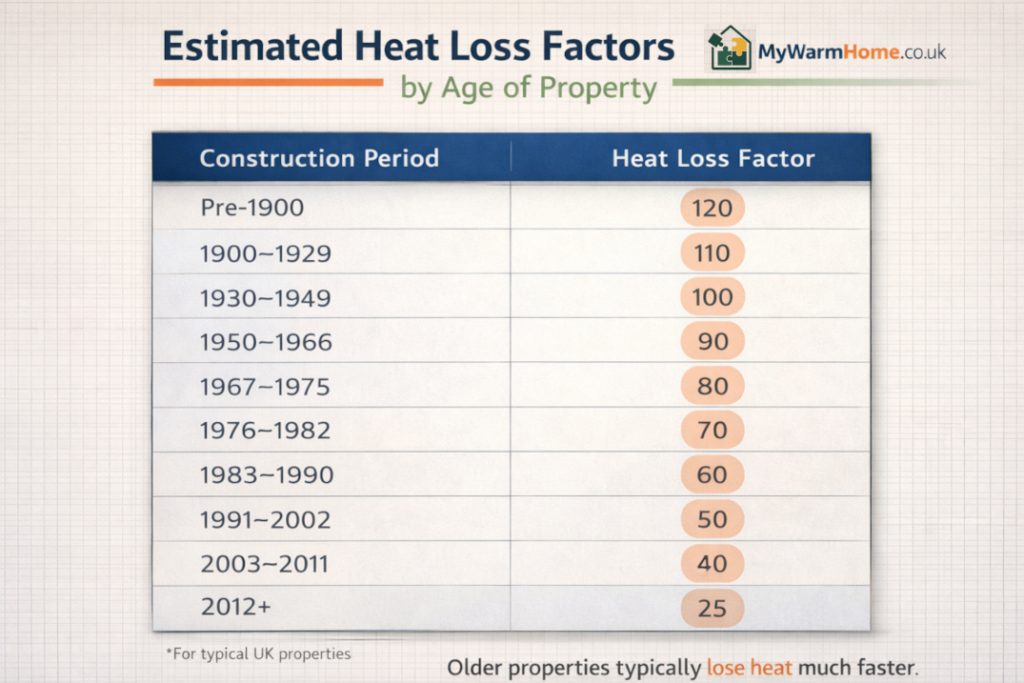
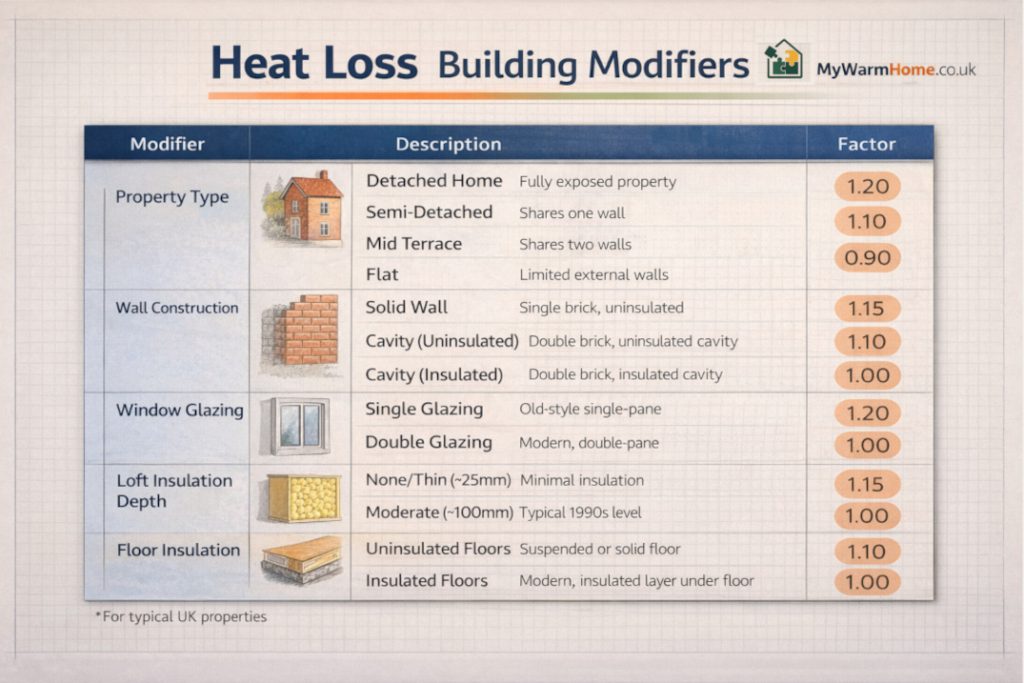
Heat Loss & Heating Design Tool
We need to determine the required heat output in watts, as modern radiators and heating systems are rated this way (traditionally it was in BTUs). To do this, measure the room’s length, width, and height—giving you three figures.
Multiply these together to get the volume.
Then apply a heat loss factor, followed by a final adjustment or modifier (see below).
So now you know a rough heating output required for our room we now need to understand Delta T (ΔT)
What ΔT Means
ΔT (Delta T) = the temperature difference between:
- Average radiator water temperature
- Room temperature
Radiators are rated for heat output at a standard ΔT, typically:
- ΔT50 → Water 70°C, Room 20°C → ΔT = 50°C
- ΔT60 → Water 75°C, Room 15°C → ΔT = 60°C
- ΔT30 → Water 35°C, Room 20°C → ΔT = 30°C (common for heat pumps)
Radiator outputs are listed for ΔT50 (standard UK value) If you run a heat pump at 35–45°C, ΔT drops → radiator output drops → room may feel cold
| Radiator | Output @ ΔT50 | Output @ ΔT30 |
|---|---|---|
| K2 600×1000 | 1800W | ~1050W |