
MyWarm
home.co.uk
Heat pumps do not generate heat, they move it.
WSHP (water source heat pump)
A water source heat pump (WSHP) works like a fridge in reverse. Instead of taking heat out of food and throwing it into your kitchen, it takes heat from water and moves it into your home.
Even when water feels cold to us, it still contains a surprising amount of heat energy. A heat pump extracts this heat and upgrades it to a higher temperature that can be used for heating and hot water.
The Basic Process
1. Heat is collected from water
The system uses a nearby water source such as:
- A lake
- River
- Canal
- Pond
- Flooded quarry
- Borehole or well
A network of pipes containing a water/antifreeze mixture is submerged in the water. As the fluid circulates through the pipes, it absorbs heat from the surrounding water.
2. The heat reaches the evaporator
The warmed fluid enters the heat pump unit and passes through a component called the evaporator. Inside the evaporator is a special refrigerant. This refrigerant is designed to boil at extremely low temperatures.
For example:
| Substance | Boiling Point |
|---|---|
| Water | 100°C |
| Typical Heat Pump Refrigerant | Around -30°C to -50°C |
Because of this low boiling point, even water at 5°C can make the refrigerant boil into a gas.
3. The compressor boosts the temperature
The refrigerant gas is compressed. When gas is compressed its
- Pressure increases
- Temperature rises dramatically
A refrigerant at 5°C may leave the compressor at 70–100°C.
This is where most of the electrical energy is used.
4. Heat is transferred into your home
The hot refrigerant passes through a condenser. Here it transfers heat into:
- Underfloor heating
- Radiators
- Hot water cylinder
The refrigerant cools and turns back into a liquid. The cycle then repeats continuously.
Coils and Mats Explained
There are two main methods of collecting heat from water.
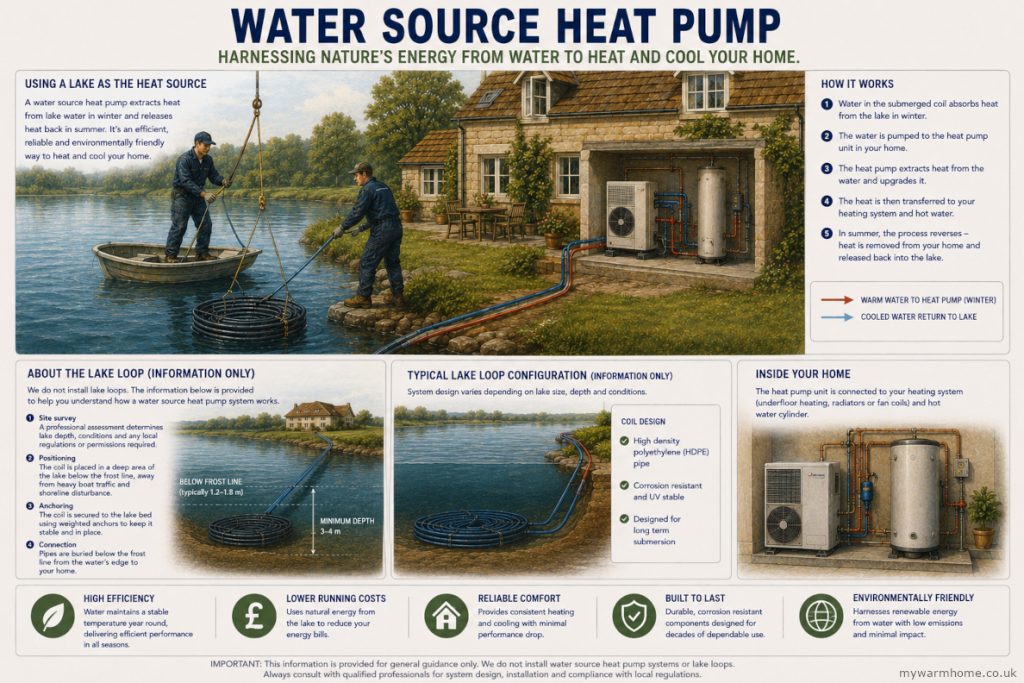
Collector Coils
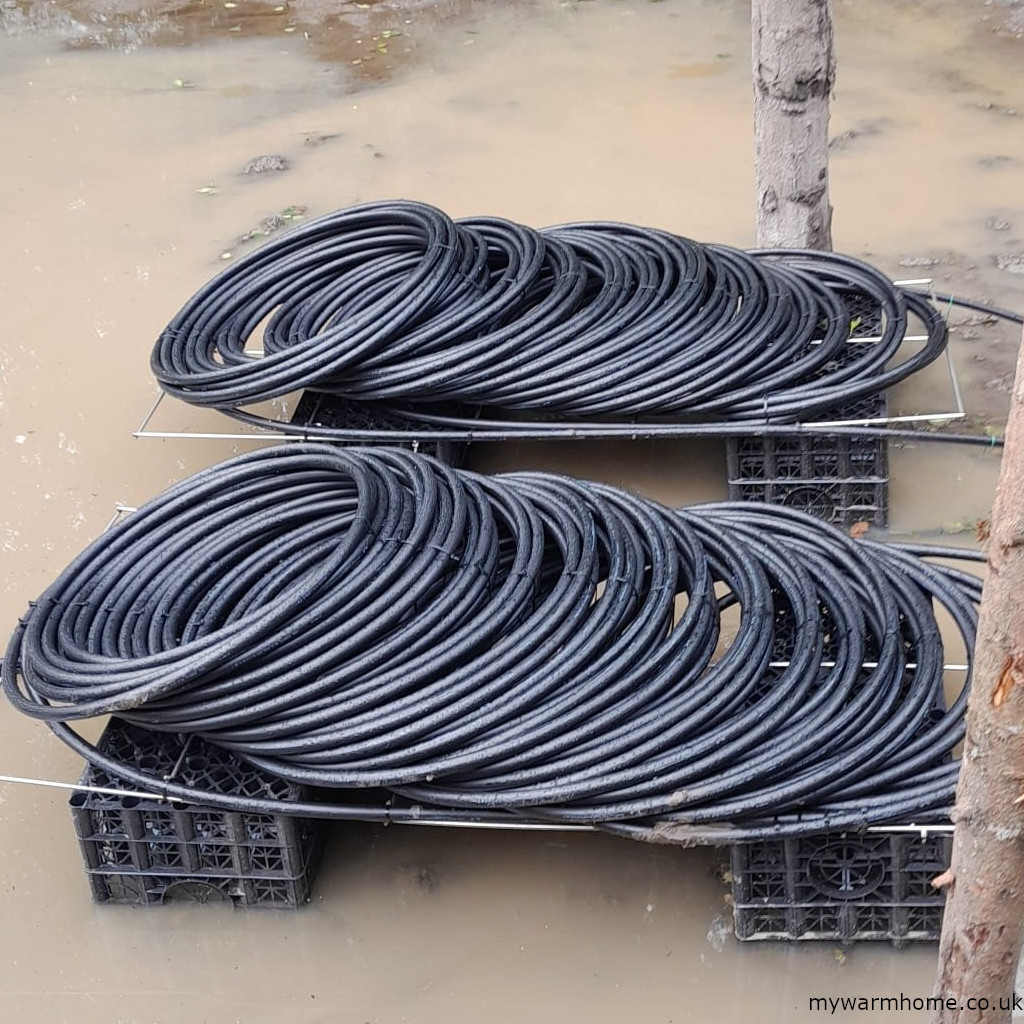
Coils are large loops of pipe sunk to the bottom of a lake, pond or quarry.
Typical Installation
- Depth: 2–20 metres
- Pipe diameter: 25–40 mm
- Material: HDPE plastic
- Pipe length: 200–2,000 metres depending on system size
The deeper the coil, the more stable the temperature throughout the year.
Advantages
✓ Lower installation cost
✓ Simple design
✓ Long lifespan (50+ years)
Disadvantages
✗ Requires suitable water body
✗ Divers may be needed for installation
✗ Can be harder to inspect after installation
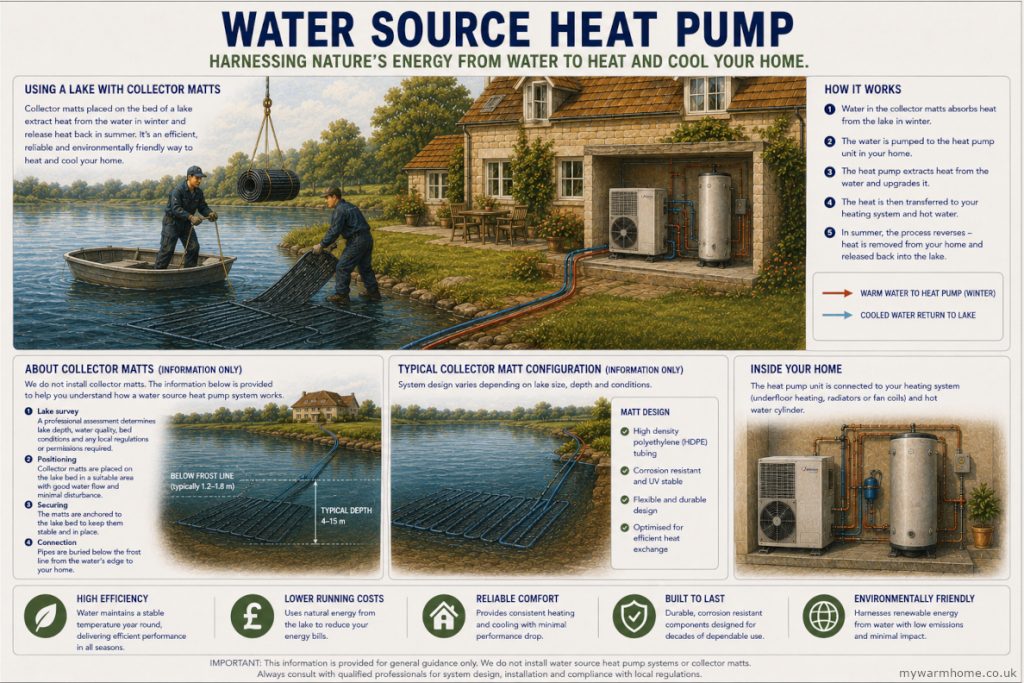
Collector Mats
Instead of loops, pipes are fixed into large flat mats. Think of them as giant underwater underfloor-heating panels.
Typical Sizes
A domestic property may require:
- 20–100 m² of mat area
- Installed at 1–5 metres depth
- Anchored to the lake or river bed
Advantages
✓ Efficient heat transfer
✓ Easier to predict performance
✓ Can require less water area
Disadvantages
✗ Higher installation costs
✗ More anchoring required
✗ Greater upfront design work
Manifolds
A manifold is simply a distribution point where several pipe loops connect together. Think of it like a road junction.
Instead of having ten separate pipes entering the heat pump:
- All loops connect to the manifold
- The manifold combines the flow
- One larger pipe returns to the plant room
Benefits
✓ Balances flow between loops
✓ Easier maintenance
✓ Allows expansion in future
Manifolds are often located:
- Underground chambers
- Small kiosks
- Plant rooms
Inspection Hatches
Inspection hatches provide access to buried equipment.
They may contain:
- Manifolds
- Isolation valves
- Flow meters
- Air vents
Typical hatch sizes:
- 600 × 600 mm
- 900 × 900 mm
- Larger chambers for commercial systems
Inspection hatches allow engineers to:
- Check pipework
- Remove trapped air
- Test pressures
- Isolate circuits
without excavating the ground.
Refrigerants Explained Simply
Refrigerant is the “magic working fluid” inside the heat pump.
- Absorbs heat at low temperature
- Changes from liquid to gas
- Gets compressed
- Releases heat into the home
- Returns to liquid
Modern refrigerants commonly include:
- R32
- R454B
- R290 (Propane)
These refrigerants are chosen because they can absorb useful heat even when temperatures are very low.
What Is the Plant?
The “plant” refers to all the main equipment that makes the system work.
A typical plant room contains:
Heat Pump Unit
The main machine.
Buffer Tank
Stores heated water and reduces cycling.
Hot Water Cylinder
Stores domestic hot water.
Pumps
Move water around the system.
Expansion Vessel (accommodates expansion as water heats up)
Controls
Thermostats, sensors and monitoring equipment.
Typical Water Temperatures
One reason water source systems perform so well is because water temperatures stay relatively stable.
| Source | Winter | Summer |
|---|---|---|
| River | 2–10°C | 10–20°C |
| Lake | 4–10°C | 15–25°C |
| Deep Borehole | 8–12°C | 8–12°C |
| Canal | 4–12°C | 12–22°C |
Compare that to air source heat pumps which may be trying to extract heat from air at:
- -5°C
- -10°C
- Sometimes lower
This gives water source systems a major efficiency advantage.
Advantages of Water Source Heat Pumps
Excellent Efficiency
Water temperatures are more stable than air.
Lower Running Costs
Often 10–30% more efficient than air source systems.
Quiet Operation
No large outdoor fan.
Long Lifespan
Collectors can last 50+ years.
Reliable Winter Performance
Performance drops less during cold weather.
Cooling Capability
Some systems can provide passive cooling in summer.
Disadvantages of Water Source Heat Pumps
Higher Upfront Cost
Installation is usually more expensive than air source systems.
Suitable Water Source Needed
Not every property has access to water.
Environmental Permissions
Lakes, rivers and boreholes may require permissions and surveys.
Specialist Installation
Design and installation are more complex.
Access Requirements
Boats, divers or specialist equipment may be needed.
Repair Costs
Collector repairs can be more difficult than replacing an outdoor air source unit.
Typical Efficiency
For every 1 kWh of electricity used:
- Air source heat pump: typically produces 3–4 kWh of heat
- Water source heat pump: typically produces 4–6 kWh of heat
This is why water source heat pumps are generally considered the most efficient renewable heating technology available where a suitable water source exists.
Major Heat Pump Manufacturers.
UK
- Vaillant – https://www.vaillant.co.uk
- Worcester Bosch – https://www.worcester-bosch.co.uk
- Ideal Heating – https://idealheating.com
- Grant UK – https://www.grantuk.com
- Calorex – https://www.calorex.com
- Aira – https://www.airahome.com
European manufacturers
- Viessmann – https://www.viessmann.co.uk
- Stiebel Eltron – https://www.stiebel-eltron.co.uk
- NIBE – https://www.nibe.eu
- Bosch Thermotechnology – https://www.bosch-thermotechnology.com
- Vaillant Group – https://www.vaillant-group.com
- Kronoterm – https://www.kronoterm.com
- Ochsner – https://www.ochsner.com
- Hoval – https://www.hoval.com
- Dimplex – https://www.dimplex.co.uk
- MasterTherm – https://www.mastertherm.com
Asian manufacturers
- Mitsubishi Electric – https://les.mitsubishielectric.co.uk
- Daikin – https://www.daikin.co.uk
- Panasonic – https://www.aircon.panasonic.eu/GB_en
- Hitachi – https://www.hitachiaircon.com
- Samsung – https://www.samsung.com/uk/business/climate
- LG – https://www.lg.com/uk/business/air-solution
Emerging manufacturers
- Carrier – https://www.carrier.com
- Trane – https://www.trane.com
- Gree – https://www.gree.com
- Midea – https://www.midea.com
- Toshiba – https://www.toshiba-aircon.co.uk
- Fujitsu General – https://www.fujitsu-general.com