MyWarm
home.co.uk
Changes can be difficult especially new ones.
Heating systems make warmth.
Insulation keeps it.
Controls decide how wisely it’s used.
Heating systems are becoming smarter, regulations are becoming stricter, and energy saving technology is developing quickly.
Boilers have provided UK homes with reliable heating and hot water for many years.
Although they may run on natural gas or oil, most work in a broadly similar way, with the main differences relating to how hot water is stored and delivered.
Combination boilers, usually known as combi boilers are the most common type found in UK homes.
Understanding how your boiler works and what its main components do can help you use it more efficiently, spot potential problems early and carry out a few simple checks before calling an engineer.
My Warm Home
Combi boiler fault finder
Choose the problem and answer a few simple questions. We’ll suggest safe checks and explain when professional help is needed.
Is there an immediate safety concern?
This includes a smell of gas, a carbon-monoxide alarm, smoke, scorching, sparks, or water reaching electrical parts.
This tool provides general guidance and cannot confirm a fault. Instructions vary between boiler models, so consult your appliance manual. Where professional help is advised, use an appropriately qualified engineer.
So lets first look at the combination boiler.
The sequence of operation.
When we ask for heat (turn boiler on )
A combinationor combi boiler provides central heating and hot water from one appliance. It does not normally need a separate hot-water cylinder.
When we ask for heat (thermostat up, programmer on etc)
- A demand for heat is created
The programmer, room thermostat or smart control asks the boiler to warm the home. - The boiler carries out safety checks
The boiler checks that the system water pressure and other operating conditions are correct. - The pump starts
Water begins circulating through the boiler and central-heating system. - The fan starts
The fan supplies air for combustion and helps safely remove the combustion gases. - Airflow is confirmed
The boiler’s safety controls confirm that the fan and flue are operating correctly. - The burner ignites
The gas valve opens and the ignition electrode creates a spark. A flame-sensing device confirms that the burner has lit safely. - Water is heated
Heat from the burner passes through the main heat exchanger and warms the water circulating to the radiators. - The boiler adjusts its output
Modern boilers can increase or reduce the flame to match the amount of heat required. This is called modulation. - The required temperature is reached
Once the home or heating water reaches its target temperature, the burner switches off. The pump may continue running briefly to carry away any remaining heat.
When a hot tap is opened, hot water takes priority over the heating. When the heating is switched on
When a hot tap is opened.
- The boiler detects water flow
A flow sensor detects that a hot tap or shower has been opened. - Hot water is given priority
The boiler temporarily pauses or reduces the flow of heat to the radiators. - The diverter valve changes position
Heated boiler water is directed towards the plate heat exchanger. - The burner operates
The boiler ignites or increases its output to meet the hot-water demand. - Cold mains water is heated
Cold drinking water passes through one side of the plate heat exchanger. Boiler water passes through the other side, transferring heat without the two supplies mixing. - Hot water reaches the tap
The heated mains water travels directly to the open tap or shower. - The tap is closed
The flow sensor detects that hot water is no longer required. The burner switches off or the boiler returns to central-heating mode.
The boiler casing should never be removed by a homeowner. Any work involving gas, oil, combustion components or internal boiler parts must be completed by a suitably qualified engineer.
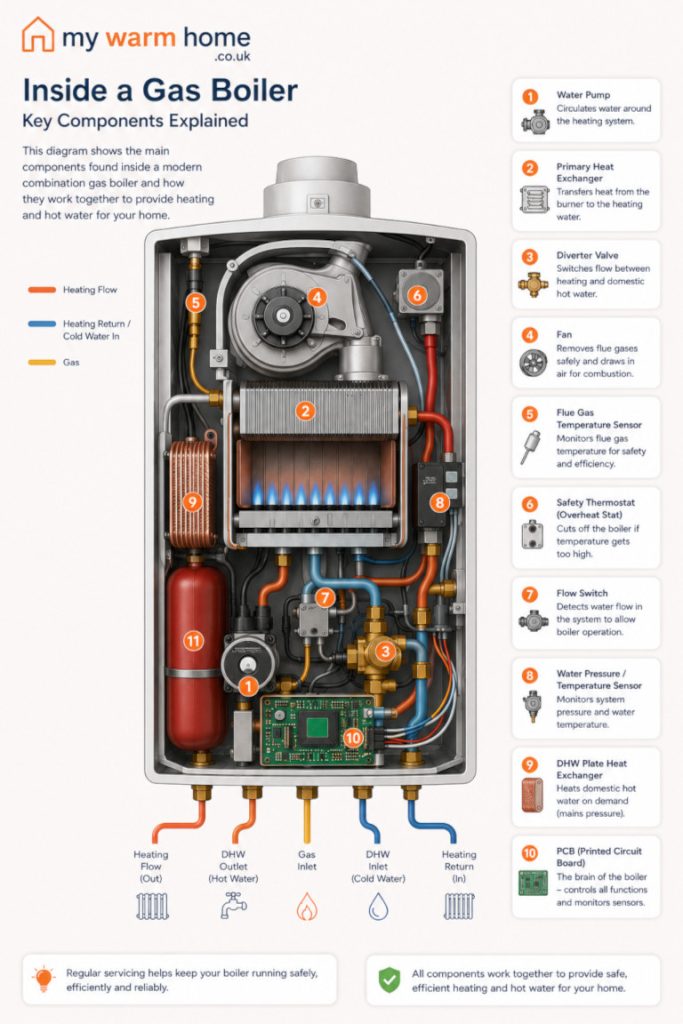
Pump.
Pumps water around the system..
Diverter valves,
Diverts the water to either hot water taps, radiators or stored hot water.
Expansion vessels.
Hot water expands so the hotter the system gets the more pressure builds up. Expansion vessells allow that expansion, just like blowing up a baloon. Older conventional systems use small tanks in the loft. Modern systems have dedicated vessels built in or external.
Fan.
Creates airflow at set values to mix with the gas creating a safe mixture for the burner to operate.
Gas Valve.
The intake mechanisim to make sure the correct amount of gas is supplies to the burner.
Heat exchanger.
This is what makes our heating and hotwater. We have a primary heat exchanger which makes our radiators get warm and with a combi we usually have a plate heat exchanger which uses the central heating water to heat our hotwater but they never mix.
PCB.
The brain, this controlls all the signals from thermostats, gas valves, dials, sensors, apps etc.
Sensors.
Lots of different ones dotted around the boiler. These sense air flow, temperature on different pipes to name a few.
Hot water storage.
Can be basic copper tank that water is supplied via seperate water tanks (vented) or modern sealed unit that works under pressure (unvented)
Programmers/Thermostats/Controls.
From hard wired to wireless and phone/tablet app connected. Some are all in one and some stand alone. (tado, nest etc). They tell our radiators, hotwater and our boilers when to come on and off, what temperature to heat up to , some modern controls can fault find!
Zone Valves,
Can control the heating in different zones, ie upstairs and downstairs.
Remember only a gas competent engineer can work on gas appliances. Always check qualifications.


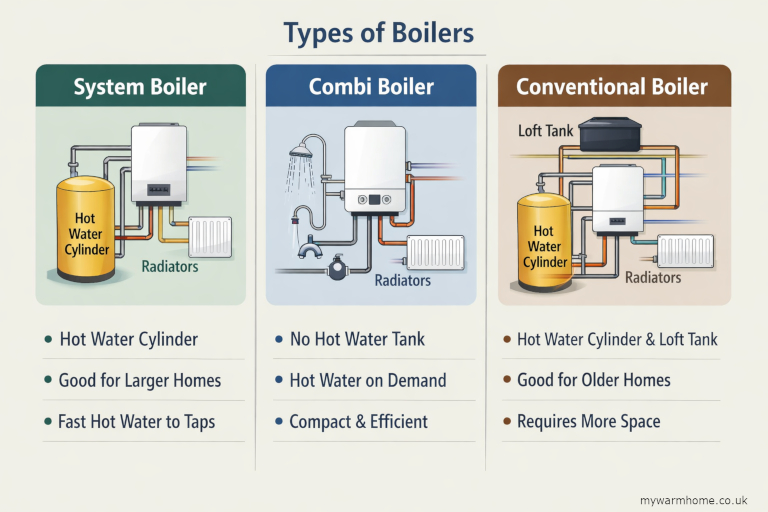
Boiler Types.
All boilers provide heating the same way.
Water is pumped around our radiators or underfloor heating.
The hotwater demand is delivered different for each of the common UK boiler types.
- Combi. Delivers heating and hot water from one unit. Pumps etc inside the main unit.
- System. Will have seperate hotwater storage but pumps etc inside the main unit
- Regular (conventinal). Will have seperate hotwater storage, pumps, valves and controllers are external from main unit.


A Combination (Combi) Boiler can delivers both central heating and hot water directly from the mains, working much like a high-powered, on demand kettle.
It heats water almost instantly whenever a tap is opened, removing the need for a separate hot water cylinder or cold-water storage tank.
Pros.
- Saves space
- Easier to install than regular or system
- All components within one unit
- Huge amount of manufactures and options
Cons.
- Hot water delivery can be slow due to system and property design
- They need good mains pressure
- They don’t have an immersion heater as backup
- They don’t usually work with power or older type showers
- They don’t usually let you use multiple showers or taps at the same time.*
Operation. Combi boilers work by the use of demand switches and valves (typically flow switches or diverters) for the hot water, so when a hot outlet is opened (tap, shower) a sensor recognises a flow and puts the boiler into hot water operation.
The heating side is controlled either by external room thermostats, individual radiator thermostats or built in controls.
Many people assume combi boilers provide “instant” hot water, but that’s not truly the case.
Heat loss, water wastage due to long pipe runs, and pre-heat settings can all affect performance and perceived efficiency.

A System Boiler can deliver both heating and hot water but the hot water side of the system is seperate.
It heats water via a stored hotwater tank, the main components like the pump, diverter valves etc, are within the boiler unit.
Pros.
- Excellent for homes with multiple bathrooms and high hot water needs.
- No need for a cold water tank in the loft.
- An electric immersion heater can be installed in the tank, providing hot water even if the boiler breaks down.
- Some models can work with solar thermal.
- Easier to install than regular boiler.
- All main components within one unit.
Cons.
- Requires a dedicated space for the hot water tank.
- Hot water can run out if the cylinder is emptied, requiring a 20-30 min reheat time.
- Higher installation cost compared to combi boilers.
- Less suitable for homes with limited space
Operation. System boilers work by the using valves, sensors and switches to recognise flow, so when a hot water setting is chosen the boiler begins to heat up the stored hot water. The hot water can take a bit of time to get up to temperature if the household has high demands. The heating is controlled via thermostats/programmers externally or built into the unit.
A Regular Boiler can heat external stored water and will have same components but may not be pressurised.
It will have external componants like pumps, diverter valves and expansion vessels.
It heats water via a stored hotwater tank, the main components like the pump, diverter valves etc external of the boiler unit.
Pros.
- Supplies hot water to multiple taps or showers simultaneously without significant pressure drops.
- Works well in areas with low mains water pressure.
- Excellent for older properties with existing traditional heating systems.
- An electric immersion heater can be installed in the tank, providing hot water even if the boiler breaks down.
- Easily integrated with solar thermal energy systems
Cons.
- Needs space for a hot water cylinder (usually airing cupboard) and a cold-water storage tank in the loft.
- Hot water is limited to the capacity of the cylinder; if it runs out, you must wait for it to reheat.
- Hot water stored in the cylinder can lose heat if not properly insulated, can lead to higher energy bills.
- Takes time to reheat water after the cylinder empties.
- More complex and costly to install due to additional tanks and pipework.
Operation.
Regular boilers work by the use of external diverter valves (2 port or 3 port depending on design), so when a hot water setting is chosen the boiler begins to heat up the stored water. Depending on household demands, design is a major factor of having enough stored hot water to satisfy needs*.
The heating is controlled via external thermostats/programmers or built into the unit.
*Whenever stored hotwater is part of the system then a real life design has to be taken into account, this will look at factors like occupation, showering and bathing habits, work patterns and demand. With modern systems an anti bactarial function is incorperated into the design.
*As with any heating system, real efficiency depends on the quality of the design and installation.
Takehome info..
Combi boiler:
The flow rate determines how much hot water the system can deliver. If you expect to use more than one hot water outlet at the same time (for example, two showers), choose a boiler with a higher flow rate (measured in litres per minute).
The KW rating of a combi boiler is primarily determined by hot water demand.
It’s not always about the size of the house—if you have more than one bathroom, you may need greater hot water output.
As a general rule of thumb in the trade, each radiator is estimated at around 1.5kW. So, a home with 10 radiators would require a boiler with a minimum output of around 15kw.
Boiler size is usually on its description!
When you see a boiler name and model the kw is usually in its name. A Worcester 40cdi is usually 40kw. A Baxi 624 is usually 24kw and so on.


Hot water on a combi takes precedence over heating.
A diverter valve is usually present that fully switches when a tap or shower is used, meaning the heating is in off mode.
Combi boilers are pressurised, so think pressure cooker! It has a safety pipe (fed by a safety valve) that comes out of the back to the outside (usually a little copper pipe externally behind the boiler location) or into a tundish. This will let off excess pressure if a build up happens, just like a pressure cooker does, remember hot water expands and boilers are sized to handle a general expansion, this may need to be upgraded on the system depending on number and size of radiators.
What is renewable energy in the home?
Renewable energy systems use naturally replenished sources such as sunlight, air, ground heat, and organic materials to reduce reliance on fossil fuels like gas and oil.
Common benefits include:
- Lower energy bills over time.
- Reduced carbon emissions.
- Improved home comfort and efficiency.
- Access to government grants and incentives..
However, these systems only perform well when your home has the right foundations, particularly insulation, ventilation, and correct system design.
Renewable Heating & Energy Options For Our Homes.
As more homes move toward low-carbon living, renewable systems are becoming increasingly common. Each technology works in a different way, and just like insulation and ventilation, what’s suitable depends on the property, location, and how the home is used.
Solar (PV & Solar Thermal.
Solar PV (photovoltaic panels) generate electricity from daylight, even on cloudy days. That electricity can be used in the home, stored in batteries, or exported to the grid. Solar thermal, on the other hand, heats water directly using sunlight. (panels are different)
- Best for: Homes with a decent, unshaded roof (ideally south facing, but east/west can still work.
- Pros: Reduces electricity bills, low maintenance, works alongside other systems.
- Considerations: Output varies with seasons; works best when paired with good insulation and energy use habits.
Air Source Heat Pumps (ASHP).
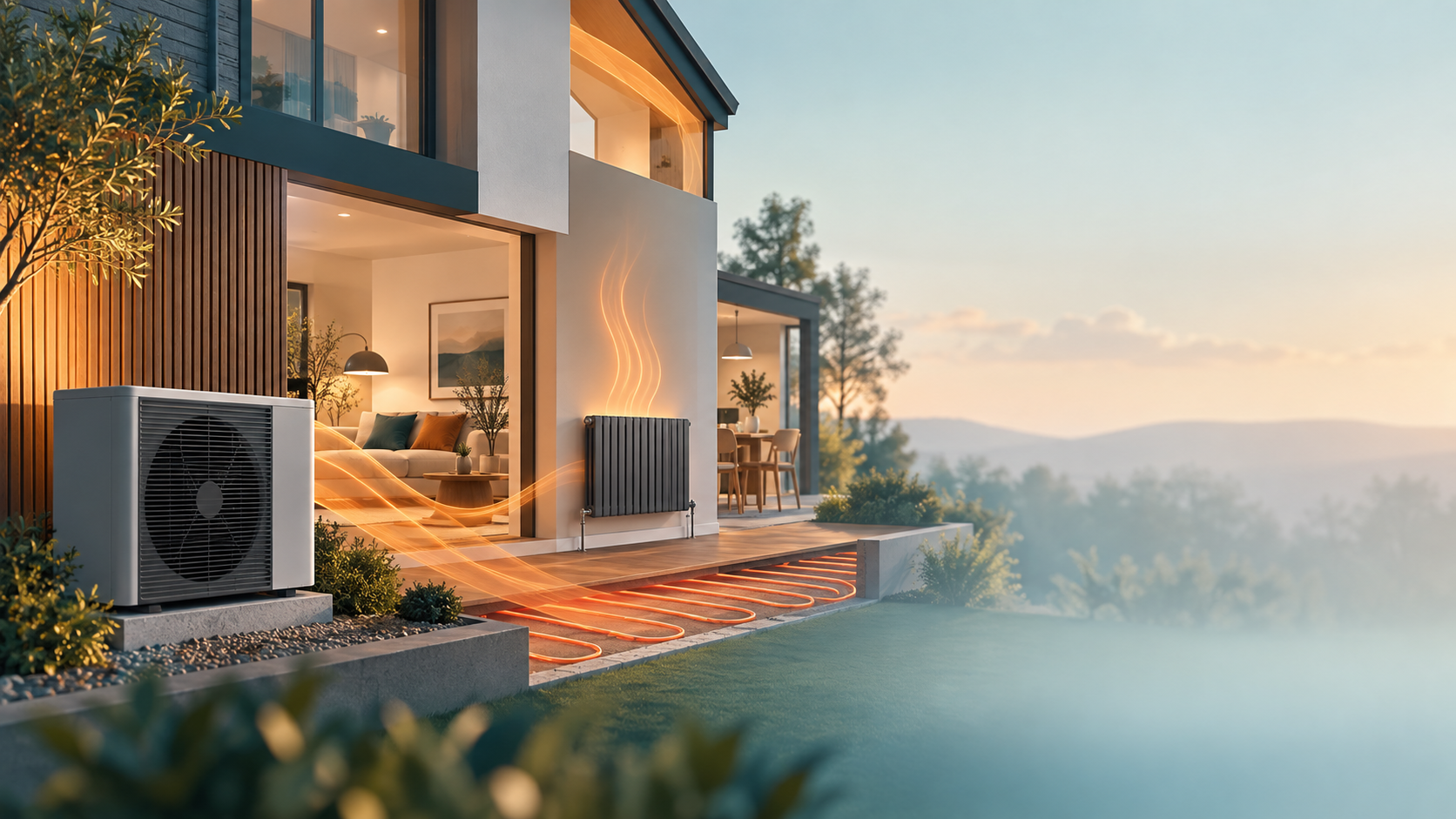
An air source heat pump extracts heat from the outside air even in cold weather and upgrades it to heat your home and hot water.
- Best for: Most property types, depending on insulation levels and system design.
- Pros: Widely applicable, relatively straightforward to install, supported by schemes like the Boiler Upgrade Scheme (BUS)
- Considerations: Typically runs at lower temperatures than traditional boilers, so radiators may need upgrading or underfloor heating installed.
Ground Source Heat Pumps (GSHP).
A ground source heat pump takes heat from the ground via buried pipes (either horizontal trenches or vertical boreholes).
- Best for: Homes with sufficient land or access for drilling.
- Pros: Very efficient and stable performance year round.
- Considerations: Higher upfront cost and more disruptive installation compared to ASHP.
Typically runs at lower temperatures than traditional boilers, so radiators may need upgrading or underfloor heating installed.
Water Source Heat Pumps (WSHP).
A water source heat pump extracts heat from a nearby water source such as a river, lake, or well.
- Best for: Properties lucky enough to have access to a suitable and permitted water source.
- Pros: Highly efficient due to stable water temperatures.
- Considerations: Requires environmental permissions and specific site conditions. Typically runs at lower temperatures than traditional boilers, so radiators may need upgrading or underfloor heating installed.
Biomass Heating.
Biomass systems burn organic material—typically wood pellets, chips, or logs—to provide heating and hot water.
- Best for: Rural or off-gas properties with space for fuel storage.
- Pros: Can deliver high temperatures similar to traditional boilers; uses renewable fuel
- Considerations: Requires regular fuel deliveries, storage space, and more hands-on maintenance.
Choosing the Right System
There’s no universal “best” option—only what’s best for your home.
- Well-insulated homes tend to suit heat pumps.
- Properties with good roof space benefit from solar.
- Rural homes may find biomass more practical.
- Site conditions determine whether ground or water source systems are viable.
The key is to treat renewables as part of the whole retrofit strategy, not a bolt on solution. When matched correctly to the building and combined with good insulation, controls and ventilation, they can deliver comfort, efficiency, and long-term savings.
Government grants for renewable heating.
Boiler Upgrade Scheme (BUS)
The Boiler Upgrade Scheme provides upfront grants to support the installation of low-carbon heating systems in England and Wales, including:
- Air source heat pumps
- Ground source heat pumps
- Biomass boilers (in limited cases, mainly off-gas homes)
Grants can significantly reduce installation costs, but eligibility depends on factors such as property type, insulation levels, and existing heating systems.
Warm Homes Plan & Local Grants.
The UK government’s Warm Homes Plan and related local authority schemes aim to improve energy efficiency and support low-income households with upgrades such as:
- Insulation improvements
- Low-carbon heating systems
- Solar panels and other energy-saving measures
These schemes often work alongside other funding routes, but requirements and availability can vary by location.
Other Low-Carbon Technologies.
Additional systems can enhance your home’s energy performance when used correctly:
- Battery storage systems (coming soon)
- Hybrid heating systems (coming soon)
- Mechanical Ventilation with Heat Recovery (MVHR)
- Smart Controls
Why renewable systems sometimes fail.
Many homeowners are encouraged to install renewables without proper preparation. This can lead to:
- Higher running costs than expected.
- Poor heating performance.
- Comfort issues such as cold rooms or overheating.
- System failures or expensive remedial work.
The most common cause of failure? Skipping the fundamentals.
The Mywarmhome.co.uk approach.
- Pre-installation checks – insulation, ventilation, and suitability
- Correct system sizing & design (technical).
- Installation quality and compliance (regulation and best practice).
- Post-installation performance and real-world results.
This ensures that any system supported by schemes like BUS or the Warm Homes Plan actually delivers the savings and comfort you expect.