

VENTILATION / MY WARM HOME
Ventilating your home.
Warmth creates moisture. Insulation keeps heat in. Ventilation helps balance the home.
01
Understand
Know where moisture comes from and why indoor air needs managing.
02
Extract
Remove moisture and pollutants where they are produced.
03
Replace
Allow fresh air back into the home through suitable ventilation routes.
04
Balance
Make insulation, airtightness and ventilation work together.
VENTILATION SYSTEMS
Different ways to move air through the same home.
01
Intermittent extract
Individual extractor fans remove moisture from rooms such as kitchens and bathrooms when required.
02
MEV
Mechanical Extract Ventilation provides continuous extraction from wet rooms using a central or decentralised system.
03
PIV
Positive Input Ventilation introduces filtered air into the property to encourage air movement through the home.
04
MVHR
Mechanical Ventilation with Heat Recovery provides controlled supply and extract ventilation while recovering heat from outgoing air.
WHY VENTILATION MATTERS
Keeping heat in changes how moisture leaves.
Condensation
Poor ventilation can contribute to condensation forming on cold surfaces such as windows and external walls.
Damp & mould
Moisture that is repeatedly allowed to build up can contribute to damp conditions and mould growth.
Indoor air quality
Ventilation helps replace stale indoor air and manage moisture and pollutants generated inside the home.
VENTILATION VS DRAUGHTS
Fresh air should be controlled.
Ventilation does not simply mean creating holes in the building and allowing uncontrolled cold air inside.
The key is controlled ventilation — providing the airflow the property needs in a way that occupants can understand and, where appropriate, regulate.
- Some safety ventilation, including combustion air for certain appliances, must remain permanently open.
- Trickle vents provide background ventilation through windows.
- Extractor fans remove moisture from wet rooms.
- Whole-house systems can provide more continuous ventilation.
The aim is not maximum airflow. The aim is the right airflow for the property and how it is being used.
BEFORE YOU IMPROVE AIRTIGHTNESS
Four ventilation checks before retrofit.
01
Extractor fans
Check existing bathroom and kitchen fans are working correctly and providing suitable extraction.
02
Vents & air bricks
Make sure existing ventilation openings have not been blocked, covered or forgotten during previous work.
03
Damp & mould
Investigate existing moisture problems before insulation or airtightness work changes the way the building behaves.
04
Air movement
Consider how air moves through rooms, loft spaces and the property as a whole before sealing unwanted gaps.
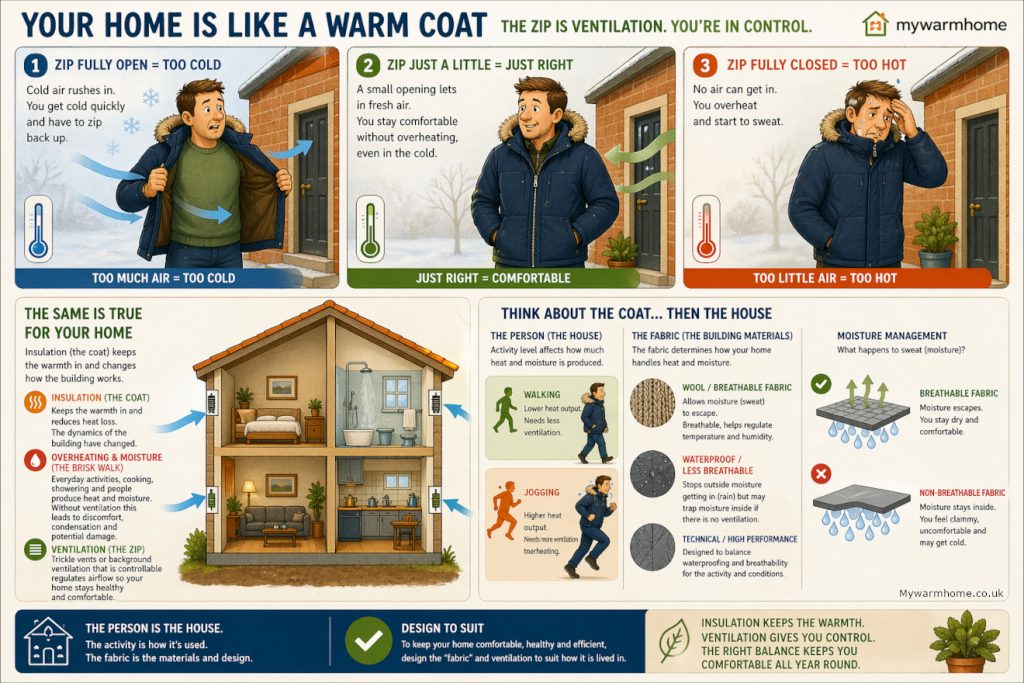
Like wrapping your house
Think about a winter coat.
If you fully unzip a thick winter coat on a cold walk, you quickly feel the chill and zip it back up. Open it slightly, however, and you allow just enough fresh air to stay comfortable without overheating.
The coat
Adding insulation is like putting on the coat. It keeps heat in more effectively, but it can also trap moisture and heat if airflow is not managed properly.
The zip
Trickle vents and controllable background ventilation act like the zip on the coat, allowing the home to breathe while maintaining comfort.
The person inside
The person’s activity represents how the property is used, while the coat represents the building fabric and insulation. Every home behaves differently depending on occupancy, lifestyle, moisture production, insulation levels, and ventilation.
AFTER THE WORK
Check how the home behaves afterwards.
Insulation and airtightness improvements can change the way heat, air and moisture move through the building. (known as HAMM)
- Check extractor fans remain effective.
- Make sure trickle vents and background ventilation remain usable.
- Monitor indoor humidity and changes in condensation.
- Watch for new damp or mould growth.
Improved airtightness does not remove the need for ventilation. It can make a planned ventilation strategy more important.
1
balanced home — heat, moisture and fresh air working together
MY WARM HOME VIEW
Ventilation should never be an afterthought.
Insulation, airtightness, heating and ventilation all change how the home behaves. They should be considered together rather than as unrelated improvements.
BEFORE YOU INSULATE OR SEAL THE HOME
Make ventilation part of the conversation before problems begin.
If you are planning insulation, heating or airtightness improvements, consider how ventilation will work in the finished home.