
HEATING HOMES / GAS HEATING
Gas heating.
Comfort starts with good design.
A boiler is only one part of the heating system. Learn how gas heating works, which boiler arrangement suits your home and how to spot problems safely.
01
How it works
Follow the journey from boiler to room.
02
Boiler types
Combi, system and regular boilers.
03
Inside the boiler
Understand what the main parts do.
04
Something wrong?
Safe observations and sensible next steps.
01 / HOW GAS HEATING WORKS
Your heating replaces the heat your home is losing.
A gas boiler burns fuel to heat water. A pump circulates that water through pipework to radiators or wet underfloor heating, where the heat enters your rooms. Controls decide when and where warmth is needed.
Controls call for heat
The programmer, room thermostat or smart control tells the boiler that the home needs heating.
The boiler heats water
The burner and heat exchanger transfer energy from burning gas into the sealed heating circuit.
Rooms receive heat
Radiators or underfloor heating release warmth. Cooler water returns to the boiler to be heated again.
02 / BOILER TYPES
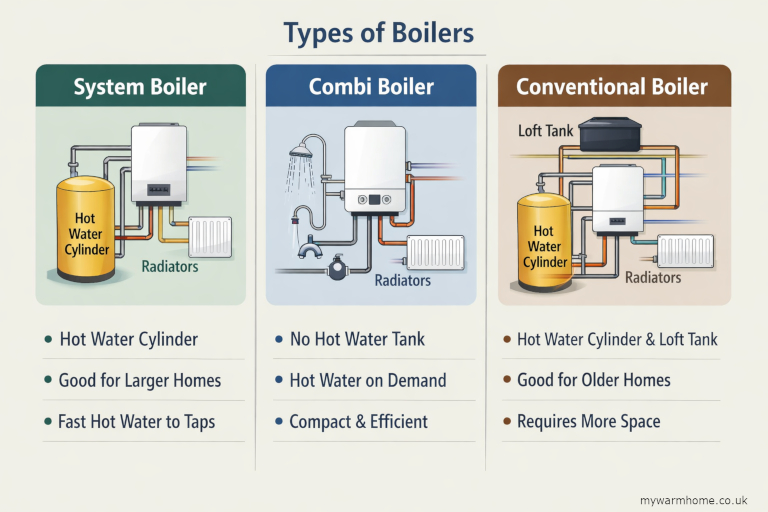
Three common ways to deliver heating and hot water.
All three can heat your radiators. The main difference is how they produce and store domestic hot water.
01
Combi boiler
A combination boiler provides central heating and heats mains water when you open a hot tap. It normally needs no separate hot-water cylinder.
Think about: Available space, incoming mains flow and whether several hot-water outlets may be used at once.
02
System boiler
A system boiler heats a separate hot-water cylinder. Many of the principal heating components are housed inside the boiler.
Think about: Cylinder space, stored-water capacity and the demand from several bathrooms.
03
Regular boiler
A regular boiler works with a separate hot-water cylinder and external components. Some systems also have a cold-water storage cistern.
Think about: The existing pipework and controls before changing an established system.
A TYPICAL COMBI / HEATING MODE
What happens when you ask for heat?
The exact start-up order depends on the boiler model, but the main jobs are similar.
01 / Check and ignite
Safety controls check operating conditions. The fan and ignition system establish and prove a safe flame.
02 / Circulate
The pump moves heated water through the heating circuit and back to the boiler.
03 / Adjust output
A modern boiler can reduce or increase burner output to better match the heating demand.
HOT-WATER PRIORITY
Open a hot tap and a combi changes job.
On a typical combi boiler, domestic hot water takes priority while the tap or shower is running. A diverter valve directs boiler water through a plate heat exchanger, warming the incoming mains water without the two water circuits mixing.
Flow matters
A combi can heat only a certain amount of incoming cold water to the required temperature at once. Check the mains flow before choosing an appliance.
“Instant” takes time
Water already in the pipe between the boiler and tap must move before freshly heated water arrives. Longer pipe runs mean a longer wait.
03 / INSIDE YOUR BOILER
The main parts and what they do.
You do not need to service a boiler to understand its basic operation. These are useful parts to recognise by name.
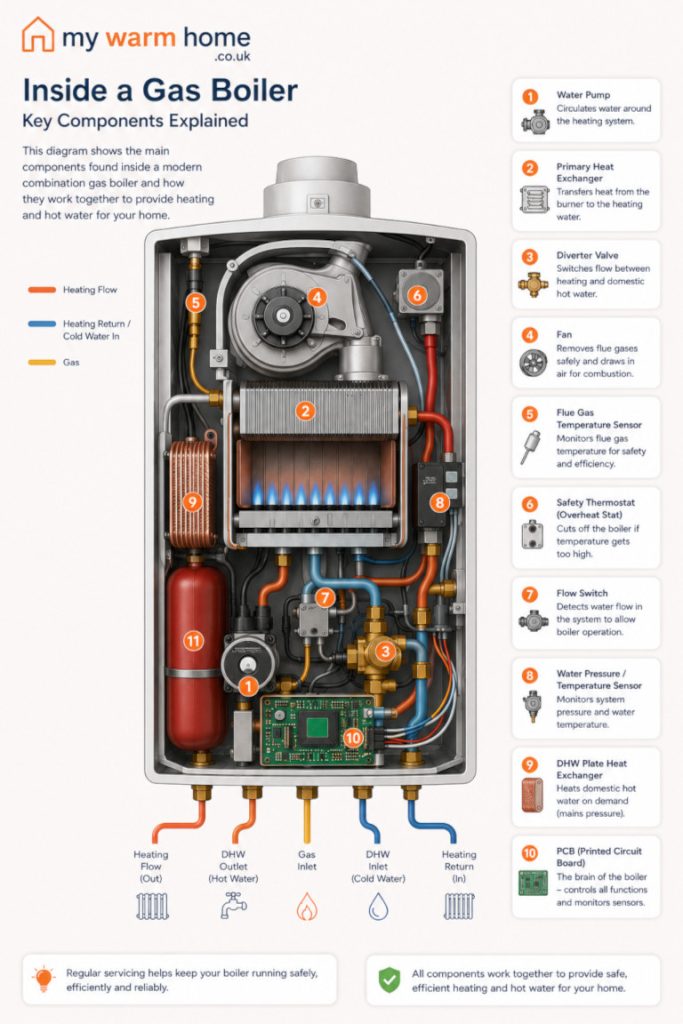
Burner and gas valve
Control the gas supply and produce the flame when heat is required.
Heat exchanger
Transfers heat from combustion into the heating water.
Fan and flue
Support safe combustion and carry combustion products outside.
Pump
Circulates water through the boiler and heating system.
Expansion vessel
Accommodates the expansion of water as it warms.
Sensors and controls
Monitor operation and respond to heating or hot-water demand.
GETTING MORE FROM GAS HEATING
Efficiency is a whole-system decision.
A modern condensing boiler can recover more heat from its flue gases when the return water is cool enough. The heat loss of the home, radiator sizes, flow temperature and controls all influence the outcome.
Start with heat loss
A room-by-room assessment helps establish how much heat each space needs and whether the existing radiators can deliver it.
Use suitable controls
A room thermostat, programme and radiator controls help supply heat at the times and in the rooms where it is needed.
Review flow temperature
On a suitable combi system, a lower central-heating flow temperature may improve efficiency if the home still warms adequately. Follow the boiler manual and get advice if unsure.
04 / SOMETHING WRONG?
Start with safe observations.
A pressure reading, error code or pattern of cold radiators can help an engineer understand the problem. Do not remove the boiler casing or repeatedly reset a recurring fault.
01
No heating or hot water
Check the normal heating controls and whether the boiler display has power. Record any error code. Do not remove the casing.
02
Cold radiators
Check radiator valves and note whether one radiator or the whole system is affected. Persistent problems need a heating-system check.
03
Low pressure
Read the pressure gauge and follow the user instructions for your boiler. Repeated pressure loss needs investigation rather than continual topping up.
04
Error or lockout
Record the displayed code and consult the boiler manual. If a permitted reset does not resolve the fault, arrange professional investigation.
GAS SAFETY
Know where homeowner checks stop.
Use normal appliance controls and follow only the user instructions supplied for your boiler. Gas, combustion, flue and internal electrical work belongs with an appropriately qualified Gas Safe registered engineer.
If you smell gas or suspect carbon monoxide, leave the property and call the National Gas Emergency Service on 0800 111 999 from outside.
1
whole heating system — boiler, emitters, controls and the home itself
MY WARM HOME VIEW
Your boiler is only one piece of the puzzle.
Comfort and energy use depend on the home around the heating system. Heat loss, radiator sizes, controls, flow temperature, insulation and how the property is used all matter.
LOOK AT THE WHOLE HOME
Heating works best when the system and the building work together.
Explore the other parts of the retrofit puzzle, including insulation, heating controls and ventilation.