
MyWarm
home.co.uk
Heat pumps do not generate heat, they move it.
Refrigerants Through the Years: From Ozone-Damaging CFCs to Modern Propane Heat Pumps
For most homeowners, refrigerants are invisible. They sit inside fridges, air conditioners, and heat pumps quietly doing their job. Yet the story of refrigerants is one of the most important environmental journeys of the last century.
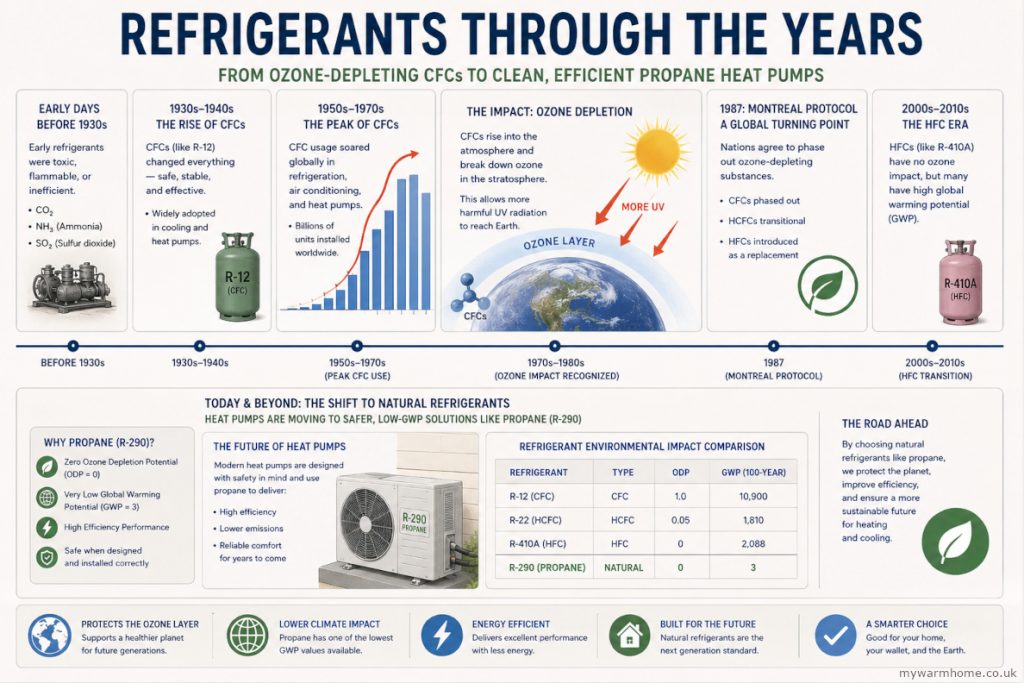
As shown in the infographic above, refrigerants have evolved dramatically, from chemicals that damaged the Earth’s ozone layer to modern low-impact alternatives helping drive the transition to cleaner heating.
The Early Days of Refrigeration
Before the 1930s, refrigeration relied on substances such as ammonia, sulphur dioxide, and carbon dioxide. While effective, many of these refrigerants were either toxic, flammable, or difficult to handle safely in homes and commercial buildings.
The industry needed something safer and easier to use.
The Rise of CFCs
The breakthrough came in the 1930s with the introduction of Chlorofluorocarbons (CFCs), most famously R-12.
At the time, CFCs seemed like the perfect solution:
- Non-toxic
- Non-flammable
- Stable and reliable
- Highly effective for cooling
As refrigeration and air conditioning expanded worldwide, CFCs became the dominant refrigerants used in millions of appliances and cooling systems.
The Peak of CFC Use
By the 1950s, 60s, and 70s, CFC use had exploded.
They were found in:
- Refrigerators
- Air conditioning systems for vehicles and homes
- Commercial cooling equipment
- Heat pumps
- Aerosol products
- Squirty cream!
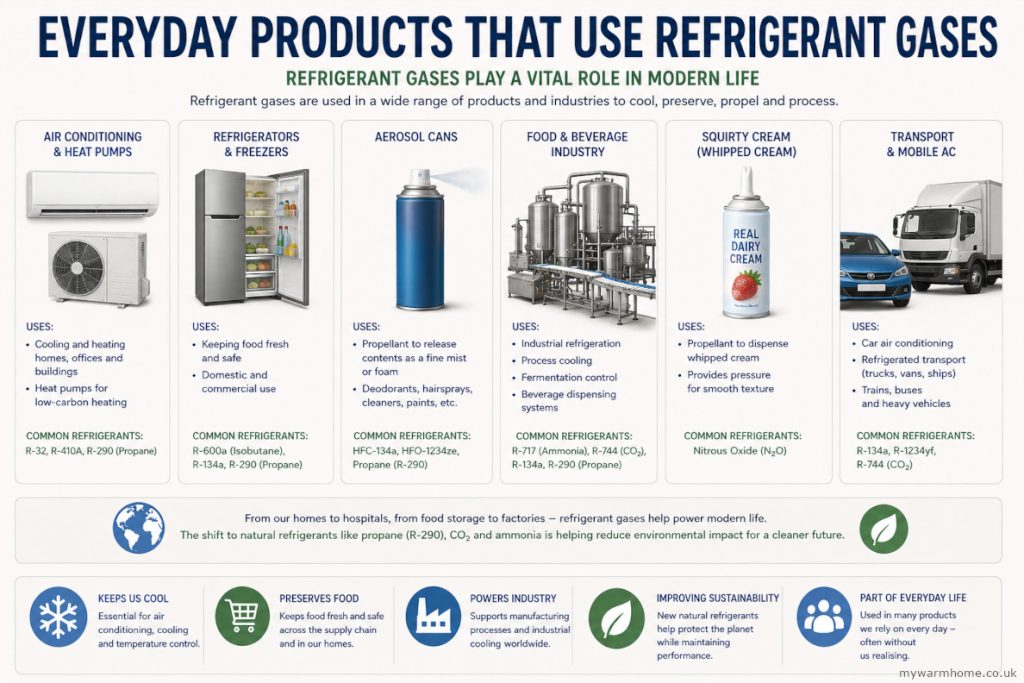
For decades, they were considered a technological success story. However, scientists eventually discovered a serious unintended consequence.
The Ozone Layer Problem
CFCs released into the atmosphere can remain intact for many years.
When they eventually reach the stratosphere, ultraviolet radiation breaks them down, releasing chlorine atoms that destroy ozone molecules.
The ozone layer acts as Earth’s natural sunscreen, protecting life from harmful UV radiation. As ozone depletion increased, concerns grew about:
- Higher rates of skin cancer
- Increased cataracts
- Damage to crops and ecosystems
- Wider environmental impacts
The discovery of the Antarctic ozone hole in the 1980s became a global wake-up call.
The Montreal Protocol: A Turning Point
In 1987, governments around the world agreed to the Montreal Protocol, one of the most successful environmental agreements ever implemented.
The agreement committed nations to phase out ozone-depleting substances, including many CFCs.
The transition happened in stages:
- CFCs were phased out.
- HCFCs were introduced as temporary replacements.
- HFCs became the dominant alternative.
The result has been a significant reduction in ozone-depleting emissions and evidence that the ozone layer is gradually recovering.
The HFC Era
While HFC refrigerants solved the ozone depletion problem, another challenge emerged.
Many HFCs have a high Global Warming Potential (GWP), meaning they can contribute significantly to climate change if released into the atmosphere.
Examples include refrigerants such as R-410A, which became widely used in heat pumps and air conditioning systems.
As climate concerns grew, manufacturers and policymakers began searching for better solutions.
The Shift to Natural Refrigerants
Today’s heat pump industry is increasingly moving towards natural refrigerants.
One of the most significant is propane (R-290).
Although propane must be handled carefully because it is flammable, modern heat pump designs incorporate strict safety measures and have demonstrated excellent performance.
Why Propane?
- Propane offers several key advantages:
- Zero ozone depletion potential (ODP = 0)
- Extremely low global warming potential (GWP ≈ 3)
- High energy efficiency
- Excellent performance at higher flow temperatures
- Widely available and naturally occurring
These characteristics make it one of the most environmentally friendly refrigerants currently available for domestic heating.
What This Means for Homeowners
The move towards propane heat pumps represents more than just a refrigerant change. It reflects a broader shift towards:
- Lower carbon heating
- Improved environmental standards
- Higher system efficiency
- Future-proof technology
Many of the latest generation heat pumps now use R-290 and are expected to play a major role in the UK’s transition away from fossil-fuel heating.
Looking Ahead
The history of refrigerants shows how technology evolves as we learn more about its environmental impact.
CFCs solved one problem but created another. HFCs addressed ozone depletion but contributed to global warming. Today, natural refrigerants such as propane are helping the industry take the next step forward.
For homeowners considering a heat pump, understanding the refrigerant inside the system is becoming increasingly important. It’s not just about heating your home efficiently, it’s about choosing technology designed for a lower-impact future.