
Mywarm
home.co.uk
A warmer home begins with choices.
How to Upgrade Your Home Efficiency – Avoiding Costly Retrofit Mistakes.
If you’re planning home improvements like insulation, a heat pump, or using schemes like ECO4, Warmhomes fund or the Boiler Upgrade Scheme (BUS), this guide will help you with your journey.
Most UK homeowners don’t get poor results because of what they install, they get poor results because of the order, design, missing steps and poor workmanship.
This guide explains the correct approach to home retrofit in the UK, based on real issues found during pre and post site inspections.
Why Many UK Home Upgrades Go Wrong!
A lot of retrofit problems come from rushing into installations without understanding the home.
Common issues include:
- Insulation installed without proper ventilation.
- Heat pumps fitted in unsuitable properties.
- Poor-quality workmanship hidden after installation.
- Grant-driven work prioritising speed over quality.
This can lead to:
- Damp and mould after insulation.
- Heat pumps that don’t perform efficiently.
- Higher energy bills instead of lower ones.
These problems are more common than most people realise.
To avoid problems, upgrades should follow a logical order.
Firstly if going down a funded route you will need to understand ECO4, Warmhomes Fund and Boiler Upgrade Scheme (BUS)
Government grants like ECO4* Warmhomes fund and the Boiler Upgrade Scheme (BUS) can help reduce costs. (*ECO 4 is winding down)
However, there are risks if not approached carefully.
What to watch for:
- Being pushed into upgrades your home isn’t ready for.
- Lack of detailed assessment before work starts.
- Installations focused on targets rather than quality.
Grants can be useful, but they should never override good planning.
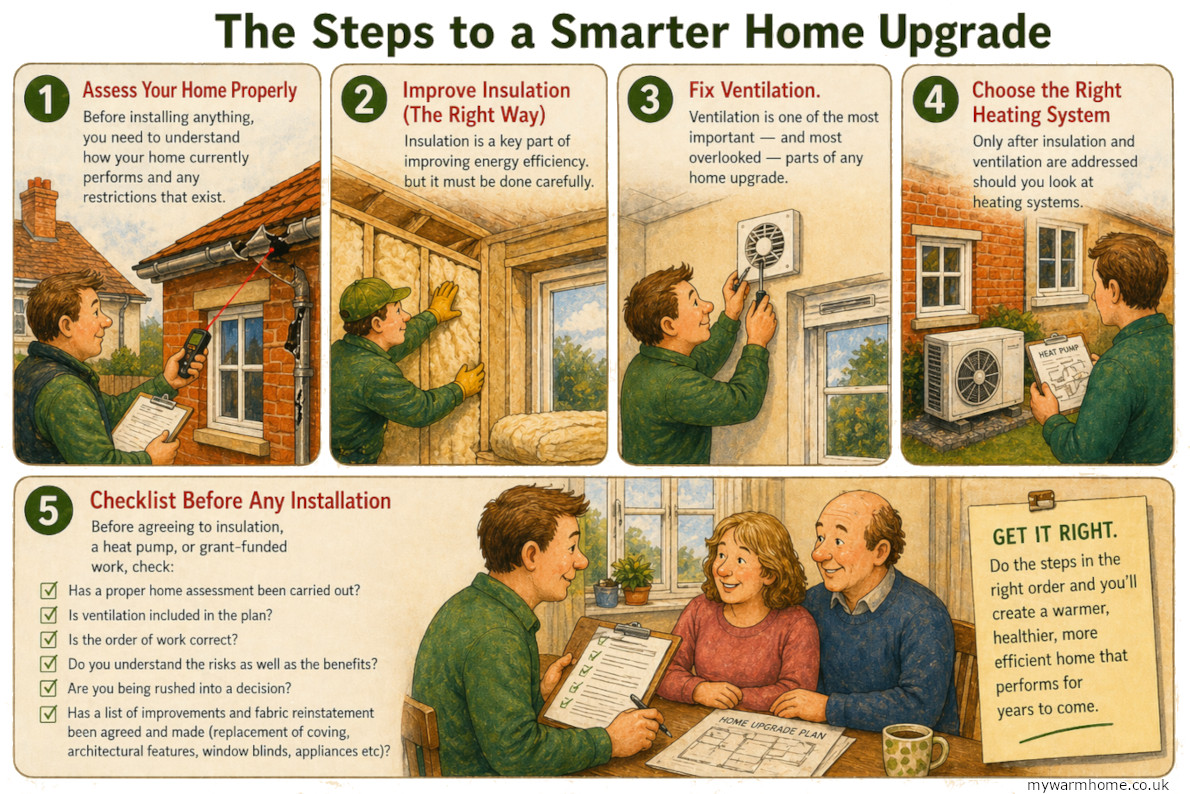
Step 1: Assess Your Home Properly.
Before installing anything, you need to understand how your home currently performs and any restrictions that exist.
This includes:
- Limitations of improvements (conservation area etc).
- Access for works (scaffolding, waste removal,etc).
- Construction type (cavity wall, solid wall, etc.).
- Existing insulation levels.
- Ventilation and airflow.
- Signs of damp, condensation, or mould.
- Existing damp course and water drainage.
- Surrounding area and neighbours.
Why this matters.
Without a proper assessment, decisions are based on guesswork which often leads to poor results.
What to check first.
- Check with local council for limitations, you may not be able to install solar panels facing certain ways or replace windows due to legal covenants or conservation.
- Can apperatus if required (scaffold, cherry pickers, skips etc) be erected or used at property. Will permits be required?
- The existing type of building make up (wals etc) can dictate the way the retrofit can proceed.
- Does insulation already exist and will this need to be removed (due to failure or poor install) or enhanced.
- Are extractor fans working correctly?. Current regulations need to be matched for specific rooms as is the type of extraction used.
- is there existing damp or condensation, a visual check is always a good place to start. If in doubt a detailed assessment may be needed.
- Can the dampcourse be seen to be doing its job, and will it maintain its purpose after the retrofit work? Will water drainage be sufficient and work with the retrofit or will it need to be modified or replaced (gutters, soil pies etc)
- Do neighbours approve of the works and disruption?, this may need to be verified to keep the peace legally and socially!
Step 2: Improve Insulation (The Right Way).
Insulation is a key part of improving energy efficiency. but it must be done carefully.
Done properly:
- Reduces heat loss.
- Improves comfort.
- Lowers heating demand.
Done poorly:
- Traps moisture.
- Causes damp and mould.
- Creates cold bridging issues.
Many insulation problems in UK homes are caused by missing ventilation considerations.
Step 3: Install or improve Ventilation.
Ventilation is one of the most important and most overlooked parts of any home upgrade.
When insulation and airtightness improve:
- Heat stays in which is good.
- Moisture also stays in which is bad.
Without proper ventilation, this leads to:
- Condensation.
- Damp patches.
- Mould growth.
Common ventilation mistakes.
- Extractor fans not powerful enough.
- Ducting incorrectly installed (e.g. direct into lofts).
- No airflow between rooms.
Poor ventilation is one of the main causes of post-retrofit problems in the UK.
Step 4: Choose the Right Heating System.
Only after insulation and ventilation are addressed should you look at heating systems.
Heat pumps in the UK.
Heat pumps can work well — but only if:
- The home is properly insulated.
- Heat loss is correctly calculated.
- The system is properly designed.
If not, you may experience:
- High running costs.
- Cold rooms.
- Poor performance.
A heating system should match the home, not the other way around.
Step 5: Checklist Before Any Installation.
Before agreeing to insulation, a heat pump, or grant-funded work, check:
- Has a proper home assessment been carried out?
- Is ventilation included in the plan?
- Is the order of work correct?
- Do you understand the risks as well as the benefits?
- Are you being rushed into a decision?
- Has a list of improvements and fabric reinstatement been agreed and made (replacement of coving, architectural features, window blinds, appliances etc)
If the answer to any of these is “no”, pause before moving forward.
Common Retrofit Mistakes in UK Homes
From real inspections, common problems include:
- Insulation installed without ventilation upgrades.
- Extractor fans venting into loft spaces or not working.
- Heat pumps installed without proper system design.
- Damp and mould appearing after improvements.
- Fixtures not fitting after retrofit (curtains, blinds etc).
- Reinstament of features not agreed (coving, arcatraves, window cills etc).
- Technology not understood or explained.
These issues are avoidable with the right approach.
Learn More About Each Step
Explore detailed guides for each part of your home upgrade:
- Heat Pumps → How they work, suitability, design, and common mistakes.
- Insulation → types, risks, and best practice
- Ventilation → systems and requirements
- Grants → ECO4, Warmhomes fund, BUS, and how to avoid problems
Final Advice for UK Homeowners
Upgrading your home is one of the best ways to improve comfort and reduce energy use,
but only if it’s done properly.
The key is to:
- Understand your home first.
- Follow the correct order.
- Avoid rushed or poorly designed installations.
Take your time, ask questions, and focus on quality over speed.
Why Trust Our Advice
We’ve been working in UK retrofit since Warm Front and ECO1, long before it became mainstream.
With experience designing heating systems, inspecting thousands of insulation installs (good and bad), and auditing renewable schemes for the likes of Ofgem, we know what works—and what doesn’t.
We’ve carried out hundreds of cavity wall surveys for the major energy companies, and we’re fully qualified in many areas.
In short: real experience, independent advice, and no guesswork