
Mywarm
home.co.uk
The occupiers need to be part of the works.
Delivering a successful retrofit isn’t just about installing measures — it’s a coordinated process involving multiple specialist roles.
Retrofit Process & Roles.
Each stage is designed to ensure your home becomes more energy efficient, safe, and comfortable without unintended consequences like damp or poor air quality.
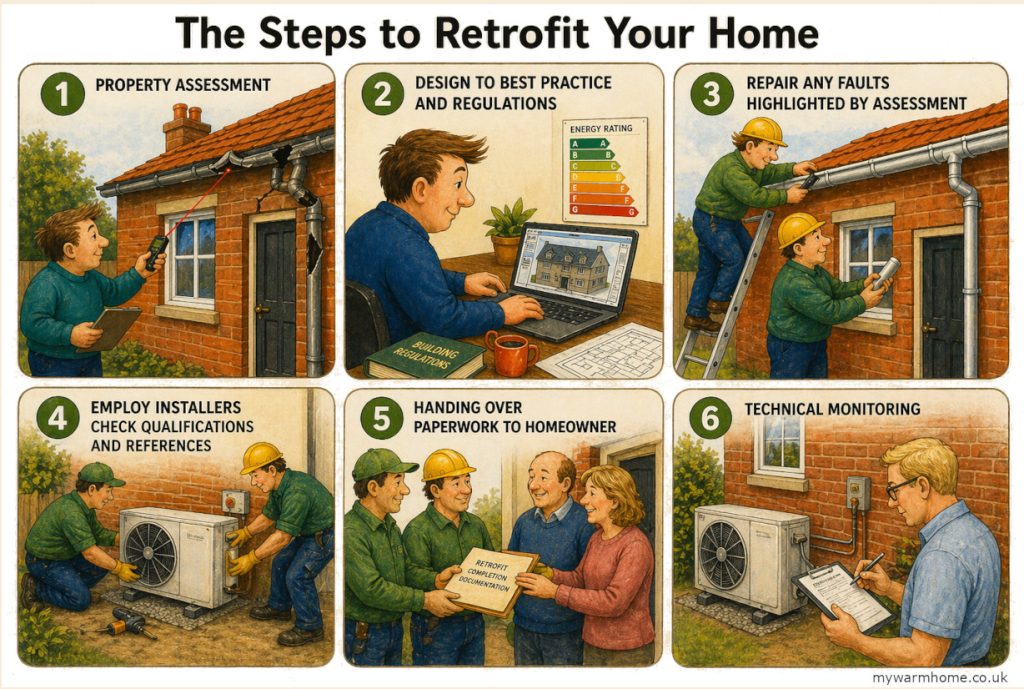
1. Assessment.
The process begins with a full property assessment. A qualified Retrofit Assessor gathers detailed information about your home, including construction type, insulation levels, heating systems, and occupancy patterns.
This stage identifies existing issues such as damp, ventilation gaps, or heat loss. Lots of pictures will be taken and these are not being used to see how you live but as a reference to be used by coordinater’s and installers alike.
2. Plan and Design.
Using the assessment data, a whole-house retrofit plan is created. This plan follows a “Fabric First” approach improving insulation and building performance before upgrading heating systems. It ensures all measures work together effectively, rather than as isolated upgrades. A Retrofit Coordinator oversees the entire process.
They are responsible for ensuring compliance with PAS 2035 standards, managing risk, and making sure all stages align with the agreed plan.
Think of them as the quality controller for your retrofit project.
2a. Ventilation Strategy
Improving insulation without proper ventilation can lead to condensation and mould. A dedicated ventilation strategy ensures your home can “breathe” correctly.
This may include upgrades such as extractor fans, background ventilation, or whole-house systems depending on the property.
3. Mitigate
Before installation begins, any risks identified must be addressed.
This includes resolving damp issues, structural concerns, or ventilation problems to ensure the property is suitable for retrofit measures. With insulation works certain parts of a property may be hard to treat so different approaches may be needed.
4. Install
Qualified and accredited installers carry out the work.
This can include insulation, heating upgrades (like heat pumps), solar panels, or other energy efficiency measures, all installed in line with the retrofit design.
5. Handover
Once the work is complete, you receive a full handover pack.
This includes instructions on how to use your new systems, maintenance guidance, and documentation of all installed measures. (MCS, Warranties, Insurances, Benchmarks etc.)
6.Monitoring
Quality checks are carried out on the installation itself.
This ensures all work meets required standards and has been completed correctly, protecting both your home and the investment. I believe lack of technical monitoring has been one of the biggest failures in recent years across all funded schemes. Some coordinators may monitor the project for some time after install to assess the impact on energybill savings compared to costs of install, and in the real world all installs should have a quality feedback after a year.