
Ground source
heat pumps.
A practical guide to ground loops, boreholes and the plant room.
GROUND SOURCE HEAT PUMPS
From the ground to your home.
01
COLLECT
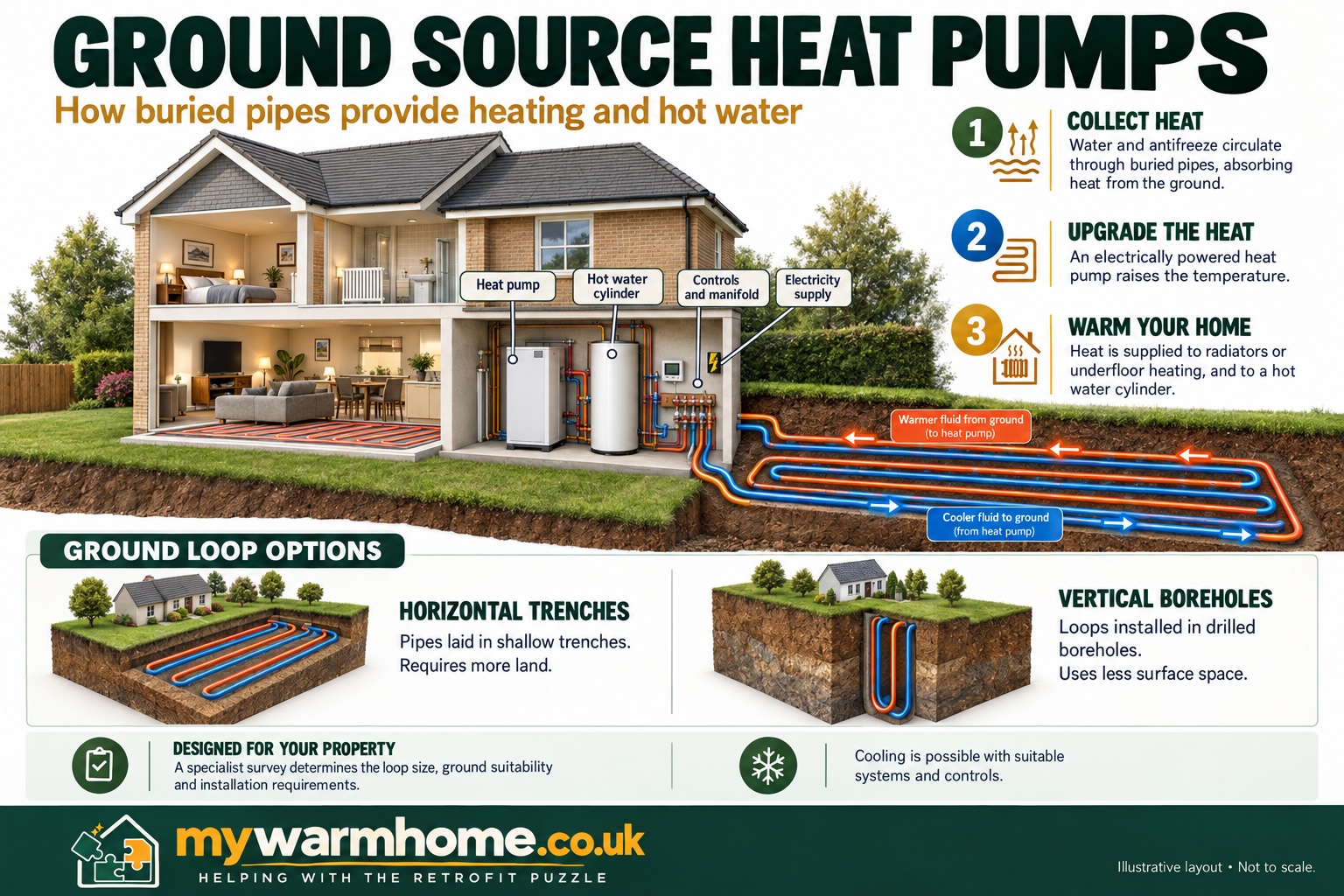
Ground loops or boreholes absorb low-temperature heat.
02
CIRCULATE
A ground-loop fluid carries this energy to the heat pump.
03
UPGRADE
The refrigeration circuit raises the useful temperature.
04
DELIVER
Heat is transferred to radiators, floors and hot water.
THE SIMPLE VERSION
A heat mover, not a heat maker.
Ground source heat pumps collect naturally stored low-temperature heat from the ground and transfer it into a building using a refrigeration cycle. The buried collection system is usually out of sight; the heat pump and controls are in a plant room or utility space.
Ground temperatures tend to be more stable than outdoor air temperatures. That can support efficient operation, but actual performance depends on ground conditions, system design, flow temperatures and heating demand.
COLLECTING HEAT
Horizontal loops or vertical boreholes?
Horizontal ground loops
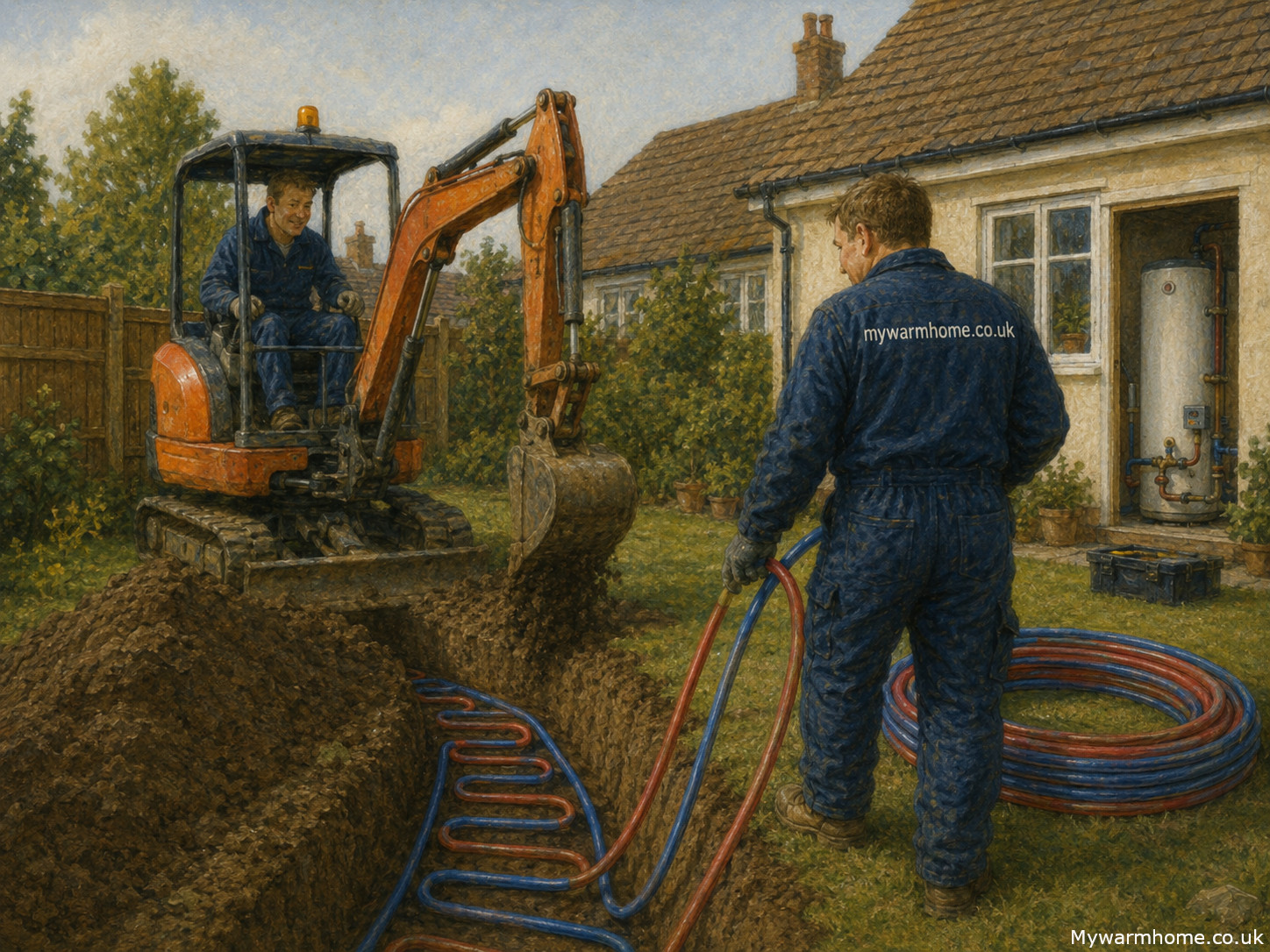
Long plastic pipes are laid in trenches across a garden or field. A water-and-antifreeze mixture circulates through them and picks up heat from the surrounding ground.
- Typical burial depth: approximately 1–2 metres.
- Often requires substantial available land and excavation.
- Loop lengths and land area depend on ground conditions and the property’s calculated heat demand.
- Can be less expensive than drilling where sufficient space exists.
Vertical boreholes
Where space is limited, specialist contractors drill boreholes and install sealed U-shaped pipes. The boreholes are grouted to provide effective heat transfer and protect the ground.
- Boreholes may be tens to hundreds of metres deep.
- Requires geological assessment and specialist drilling.
- Usually uses less surface land than horizontal loops.
- Depth, number and spacing must be designed for the actual property.
Design note: Original example ranges (such as 300–1,000+ metres of pipe, 50–200-metre boreholes and 200–1,000m² of land) are illustrative, not sizing rules. Ground thermal conductivity, borehole yield, load profiles and spacing determine the actual installation.
THE GROUND COLLECTOR
What changes with depth?
Temperatures near the surface vary with the seasons. Deeper ground generally experiences smaller seasonal swings, although temperatures depend on location, geology and the borehole design.
| Approximate depth | Illustrative ground temperature |
|---|---|
| Surface | Varies considerably |
| 1.5 m | 8–12°C |
| 15 m+ | 10–13°C |
| 100 m+ | 11–14°C |
These are broad illustrations carried over from the original article, not guaranteed site temperatures. A ground investigation is needed before design.
CONNECTING THE LOOPS
Manifolds and inspection chambers.
Manifolds
Think of the manifold as a traffic junction. It connects multiple ground circuits to the heat pump, enables flow balancing and may let individual loops be isolated.
- Collects and distributes ground-loop flow.
- Allows balancing and isolation.
- May be housed in the plant room or a protected chamber.
Inspection access
Where manifolds are buried, an accessible chamber or hatch allows an engineer to inspect joints, valves and pressure and carry out maintenance.
- Chamber sizing should suit the manifold and safe access.
- The original page lists 450 × 450 mm and 600 × 600 mm as examples.
- Covers, drainage and frost protection are design considerations.
THE REFRIGERATION CYCLE
How the collected heat becomes useful.
Ground-loop liquid and refrigerant are separate circuits. A heat exchanger transfers energy from the ground-loop fluid to the heat pump refrigerant.
01
Evaporate
Refrigerant absorbs heat and evaporates.
02
Compress
The compressor raises the vapour’s pressure and temperature.
03
Condense
Useful heat passes into the heating water as refrigerant condenses.
04
Expand
Pressure drops through an expansion device so the cycle can repeat.
INDOOR EQUIPMENT
Inside the plant room.
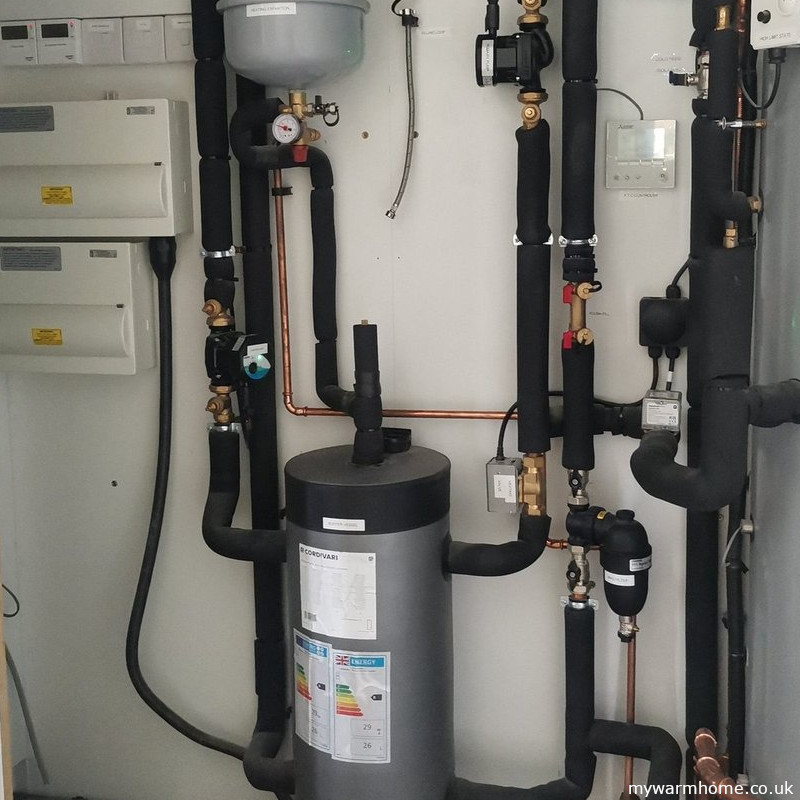
The ground source heat pump itself is usually indoors, alongside equipment selected for the property. The layout varies: not every system needs a buffer tank, and some functions are built into the heat pump.
- Heat pump and source-side circulation equipment
- Heating circulation pumps, valves and controls
- Hot-water cylinder, if the system produces stored hot water
- Expansion vessels and safety devices
- Optional buffer vessel, depending on the hydraulic design
- Insulated pipework and electrical connections
Allow enough clearance for safe servicing and installation; plant-room dimensions are equipment-specific.
SYSTEM TEMPERATURES
What temperatures might you see?
Ground-loop side
| Stage | Illustrative temperature |
|---|---|
| Fluid leaving ground | 6–12°C |
| Fluid returning to ground | 2–8°C |
Heating-water side
| System | Illustrative flow temperature |
|---|---|
| Underfloor heating | 30–45°C |
| Low-temperature radiators | 40–55°C |
| Domestic hot water | 50–60°C |
The examples above are not operating targets for all installations. Some modern ground source heat pumps can produce higher flow temperatures, but efficiency and available output depend on the model and operating conditions.
BENEFITS AND TRADE-OFFS
The pros and cons.
Potential advantages
- Stable source temperatures may support high seasonal efficiency.
- No large outdoor fan is normally needed.
- Ground collectors can have long service lives if properly designed and installed.
- Can reduce emissions compared with higher-carbon heating, depending on electricity supply and displaced fuel.
Important considerations
- Higher upfront cost than many alternatives.
- Horizontal installations require space and can disrupt gardens.
- Boreholes require specialist drilling and site investigation.
- Running-cost and payback outcomes depend on tariff, efficiency and heating demand.
Illustrative costs in the original article: horizontal loops £15,000–£30,000+ and borehole systems £20,000–£45,000+. These are not live quotations; ask for an itemised, property-specific design and price.
BEFORE YOU COMMIT
Get the assessment and design right.
A reliable installation starts with room-by-room heat-loss calculations, an assessment of the ground collector, emitter sizing and suitable heating controls. Check access, excavation or drilling impacts, relevant permissions, commissioning and maintenance arrangements.
Choose a competent installer and compare estimates of seasonal performance and electricity costs. Ground conditions should be investigated rather than assumed.
FURTHER READING
Heat pump manufacturers and resources.
The original page includes a broad directory of heat pump manufacturers. Not every company listed necessarily supplies domestic ground source systems; check each company’s current product range.
UK and UK-market suppliers
European manufacturers
- Viessmann
- Stiebel Eltron
- NIBE
- Bosch Thermotechnology
- Vaillant Group
- Kronoterm
- Ochsner
- Hoval
- Dimplex
- MasterTherm