
Balancing a central heating system properly is what separates a working” system from an efficient, comfortable, and compliant one
1. Pre-checks are critical.
Before touching lockshield valves:
- System fully bled (no air)
- Correct system pressure.
- Pump operational and correctly set.
- All TRVs fully open.
- Room thermostat calling for heat.
- Boiler at normal operating temperature (flow ~70°C typical).
If these aren’t right, balancing will be inaccurate.

2. Identify radiator order
You need to know flow sequence:
- First radiators = closest to boiler
- Last radiators = furthest away
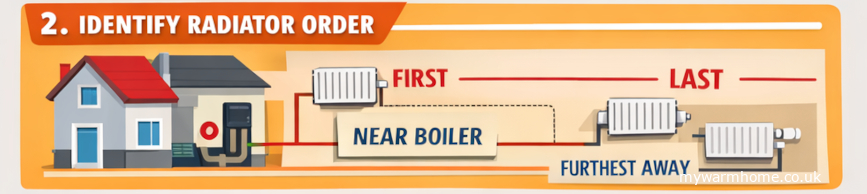
This matters because closer radiators naturally take more flow.
3. Fully open all lockshield valves
- Remove caps (if still on!).
- Open all lockshields fully (anti-clockwise).
4. Measuring temperatures.
Measuring temperatures when balancing radiators can feel a bit daunting at first, but a digital thermometer is inexpensive and easy to use. Most are simple point-and-click devices, allowing you to quickly take readings from the flow and return pipes.
For greater accuracy, clamp thermometers can be used, although they tend to be more expensive.
The flow and return pipes can be installed either way, but typically the TRV is fitted on the flow side. If you’re unsure, it’s worth checking while the system is heating up one side will warm up faster, helping you identify the flow
- Flow temperature (T₁) (going into radiator)
- Return temperature (T₂) (going from radiator)
Target: Remember Delta T (ΔT)
A temperature drop (ΔT) of about 11°C (older systems ~11–12°C, modern condensing often 15–20°C depending on design)
5. Start balancing (closest radiator first)
For each radiator:
- Let system stabilise.
- Measure ΔT.
- Adjust lockshield valve only.
If ΔT is too small (e.g. 3–5°C):
Too much flow,
Close lockshield slightly,
If ΔT is too large (e.g. 20°C+):
Not enough flow.
Open lockshield slightly.
6. Work progressively through the system
- Move from radiator to radiator.
- Always allow 2–5 minutes stabilisation after each adjustment.
- Recheck earlier radiators as adjustments affect the system.
7. Final system check
Once all radiators are balanced:
- All rooms should heat evenly
- Boiler should run more steadily (less cycling)
- Return temperatures should be lower → improves condensing efficiency
Professional targets (important)
- Typical ΔT:
- ~11°C (traditional UK benchmark).
- 15–20°C for modern condensing optimisation.
- Even heat distribution across property.
- No “first radiator scorching / last radiator cold” issue.
Common mistakes.
- Balancing with TRVs partially closed.
- Not measuring temperatures (guesswork).
- Adjusting both valves instead of lockshield only.
- Rushing without stabilisation time.
- Ignoring pump speed or system design.
Pro tips
- Use clamp thermometers instead of infrared guns (more accurate).
- Slightly underfeed first radiators to prioritise system distribution.
- Aim for lower return temps to maximise condensing boiler efficiency.
- Consider weather compensation or smart controls after balancing.
A poorly balanced system:
- Reduces heat pump performance massively.
- Causes overheating/underheating problems.
- Fails to meet expected SAP or EPC improvement.
A properly balanced system:
Maximises efficiency.
Improves comfort.
Supports compliance.