Category: Efficiency
-
Who is qualified?
Selecting a trustworthy installer for your heating, insulation, or renewable energy project requires careful research and due diligence. Hiring the right professional ensures your home is safe, efficient, and compliant with regulations, and helps protect warranties, insurance, and grant eligibility. Reputable installers are often accredited by recognised trade bodies or professional organisations. Accreditation confirms that…
Written by
-
Trying best to improve to “C”
Improving your EPC rating isn’t just a “box-ticking exercise” it brings real financial, comfort, legal, and long-term benefits. Improving your EPC rating isn’t just a “box-ticking exercise” — it brings real financial, comfort, legal, and long-term benefits. It matters because, as we progress through life, our habits, and priorities tend to shift. The carefree 20-year-old…
Written by
-
Regular and System boilers.
A combi boiler provides both central heating and hot water directly from the mains, functioning much like a powerful, on-demand kettle. In contrast, a system or regular boiler works by heating a larger volume of water that is stored in a separate hot water cylinder. This stored hot water can then be supplied to multiple…
Written by
-
Allowing Homes To Breathe.
When we insulate or upgrade a property, the original construction is just as important as the finished result. Trying to achieve the unachievable often leads to failure and when it comes to improving our homes, that’s especially true if we ignore how they were originally built. When we insulate or upgrade a property, the original…
Written by

-
MPAN and DNO.
Meters need to be equipped with a unique reference to allow the collection of bills. MPAN (Meter Point Administration Number) sometimes called an “Electricity Supply Number” is a unique 12-digit number that identifies the specific electricity supply point for a property in the UK. It’s used by electricity suppliers and network operators to ensure energy…
Written by
-
UK Property History.
Over the years, many homes have been layered with materials like non-breathable paints, renders, pebble dashing. Homes built in the UK before the 1980s often lack adequate insulation or have none at all. While building regulations at the time may have included some insulation standards, they were typically not enforced in practice. When planning insulation…
Written by
-
Solar in Depth.
The light energy frees electrons, creating a Direct Current (DC) flow of electricity. A photovoltaic system consists of PV cells, which are grouped into modules (solar panels) and arranged into arrays. Solar PV basics. Solar panels provide an eco-friendly and sustainable method for power generation, as they harness sunlight and produce no direct greenhouse gas…
Written by

-
Solar Tariffs.
Store or use, the supplier will pay less for the power return. Having solar panels on our properties allows us to generate electricity when the British weather cooperates, of course! How we use that electricity depends on our needs and what we can afford to optimize. While batteries are an excellent way to store and…
Written by
-
Heat Batteries
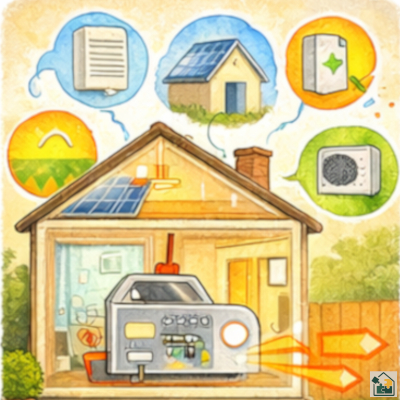
A heat battery is a device that stores heat energy and releases it when your home needs it. As the UK moves towards cleaner and smarter ways to heat our homes, one technology is starting to make a name for itself: heat batteries. You might have seen them mentioned alongside heat pumps in recent government…
Written by
-
Pas 2030/35
Pas 2030 and 2035 Basics. PAS 2030/2019 here. Pas 2035/2023 here. A Publicly Available Specification (PAS) is a document that defines good practice standards for a product, service, or process. PAS 2035/2030 are linked frameworks that outline best practices for retrofitting homes in the UK to enhance energy efficiency. While PAS 2030 focuses on the quality of the…
Written by