
Heat pumps move energy so we can heat our homes and provide hot water.
Consider a heat pump to be a heat mover, not a heat maker.
The technical side of heat pumps can be somewhat confussing as grasping the idea that we create heat from cold air still baffles most of us. Hopefully this section will shed some light and hep with understanding. We also include some regulations and the “best practices”.
The Science.
To understand how heat pumps work, we need to cover some basic physics. At a temperature of 0°C (273 K) and a pressure of 1 atmosphere (average sea level pressure), water freezes.
This condition is known as “Standard Temperature and Pressure (STP)”. While temperatures can drop below 0°C, the theoretical lowest possible temperature is called absolute zero.
At absolute zero (0°K*, -273.15°C, or -460°F), there is no molecular motion and no heat energy within the medium.
This understanding highlights an important fact: even when it feels freezing outside, the air, water, and ground still contain heat energy.
*The kelvin (K) is the SI base unit for thermodynamic temperature, starting at absolute zero (-273c) this is where all molecular motion ceases so anything above this movement exists and with movement temperature exists.
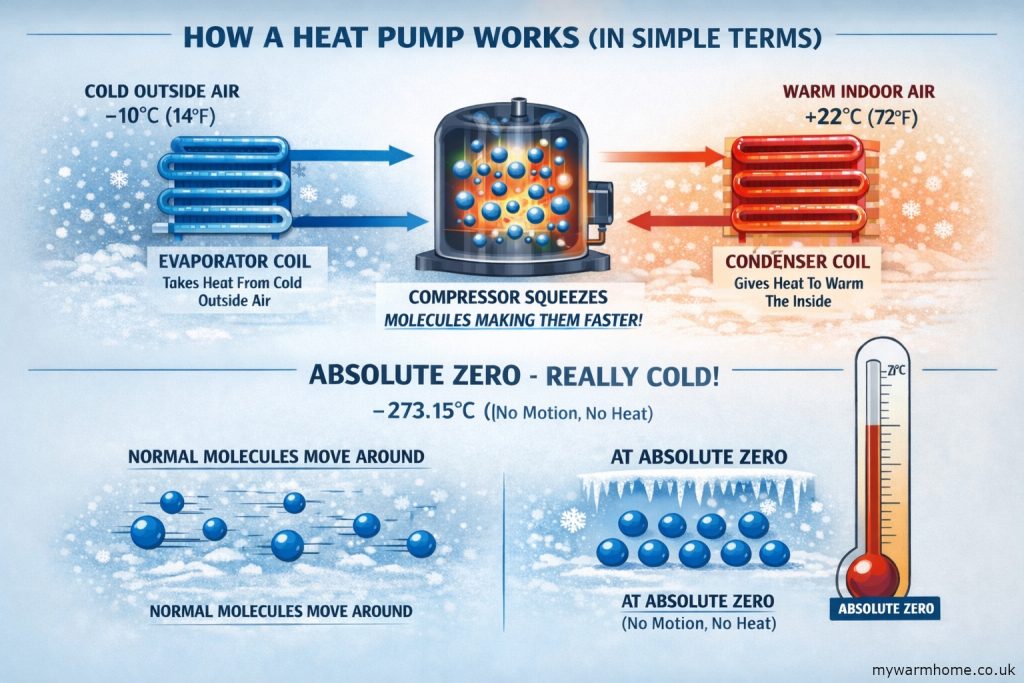
The key is finding a way to extract that heat and transfer it to a usable medium, such as radiators.
This is where refrigerants come into play. Instead of water circulating within the heat pump (like we would have in a gas boiler), a refrigerant (see below) is used.
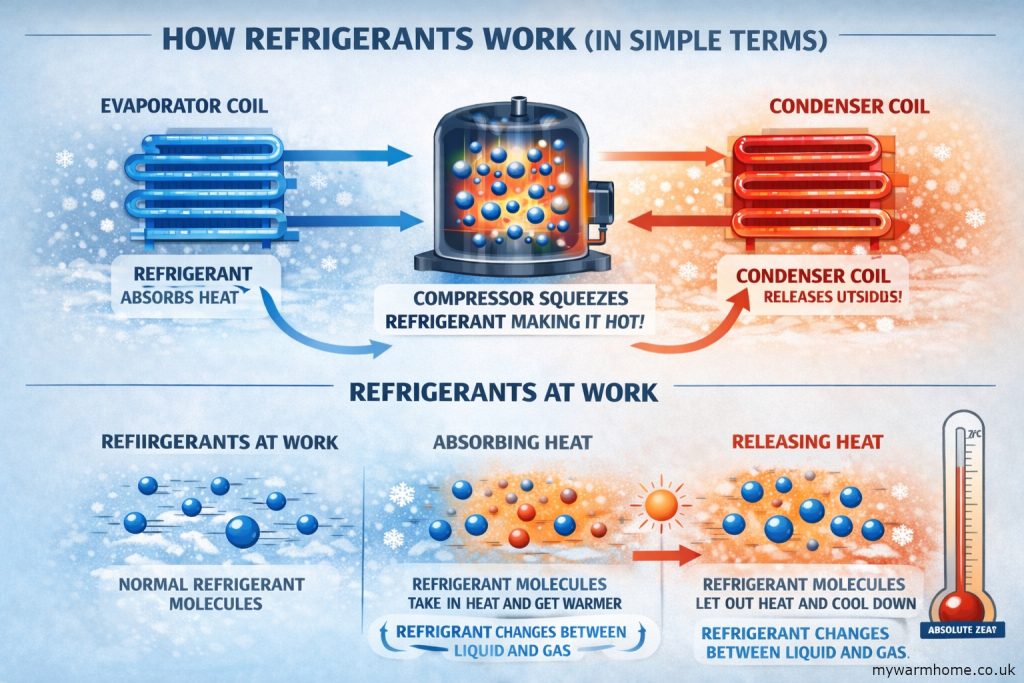
These refrigerants absorb heat from the outside environment, even at low temperatures, and their temperature increases as they change state.
Heat pumps come in three main types:
Air Source. (ASHP)
Water Source. (WSHP)
Ground Source. (GSHP)
Although their setups and installation methods differ, they all operate on the same fundamental principle: transferring heat from one place to another using a refrigerant cycle.
Once you grasp the physics of this cycle, understanding how heat pumps function becomes straightforward..ish.

How it works! All heat pumps.
Heat pumps move heat from the selected source into a building through a refrigeration cycle. Whether its air, ground or water they all work on the same principe but with different installation techniques.
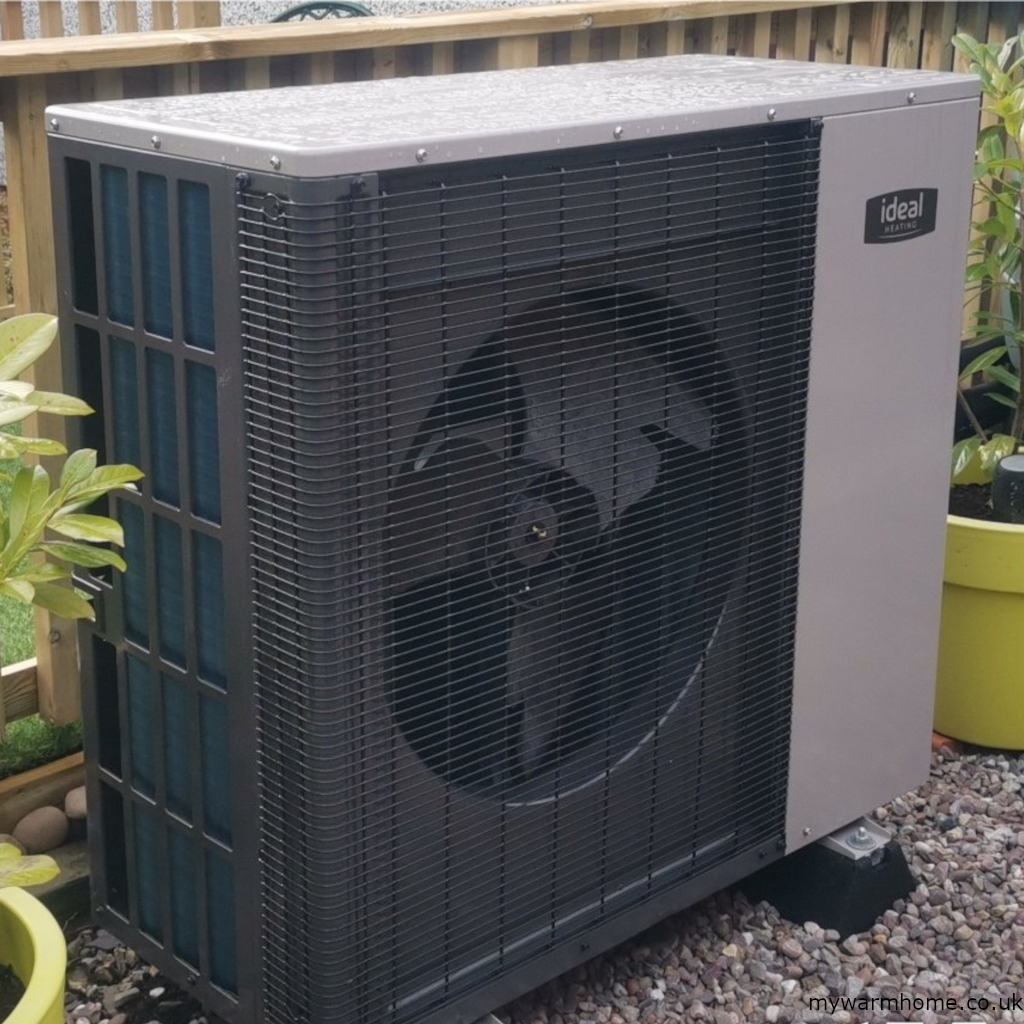
ASHP use units outside that look like air condition units (they basically are).
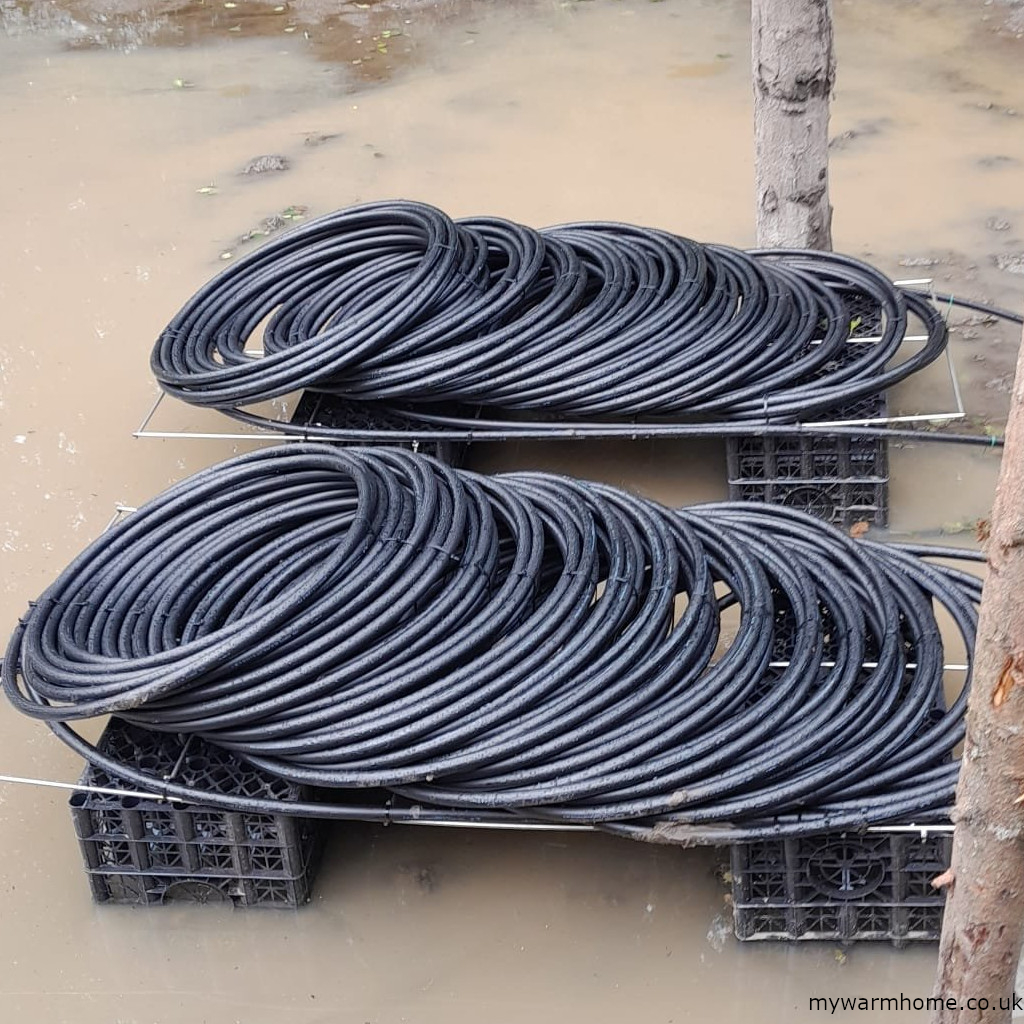
WSHP use coils or matts submerged in water and GSHP use horizontal loops spread over a open space at a depth of around 2m or vertical loops bored deep at around 100m.
The heating side is the same and designed to suit the property and personal preferences.
Properties need to be well insulated to reap the full benefits and cost savings. Radiators should ideally be a size and rating to match the system and property requirements. The delta rating of radiators is becoming more important in the system design.
Most new builds and retrofitted properties opt for underfloor heating systems, as they naturally run at a lower temperature.
A radiator’s delta rating, or Delta T, is the difference in temperature between the water circulating in a radiator and the room temperature. It’s calculated by subtracting the average room temperature from the average radiator temperature.
For example, if the radiator water temperature is 70°C and the room temperature is 20°C, the Delta T is 50°C
Now that you know a bit about Delta T, you can see how important it is to size a heating system correctly for your home.
If the heat pump is too small, it will have to work too hard and may struggle to keep up.
If it’s too large, it will use more electricity than necessary.
The aim is to find the right balance between comfort and running costs, something that’s possible with good design and by using the system the right way.
It works a bit like a fridge in reverse:
- A fridge pulls heat out of food and dumps it into your kitchen
- A heat pump pulls heat from outside and dumps that heat it into your home (that’s why the back of a fridge is always warm)
How it actually warms your house.
- Heat is collected from outside (air, ground, or water).
- That heat is compressed to raise its temperature.
- The warmed heat is delivered to radiators, underfloor heating, blower units, or hot water.
- The cycle repeats, quietly and continuously.
You may ask how can heat energy be in cold water, the ground or cold air? Well thats the confussing part that can be hard to understand. Heat is always around us, even when it feels cold. The air, the ground and water all contain natural heat energy because they’ve absorbed warmth from the sun and the earth over time. Even on a chilly day, there is still energy in the air, it’s just at a low temperature.
Modern heating systems like heat pumps don’t create heat from scratch; they simply collect this existing, low-level warmth and concentrate it to a higher temperature that can be used to heat your home. So instead of making heat, we’re just capturing and upgrading the heat that’s already there.
Because it’s moving heat rather than creating it, it uses much less energy than traditional heating when designed and specified properly.
Some heat pumps can be 400% efficient.
When people say a heat pump is “400% efficient”, it doesn’t mean it’s magically creating energy. It means for every 1 unit of electricity you put in, you get about 4 units of heat out. Abbreviations like “SCOP (seasonal coefficient of performance” and “COP (coefficient of performance)” are used and this is where the % comes from.
- COP = today’s efficiency
- SCOP = the yearly average efficiency
SCOP is the number that really matters for running costs.
The Different Types of Heat Pumps.
If you’re considering replacing your current heating and hot water system with a renewable alternative, it’s essential to be aware that this can be a significant investment. In many cases, it involves a partial or complete system upgrade, as heat emitters often (though not always) need to be updated to achieve optimal flow rates.
To determine if a heat pump is suitable for your property, you can consult the UK government’s suitability guide.
The MCS best practice is here.
The primary types of heat pumps used in the UK include:
- ASHP: Air Source Heat Pumps.
- WSHP: Water Source Heat Pumps.
- GSHP: Ground Source Heat Pumps.
A hybrid system is another option to consider, where a fossil fuel-powered boiler (like gas) works alongside a heat pump. This setup can help meet increased heating demands during the colder winter months while still reducing overall reliance on non-renewable energy sources
Although all heat pumps work on the same principle, they collect heat in different ways:
- Air Source Heat Pumps (ASHP)
These draw heat from the outside air using a unit that looks similar to an air conditioner — because it almost is one, just working the other way around. - Water Source Heat Pumps (WSHP)
These collect heat through coils or mats placed under the surface of a pond, lake, or river. - Ground Source Heat Pumps (GSHP)
These use long loops of pipe buried in the ground — either horizontally about 2 metres deep or vertically down boreholes reaching around 100 metres.
Once the heat is gathered, it’s transferred into your home through radiators, underfloor heating or blower units, depending on your home’s design and comfort preference.
This technology is new to many of us, and it needs to be used a little differently.
During the heating season, it’s best to control your home’s temperature rather than demand it. In other words, let the system maintain a steady temperature instead of turning it off and on all the time. It’s more efficient (and cheaper) to let the heat pump gently adjust the temperature up or down.
Most modern systems use outdoor temperature sensors to help with this. These sensors measure the air temperature outside and tell the heat pump how much heat your home is likely to need. On mild days, the system runs at a lower level; when it’s colder, it automatically increases output. This helps your heat pump work in tune with the weather — keeping your home comfortable while using less energy overall.
Things to consider ASHP (other heat pumps in main section).
Position.
Away from sleeping and noise-sensitive areas. (newer ASHPs are very quiet).
Making sure the area around the heat pump is to manufacturers guidance to allow optimum airflow and service needs.
Condensation removal.
Water will come from the unit and can pool. It’s not the same as gas boiler condensate, which can be acidic, so just basic removal to soak away or drain, depending on the manufacturer’s instructions.
Radiator sizes and pipework.
Heat pumps work at lower temperatures, so a bigger surface area, ideally underfloor heating, is beneficial. (see delta T in technical area)
Insulation of property.
The better the wall and loft (or room in roof) insulation, the less heat loss.
Uninsulated pipework.
Bathroom supplies and central heating pipework at the plant should all be insulated. All external pipework should be insulated with a class 0 UV protected insulation.
Maintenance requirements.
Please refer to manufacture guidance as maintenance period may affect warranties. In a ideal world you shoul get external ASHP serviced every year after the heating season. A good clean and check that the unit is in good condition is a must.
Running costs.
What is the average yearly cost to run the heat pump! This can be really important, and research and information from your installer is a must.
Heat Pump Running Cost
Solar matching.
As heat pumps operate differently through the seasons, the same goes for solar. If you are having solar PV installed thinking the panels will run the heat pump, then think again. You could try to match the solar generation to the heat pumps output, which could help with running costs.
Understanding Heat Pump Efficiency: SCOP and COP.
When looking at heat pumps, you’ll often see the terms COP and SCOP. These are simply ways of measuring how efficiently your system turns electricity into heat.
COP — Coefficient of Performance.
Measures efficiency at one moment in time — usually in perfect test conditions.
For example, a COP of 4 means that for every 1 unit of electricity the heat pump uses, it provides 4 units of heat.
However, real life isn’t always perfect — temperatures change, systems switch on and off, and conditions vary throughout the year. That’s where SCOP comes in.
SCOP — Seasonal Coefficient of Performance.
Gives a more realistic picture of your heat pump’s efficiency over an entire heating season.
It takes into account:
- Changing outdoor temperatures as the weather warms and cools.
- Energy used during standby and defrost cycles.
- How efficiently the system runs at different power levels.
In short, SCOP tells you how efficient your heat pump is across the whole year, not just in ideal lab conditions.
How is SCOP Is Calculated?
SCOP compares how much heat energy your system produces with how much electricity it uses:
SCOP = Total Heat Output ÷ Total Electricity Used
Example.
If your heat pump has a SCOP of 4, that means for every 1 kWh of electricity it uses, it provides 4 kWh of heat.
That’s why people often say a heat pump can be “400% efficient” — it’s not creating energy, just moving it very efficiently.
Privately installed or funded?
For any renewable heating project, whether funded privately or through a UK grant scheme, the current best practices, manufacturer’s instructions and relevant building regulations should be strictly adhered to.
If installed on a UK grant scheme then a quality assurance program that certifies small-scale renewable energy systems and installers need to be followed, currently this is called MCS if insulation is being carried out at the same time and as part of the funding then it must meet the current PAS.
Have a look at the funding area of the site for more information especially the changes to the ECO scheme.
Installation Guide.
The manufacturer’s instructions will highlight any regulations that are required. Currently, all electrical regulations need to be followed and documented, as is the MCS checklists if installed on government scheme. Requirements are that properties are well insulated prior to the installation (fabric first approach) and full heat loss calculations are carried out to provide information to install the system to best practice.
If hot water is being heated in storage tanks by the heat pump then steps need to be taken to protect from bacterial growth. Stored hot water systems connected to heat pumps have cycles to heat the water at given times and a given temperature to stop the growth of Legionella bacteria.
Electrical certificates.
The two types of electrical certificates you will come across as a customer who is having any electrical work as part of installing EEM’s (energy efficient measures)
- Electrical Installation.
- Minor Works Certificate.
Electrical Installation Certificate.
An electrical installation certificate is the type of certificate a customer receives after an electrician has installed one or more new circuits. Other examples include a complete rewire, a replacement consumer unit or an additional consumer unit. Generally, any time electrical work is done at the consumer unit, a new installation certificate will be issued.
Minor Works Certificate.
A minor works certificate is issued after an electrician has made an alteration to an existing circuit. Minor works certificates are often used to certify work such as adding additional sockets to an existing circuit or increasing the number of light fittings in a room. It can also be where a fused spur has been installed for an appliance or boiler connection.