
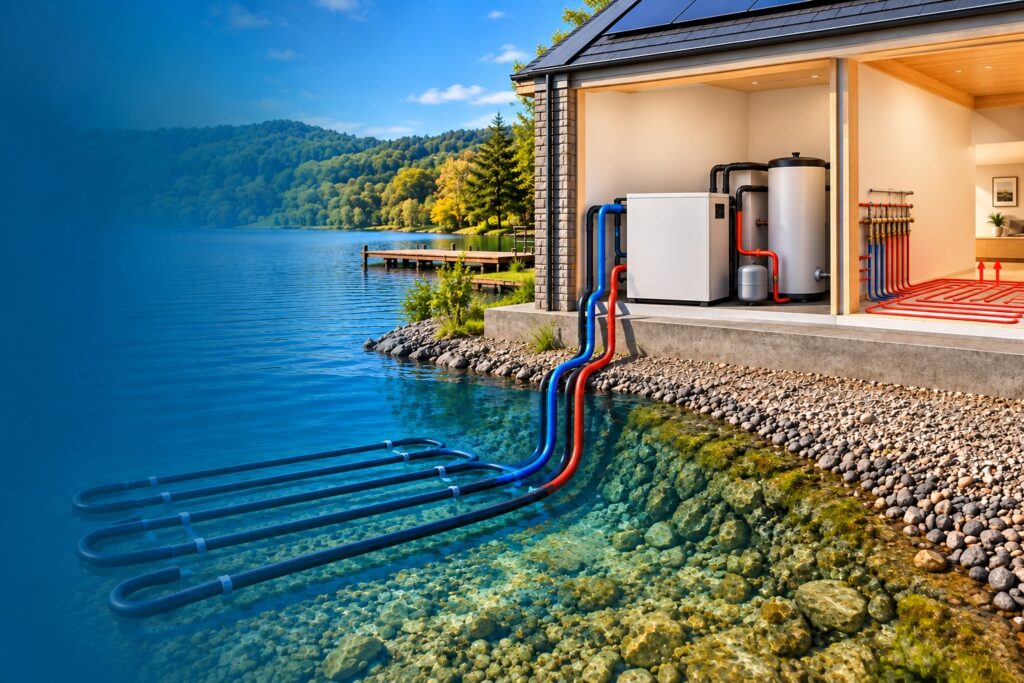
RENEWABLE HEATING / WATER-SOURCE SYSTEMS
Water Source Heat Pumps
How water provides useful heat for your home — from underwater collectors to the plant room.
Heat pumps do not create heat by burning fuel; they move it from one place to another.
01
THE PRINCIPLE
How heat is extracted and upgraded
02
COLLECTORS
Coils, mats and water sources
03
SYSTEM DESIGN
Manifolds, plant and permissions
04
PERFORMANCE
Efficiency, costs and suitability
SECTION 01
How a water-source heat pump works
A water-source heat pump (WSHP) operates much like a refrigerator in reverse. Instead of extracting heat from food and releasing it into a kitchen, it absorbs low-grade heat from water and transfers useful heat into a building.
Even cool water contains thermal energy. Depending on the system, heat may be collected from a lake, river, canal, pond, flooded quarry or a groundwater source. Closed-loop systems circulate fluid through submerged collectors; open-loop systems abstract water through suitable heat exchangers and may need different permissions.
The four stages
1. Collect
A submerged circuit circulates a water/antifreeze mixture and absorbs heat from the surrounding water. In an open-loop system, water is instead passed through a suitable heat exchanger.
2. Evaporate
The heat collected is transferred to a refrigerant within the evaporator. Because the refrigerant boils at a low temperature at the operating pressure, it changes from liquid to vapour.
3. Compress
An electrically driven compressor raises the refrigerant pressure and temperature. This is a major part of the system’s electricity demand.
4. Condense
The hot refrigerant gives up heat through the condenser to radiators, underfloor heating or a hot-water circuit. It then passes through an expansion device and the cycle repeats.
Important: Refrigerant boiling points depend on the particular refrigerant and operating pressure; a single boiling-point figure does not apply to every heat pump.
SECTION 02
Underwater collectors: coils and mats
A correctly designed collector must deliver sufficient heat without excessively cooling the source. The available water volume, movement, depth, seasonal temperature and environmental constraints all matter.
Collector coils
Large loops of high-density polyethylene (HDPE) pipe can be placed on the bed of a pond, lake or quarry. The closed circuit is secured and connected back to the property.
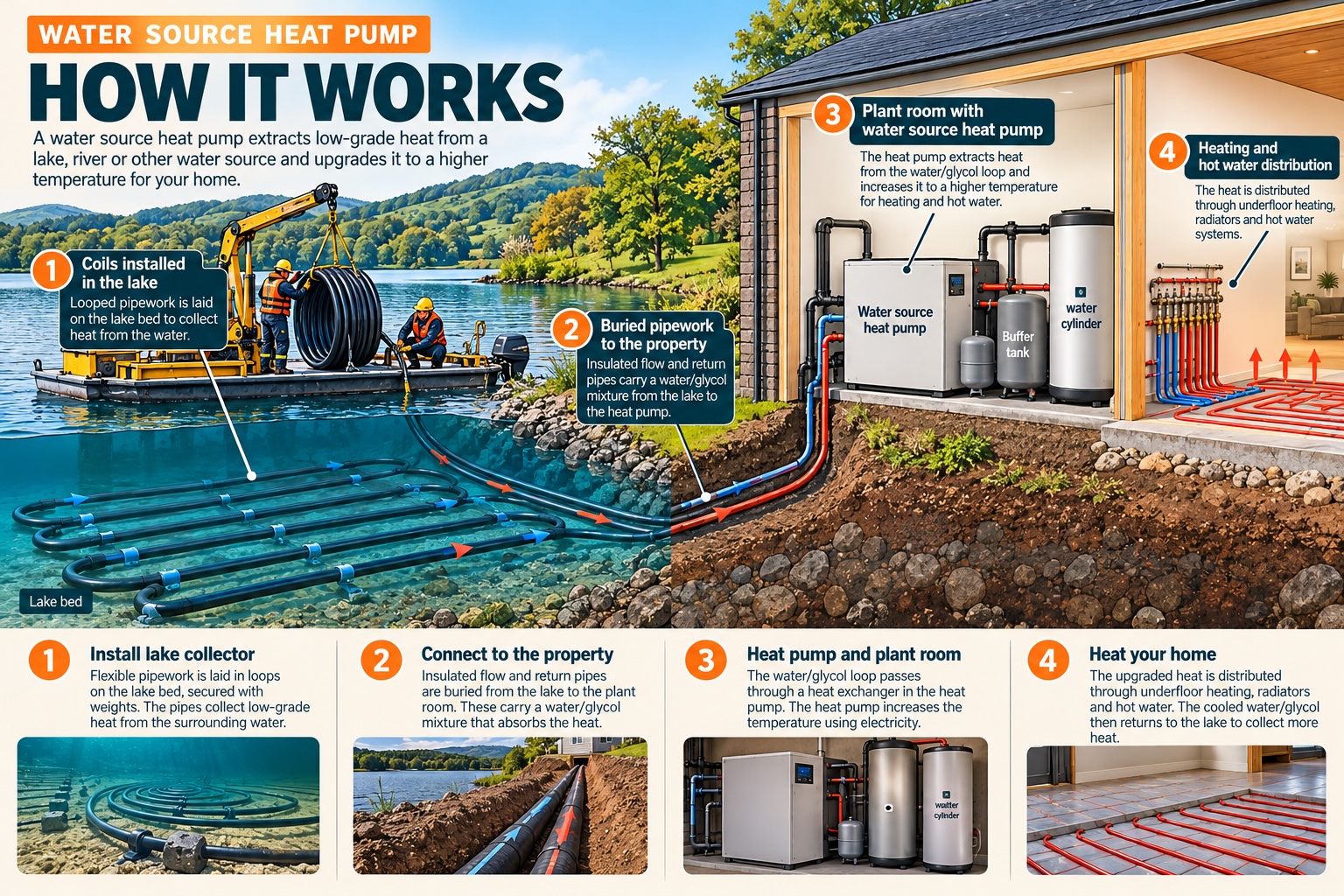
Design considerations: pipe diameter and length, circuit spacing, fluid flow, anchoring, depth, access for installation and the effect on aquatic habitats. Exact values must come from the site survey and heat extraction design.
Collector mats
Collector mats secure pipework into flatter, modular assemblies rather than free-standing coils. They may help when a particular bed geometry or available water area suits this approach.
Coils or mats?
| Consideration | Coils | Mats |
|---|---|---|
| Installation | Flexible loops that need suitable restraint and spacing | Modular structures that need suitable anchoring |
| Design | Can offer a relatively simple layout | Can offer repeatable geometry |
| Constraints | Access, sediment, damage risk and available footprint | Structure, anchoring, access and capital cost |
Neither option is automatically more efficient or cheaper: performance and costs depend on the water body, design and installation.
SECTION 03
Manifolds, inspection access and plant
Most WSHP installations have more to them than the heat-pump unit. Collector hydraulics, pumps, valves, controls and access for maintenance all influence reliability.
Manifolds
A manifold is a junction for several collector circuits. It distributes and combines flow, and may incorporate isolation valves, balancing equipment and test points. Manifolds may be housed in suitable accessible chambers, kiosks or plant rooms.
- Circuits can be isolated for testing and maintenance.
- Flow through individual loops can be measured or balanced where designed.
- Accessible manifolds make future servicing more practical.
Inspection chambers and hatches
Where a system includes buried manifolds or valves, accessible inspection chambers may provide space for isolation, venting, testing and servicing without excavation. Chamber dimensions are site- and equipment-specific, rather than a universal standard size.
What is in the plant room?
- Heat-pump unit: evaporator, compressor, condenser and expansion device.
- Circulation pumps: move fluid through source and heating circuits.
- Hot-water cylinder: stores domestic hot water where specified.
- Buffer or volumiser: fitted when hydraulic design and manufacturer instructions call for one.
- Expansion vessels and safety equipment: accommodate system expansion and protect circuits.
- Controls and sensors: manage heating, temperature and system operation.
Refrigerants made simple
The refrigerant absorbs low-temperature heat as it evaporates, is compressed, gives up heat as it condenses and passes through an expansion device to repeat the cycle. Refrigerants found in various modern heat-pump products include R32, R454B and R290 (propane); suitability and safety requirements are product-specific.
Permissions and environmental checks
Do not assume that proximity to a river or lake means a system can be installed. Land ownership, access rights, abstraction and discharge consents for open-loop systems, environmental permitting, fisheries, protected habitats and local planning requirements may all need consideration.
SECTION 04
Temperatures, efficiency and running costs
Water can be a relatively stable heat source, but actual water-source temperatures change with geography, depth, season, water flow and groundwater conditions.
Source temperatures are site-specific
A deep groundwater source may remain comparatively stable through the year, while shallow lakes, rivers and canals can vary significantly. Temperature ranges sometimes quoted in general guides are illustrative only; a design should use measured or defensible site data.
COP and seasonal performance
A heat pump’s coefficient of performance (COP) indicates useful heat output divided by electricity input at a defined test condition. For example, a COP of 4 means 4 kWh of heat delivered for 1 kWh of electricity at that condition. Annual performance is better assessed using a seasonal performance factor (SPF/SCOP), allowing for changing conditions and relevant auxiliary loads.
Water-source heat pumps can perform particularly well where source temperatures are favourable, but there is no universal 10–30% efficiency advantage over air-source heat pumps, nor a guaranteed COP of 4–6. The real result depends on water temperature, heating flow temperature, pumping energy, controls and installation quality.
Potential advantages
- Potentially stable source temperatures and strong seasonal efficiency.
- No air-source outdoor fan at the collector location.
- Potential for suitable heating and, with appropriately designed systems, cooling.
- Long-lived buried or submerged collector infrastructure when correctly designed and protected.
Potential disadvantages
- Higher installation and design complexity; specialist installation may be needed.
- Dependence on suitable water access, permissions and environmental surveys.
- Collector inspection, repair or retrieval can be difficult.
- Source-side circulation pumps add electricity consumption.
- Capital costs and running costs vary considerably from site to site.
Is a water-source heat pump right for your property?
Before choosing the technology, establish the building heat demand and the practical capacity of the proposed water source.
A sensible pre-design checklist
- Complete a room-by-room heat-loss assessment to BS EN 12831.
- Review insulation, ventilation and fabric improvements.
- Check radiators or underfloor heating against target flow temperatures such as 40°C, 45°C and 50°C.
- Survey the water body or groundwater source and confirm access rights.
- Assess collector sizing, seasonal heat extraction and source-side pump loads.
- Clarify permissions, ecology, water quality and any abstraction/discharge requirements.
- Compare complete installed costs, servicing arrangements and predicted seasonal performance.
Independent advice first: A whole-house assessment helps you decide whether water-source, ground-source or air-source equipment is the most suitable match for the property, rather than designing a project around a product.
Heat-pump manufacturers and further reading
The original page included a broad manufacturer directory. This reference list covers heat-pump brands and wider HVAC businesses; it does not imply that each makes a domestic water-source model.
UK and UK-market brands
Vaillant · Worcester Bosch · Ideal Heating · Grant UK · Calorex · Aira
European manufacturers
Viessmann · Stiebel Eltron · NIBE · Bosch Thermotechnology · Vaillant Group · Kronoterm · Ochsner · Hoval · Dimplex · MasterTherm
Asian manufacturers
Mitsubishi Electric · Daikin · Panasonic · Hitachi · Samsung · LG
Other global HVAC brands
Carrier · Trane · Gree · Midea · Toshiba · Fujitsu General
Check current product availability, refrigerant specifications and suitability directly with manufacturers and accredited designers.