Awaab’s Law Phase 2: What Changes From November 2026?
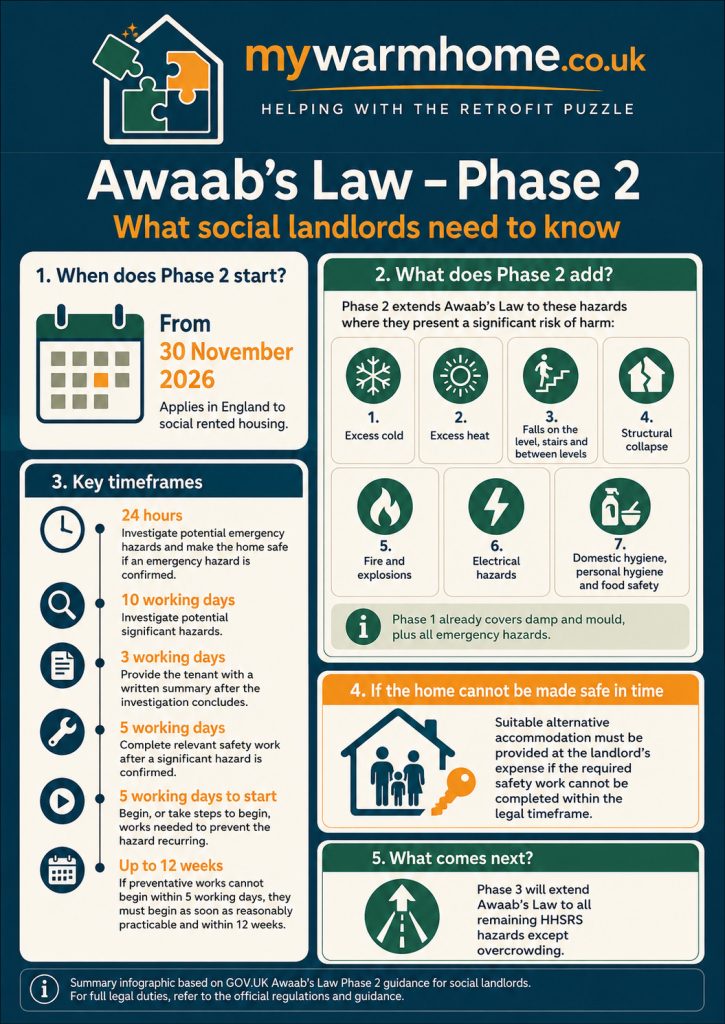
From 30 November 2026, Phase 2 of Awaab’s Law will extend the legal duties placed on social landlords in England, requiring them to investigate and act on a much broader range of serious hazards within strict time limits.
The first phase, introduced on 27 October 2025, concentrated primarily on dangerous damp and mould alongside emergency hazards. Phase 2 moves the legislation much closer to a wider whole home approach to health and safety.
For tenants, it means more protection.
For social landlords, it means the condition of the building, heating, insulation, ventilation, electrical systems and other elements of the property may need to be assessed together rather than simply treating an individual repair in isolation.
What is Awaab’s Law?
Awaab’s Law was introduced following the death of two-year-old Awaab Ishak, who died in 2020 following prolonged exposure to mould in his social housing home.
His family had repeatedly raised concerns about the condition of their property.
The legislation creates legally enforceable timeframes requiring social landlords to investigate serious hazards and take appropriate action. Tenants may ultimately take legal action where a landlord fails to comply with its obligations.
Phase 2 begins on 30 November 2026.
What hazards will Phase 2 cover?
Phase 2 significantly expands the types of significant hazards covered by the law.
From 30 November 2026 these will include:
- Damp and mould
- Excess cold
- Excess heat
- Falls, including falls on level surfaces, stairs and between levels
- Structural collapse and falling elements
- Fire and explosions
- Electrical hazards
- Domestic hygiene, including personal hygiene and food safety
The new Awaab’s Law timeframes
The legislation doesn’t simply tell landlords that repairs must be completed.
It places maximum timescales around different parts of the process.
Emergency hazards — 24 hours
Where there is a potential emergency hazard, the landlord must investigate it and, where an emergency hazard is identified, carry out relevant safety work as soon as reasonably practicable and within 24 hours of becoming aware of the hazard.
An emergency hazard is effectively one where a reasonable landlord would consider that action was necessary within 24 hours because of an imminent and significant risk to the occupant.
Examples could potentially include serious electrical dangers, major structural risks, severe heating failures affecting a vulnerable resident or an immediate fire hazard.
Each situation has to be assessed individually.
Significant hazards — investigation within 10 working days
Where a potential significant hazard is reported or identified, the landlord must investigate it within:
A significant hazard is one presenting a significant risk of harm to the health or safety of an occupant and which a reasonable landlord, with the relevant knowledge, would make safe within 15 working days.
The circumstances of the people living in the property matter.
Age, disability, health conditions and other vulnerabilities can affect how urgently a hazard needs to be treated.
Written findings — within 3 working days
Following the investigation, the landlord must provide the tenant with a written summary within three working days.
Repairs should no longer disappear into a system where the tenant reports a problem and then receives little explanation about what happens next.
The legislation places much greater emphasis on communication and record keeping.
Safety work — within 5 working days
If the investigation identifies a significant hazard, relevant work required to make the property safe must be completed within 5 working days:
Temporary measures can sometimes be used where necessary.
For example:
A failed heating system could potentially require temporary heating while the permanent repair is organised.
A mould problem might initially require cleaning and moisture control while work is arranged to address the underlying cause.
The important point is that making something temporarily safe does not necessarily end the landlord’s responsibility.
Fixing the cause — not just the symptom
One of the most important aspects of Awaab’s Law is the distinction between:
making the property safe and preventing the hazard from happening again.
Once a hazard has been identified, landlords may also have to carry out what the regulations describe as supplementary preventative work.
Where possible, this work should begin within five working days of the investigation.
Where that is not reasonably practicable perhaps because specialist contractors, surveys, materials or approvals are required landlords must take steps towards the work within those five working days and the work must begin as soon as reasonably practicable and within 12 weeks.
The preventative work must then be satisfactorily completed within a reasonable period.
Damp and mould is a good example
Imagine mould repeatedly forming on the external wall of a bedroom.
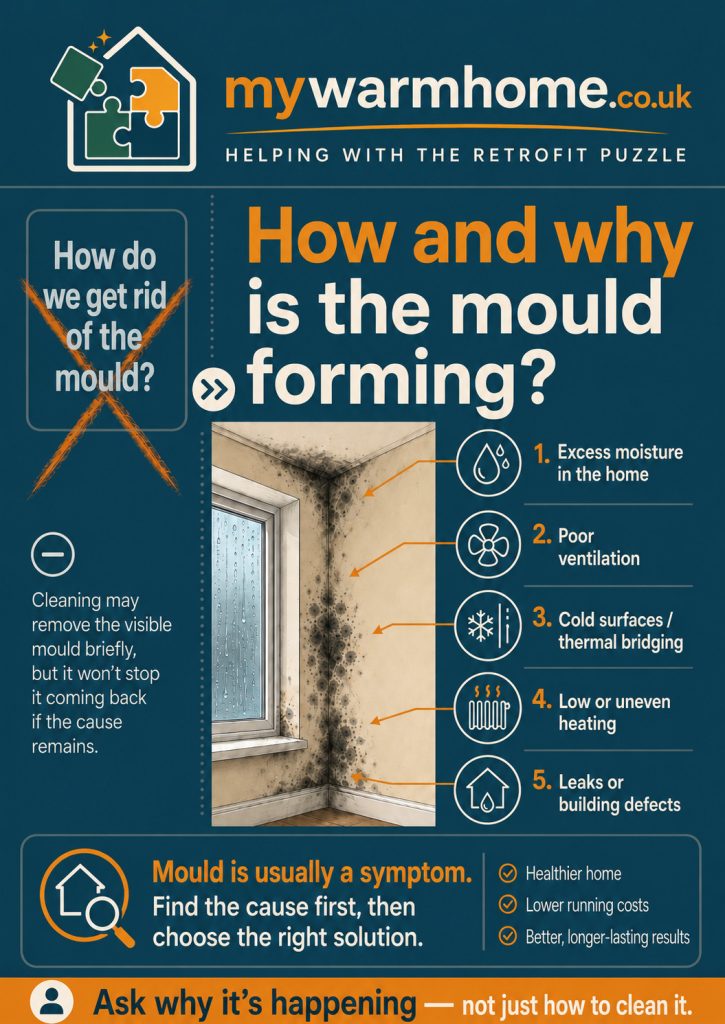
Simply washing the mould away may remove the immediate visible problem.
But why is it happening?
The cause could include:
- inadequate ventilation
- missing or poorly performing insulation
- thermal bridging
- water penetration
- leaking gutters or roof coverings
- defective pointing
- plumbing leaks
- insufficient heating
- a combination of several factors
Government guidance specifically recognises that where damp and mould results from missing ventilation or poor insulation, appropriate remedial work might include the installation of mechanical ventilation or effective insulation.
Instead of ‘how do we remove the mould” we should be asking “why is the mould forming”
Excess cold could become particularly important
For those working in energy efficiency and retrofit, excess cold is arguably one of the most significant additions in Phase 2.
A property may have a working boiler or heat pump and still be excessively cold.
The problem could relate to:
- insufficient loft insulation
- poorly insulated walls
- significant thermal bridging
- draughts
- defective windows or doors
- inadequate heating provision
- poorly designed heating controls
- high heat loss
- moisture within the building fabric
A repair-only approach may therefore fail to identify the real problem.
In some properties, a proper assessment of the building fabric, ventilation and heating system together may be necessary.
Ventilation must not be forgotten
Improving insulation and reducing uncontrolled air leakage can make homes warmer and more efficient.
But moisture still has to leave the building.
Cooking, showering, washing clothes and simply breathing all release moisture into the home.
Importantly, government guidance makes clear that landlords should not simply attribute damp and mould to a tenant’s “lifestyle”. Normal activities such as cooking, bathing, washing and drying clothes inevitably create indoor moisture and are unlikely, by themselves, to amount to a tenant breaching their tenancy.
Where insulation is improved, ventilation should therefore be assessed alongside it.
That could include checking:
- bathroom extract ventilation
- kitchen extraction
- background ventilation
- trickle vents
- airflow between rooms
- existing mechanical ventilation
- signs of condensation
- internal humidity
- cold surface temperatures
A warm home needs to be a well-ventilated home too.
What if the home cannot be made safe?
If the required safety work cannot be completed within the statutory timeframe, the landlord may have to arrange suitable alternative accommodation at its own expense until the property can be made safe.
This is another reason why good inspection, triage and repair systems are becoming increasingly important.
Phase 2 is not currently for private landlords
There is an important distinction homeowners and tenants should understand.
The Phase 2 rules beginning on 30 November 2026 apply to the social rented sector in England including registered providers such as councils and housing associations.
They do not currently apply in the same way to ordinary privately rented or owner-occupied homes.
The government has separately indicated its intention to extend Awaab’s Law-style protections into the private rented sector, but that is a separate process.
What should social landlords be doing now?
30 November 2026 may sound some way off, but housing providers have a considerable amount to prepare for.
Repair systems will need to recognise potential Awaab’s Law cases quickly.
Staff receiving calls, carrying out inspections or visiting homes need to understand that what initially appears to be a routine repair could actually indicate a significant hazard.
Organisations should be considering how to manage the process and record the data that will enable a transition to a more holistic approach to the properties that are let out.
That could include photographs, moisture readings, thermal observations, ventilation information, heating system information and clear records of communication with the tenant.
Where retrofit fits into Awaab’s Law
Awaab’s Law isn’t a retrofit standard.
But the principles behind good retrofit have a great deal in common with what the legislation is trying to achieve.
Both require us to understand how a property works as a system.
Changing one part of a building can affect another.
For example:
- Insulation affects heat loss.
- Heat loss affects internal temperatures.
- Temperature affects relative humidity.
- Relative humidity and surface temperature affect condensation risk.
- Ventilation affects moisture removal.
- Moisture affects building fabric and occupant health.
That is why diagnosing the root cause of housing problems is so important.
Treating symptoms repeatedly can be expensive for landlords and frustrating or potentially dangerous for residents.
Phase 3 comes next
Phase 2 isn’t the end of the process.
The government intends to introduce Phase 3 during 2027, extending the requirements to the remaining hazards within the Housing Health and Safety Rating System, with the exception of overcrowding.
Awaab’s Law is therefore gradually becoming a much broader framework for dealing with dangerous housing conditions.
The MyWarmHome view
Awaab’s Law should encourage a move away from repeatedly treating individual symptoms towards properly understanding why a home is failing.
Damp, mould, excess cold, ventilation, insulation and heating are frequently connected.
A mould wash might remove mould.
A new boiler might restore heating.
A new extractor fan might increase ventilation.
But if the underlying building problem has not been understood, the hazard may simply return.
Good housing starts with good diagnosis.
At MyWarmHome.co.uk, we believe homes should be looked at as complete systems considering the building fabric, insulation, heating, ventilation, moisture and the people living inside the property.
Because ultimately, energy efficiency isn’t simply about reducing a number on an EPC.
It’s about creating homes that are:
Warm. Healthy. Safe. Efficient.