
MyWarm
home.co.uk
Heat pumps do not generate heat, they move it.
GSHP (Ground Source heat Pump)
While a ground source heat pump may lbe invisible to the naked eye a lot is going on either under ground or in the plant room. We know that air contains usable heat but the ground contains a lot more steady usable heat. The deeper you go the warmer it gets!
How a Ground Source Heat Pump Works
A ground source heat pump (GSHP) works a bit like a fridge in reverse. Instead of taking heat out of food and throwing it into your kitchen, it takes naturally stored heat from the ground and moves it into your home.
Even when the ground feels cold, there is a huge amount of stored solar energy underground. A ground source heat pump collects this low-temperature heat, boosts it to a higher temperature, and uses it to heat your radiators, underfloor heating, and hot water.
Step 1: Collecting Heat from the Ground
There are two main ways to collect heat:
Horizontal Ground Loops (Coils)
These are long plastic pipes buried in trenches across a garden or field.
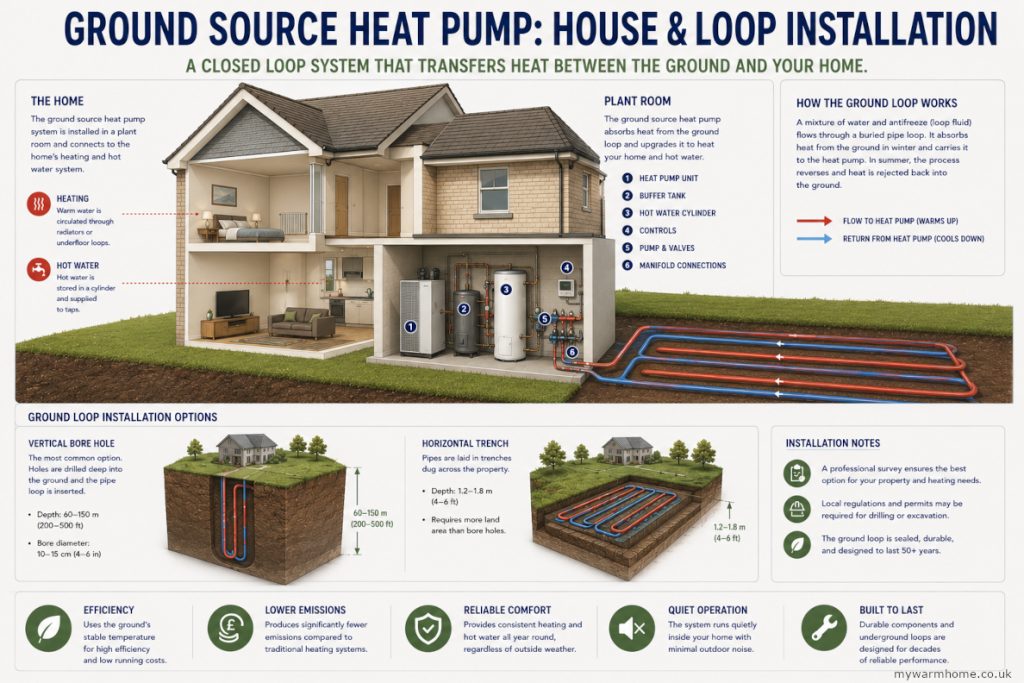
Typical Installation
- Depth: 1.0–2.0 metres
- Pipe length: 300–1,000+ metres
- Land area required:
- Small home: 200–400m²
- Larger home: 500–1,000m²+
A mixture of water and antifreeze circulates through the pipes and absorbs heat from the surrounding soil.
Advantages
✓ Lower installation cost
✓ Easier maintenance
✓ No deep drilling required
Disadvantages
✗ Requires a large garden
✗ Excavation can be disruptive
✗ Performance can vary slightly with ground conditions
Vertical Boreholes
Where space is limited, deep boreholes are drilled.
Typical Installation
- Borehole depth:
- 50–200 metres
- Most UK homes: 80–150 metres
- Diameter:
- Usually 110–180mm
- Number of boreholes:
- 1–6 depending on heat demand
A U-shaped pipe is inserted into each borehole and grouted into place.
The temperature deep underground remains relatively constant throughout the year.
Ground Temperatures
| Depth | Typical Temperature |
|---|---|
| Surface | Varies greatly |
| 1.5m | 8–12°C |
| 15m+ | 10–13°C |
| 100m+ | 11–14°C |
This stable temperature makes boreholes very efficient.
Advantages
✓ Requires little land
✓ Very stable temperatures
✓ Excellent efficiency
✓ Long lifespan
Disadvantages
✗ Higher installation cost
✗ Requires specialist drilling
Step 2: Manifolds
The pipes from the ground loops or boreholes connect to a manifold.
Think of the manifold as a traffic junction,
- Collects flow from multiple loops
- Balances water flow
- Allows individual circuits to be isolated
- Connects all ground loops to the plant room
The manifold may be:
- Underground
- Inside a chamber
- Located in the plant room
Step 3: Inspection Hatches
Inspection hatches provide access to buried manifolds.
Typical sizes:
- 450mm × 450mm
- 600mm × 600mm
- Larger chambers for commercial systems
They allow engineers to:
- Inspect joints
- Check valves
- Monitor pressure
- Service manifolds
Most are fitted with insulated covers to prevent frost.
Step 4: The Refrigerant Circuit
The ground loops never enter your house directly. Instead they pass their heat to the heat pump via a heat exchanger.
Like all heat pumps refrigerants are used.
What Happens?
- Ground loop fluid arrives at around 5–12°C.
- The refrigerant absorbs this heat.
- The refrigerant boils into a gas.
- A compressor squeezes the gas.
- The temperature rises dramatically.
- Heat is transferred into your heating system.
- The refrigerant cools and repeats the cycle.
This process moves heat rather than creating it.
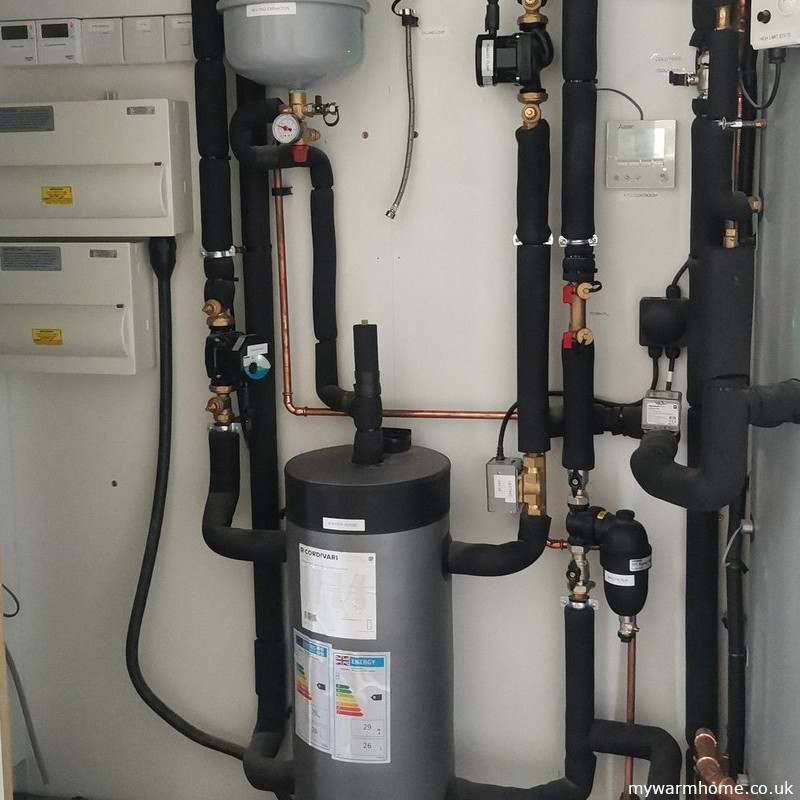
Step 5: Plant Room
The plant room is the heart of the system.
It usually contains:
- Ground source heat pump
- Buffer tank
- Hot water cylinder
- Pumps
- Expansion vessels
- Control systems
- Electrical equipment
A typical domestic plant room needs approximately:
- 2–6m² of floor space
Typical Temperatures
Ground Loop Side
| Stage | Temperature |
|---|---|
| Fluid leaving ground | 6–12°C |
| Fluid returning to ground | 2–8°C |
Heating System Side
| System | Flow Temperature |
|---|---|
| Underfloor heating | 30–45°C |
| Low-temperature radiators | 40–55°C |
| Domestic hot water | 50–60°C |
Modern GSHPs can achieve:
- 60–70°C flow temperatures
- Some models up to 75°C
Pros
Excellent Efficiency
Ground temperatures stay fairly constant all year.
Lower Running Costs
Usually cheaper to run than oil, LPG and direct electric heating.
Long Life
- Ground loops: 50–100+ years
- Boreholes: 100+ years
- Heat pump unit: 20–25 years
Quiet Operation
No large outdoor fan like an air source heat pump
Low Carbon
Can significantly reduce carbon emissions
Cons
High Installation Cost
Typical UK domestic costs:
- Horizontal loops: £15,000–£30,000+
- Borehole systems: £20,000–£45,000+
Space Requirements
Horizontal systems need substantial land
Ground Investigation Required
Soil type, rock conditions and groundwater affect design.
Installation Disruption
Trenching or drilling can be significant.
Longer Payback
Although running costs are low, the upfront investment is substantial.
Major Heat Pump Manufacturers.
UK
- Vaillant – https://www.vaillant.co.uk
- Worcester Bosch – https://www.worcester-bosch.co.uk
- Ideal Heating – https://idealheating.com
- Grant UK – https://www.grantuk.com
- Calorex – https://www.calorex.com
- Aira – https://www.airahome.com
- Kensa- https://kensa.co.uk/
European manufacturers
- Viessmann – https://www.viessmann.co.uk
- Stiebel Eltron – https://www.stiebel-eltron.co.uk
- NIBE – https://www.nibe.eu
- Bosch Thermotechnology – https://www.bosch-thermotechnology.com
- Vaillant Group – https://www.vaillant-group.com
- Kronoterm – https://www.kronoterm.com
- Ochsner – https://www.ochsner.com
- Hoval – https://www.hoval.com
- Dimplex – https://www.dimplex.co.uk
- MasterTherm – https://www.mastertherm.com
Asian manufacturers
- Mitsubishi Electric – https://les.mitsubishielectric.co.uk
- Daikin – https://www.daikin.co.uk
- Panasonic – https://www.aircon.panasonic.eu/GB_en
- Hitachi – https://www.hitachiaircon.com
- Samsung – https://www.samsung.com/uk/business/climate
- LG – https://www.lg.com/uk/business/air-solution
Emerging manufacturers
- Carrier – https://www.carrier.com
- Trane – https://www.trane.com
- Gree – https://www.gree.com
- Midea – https://www.midea.com
- Toshiba – https://www.toshiba-aircon.co.uk
- Fujitsu General – https://www.fujitsu-general.com