
Biomass Heating
Wood pellets,
wood chips & logs.
Biomass is often described as renewable or low-carbon heating. But a biomass boiler still creates heat by burning a fuel. So are we really moving beyond combustion — or simply changing what we burn?
01
Biomass explained
02
Fuels & combustion
03
Carbon & air quality
04
Is biomass right?
01 — Biomass explained
What is biomass heating?
A biomass heating system produces heat by burning material of biological origin. In homes and smaller buildings this usually means wood pellets, wood chips or logs.
Unlike coal, oil and natural gas, trees can be replanted and grown again. This is why sustainably produced biomass can be classified as a renewable energy source.
That does not, however, mean that burning wood produces no emissions.
The important distinction
Renewable does not automatically mean clean.
Biomass can replace a fossil fuel, but it still relies on combustion.
The fuel
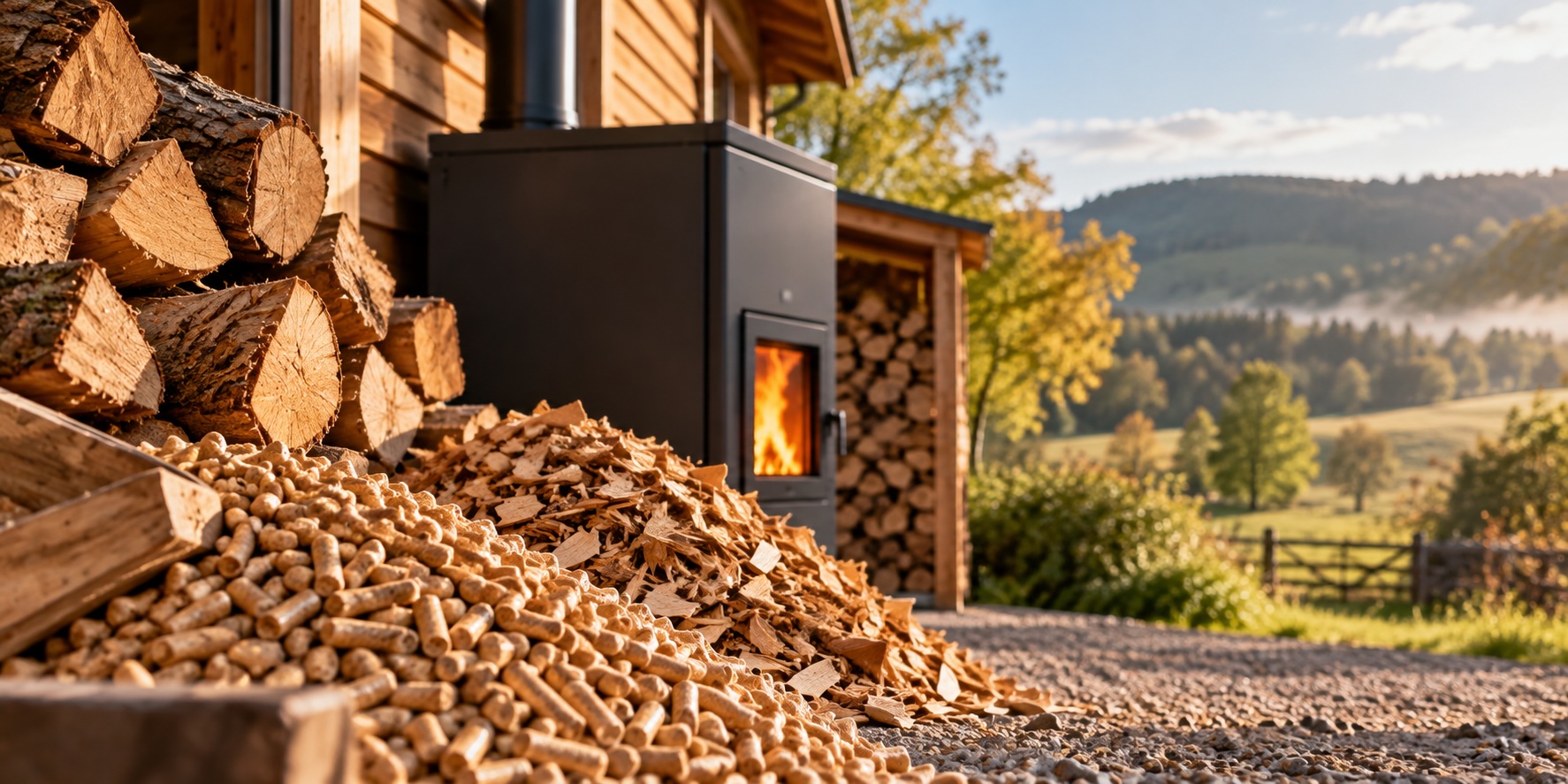
Three common biomass fuels.
The type of fuel makes a significant difference to how the heating system is stored, supplied and operated.
01 / PELLETS
Wood pellets
Compressed processed wood with a controlled moisture content. Pellets are commonly used in automatically fed pellet boilers and pellet stoves.
02 / CHIPS
Wood chips
Chipped timber normally supplied in bulk. Wood-chip systems are more commonly found in larger homes, commercial properties and district heating systems.
03 / LOGS
Logs
Cut and seasoned timber requiring suitable dry storage. Logs can be used in dedicated log boilers as well as domestic wood-burning stoves.
02 — Fuels & combustion
Wood still produces CO₂ when we burn it.
There can be a misconception that because wood is renewable, burning it doesn’t produce carbon dioxide.
It does.
As a tree grows it absorbs carbon dioxide from the atmosphere. When the wood is later burned, much of that stored carbon is released again.
The argument for biomass therefore relies on a carbon cycle. New growth can absorb carbon again, unlike fossil fuels which introduce carbon that has been stored underground for millions of years into the modern carbon cycle.
Look beyond the boiler
It isn’t as simple as “the tree grows back”.
The environmental impact of biomass depends heavily on where the fuel comes from and what happens throughout its lifecycle.
- Where did the wood come from?
- Was timber specifically felled for fuel?
- Could forestry residues be used instead?
- How far has the fuel travelled?
- How much energy was used processing it?
- How long will replacement growth take?
A tonne of locally sourced forestry residue is a very different environmental proposition from timber harvested, processed into pellets and transported thousands of miles.
03 — Carbon & air quality
We’re still burning something.
Moving from an oil, coal or gas boiler to biomass can mean moving away from a fossil fuel. But we haven’t moved away from combustion.
01
Carbon dioxide
The carbon stored in the wood is released as it burns.
02
Particulates
Wood combustion can produce fine particulate pollution, including PM2.5.
03
NOx
Combustion can also produce nitrogen oxides which contribute to air pollution.
Different approaches
Biomass vs a heat pump.
Both can form part of a lower-carbon heating strategy in the right circumstances, but they provide useful heat in fundamentally different ways.
Biomass boiler
Burns fuel to create heat.
Pellets, chips or logs are combusted. Fuel must be stored, delivered and continually replaced.
Heat pump
Moves heat instead of creating it by burning fuel.
Heat already present in the air, ground or water is transferred into the property using electricity. There is no combustion at the home.
04 — Is biomass right for a home?
So, is biomass green?
There isn’t a simple yes or no answer.
Biomass can make sense where:
- It replaces oil, coal or another high-carbon fuel.
- There is a genuinely sustainable local fuel source.
- Forestry residues or waste material can be used.
- The boiler is efficient, correctly sized and properly maintained.
- There is sufficient space for fuel storage and deliveries.
- Local air-quality implications have been properly considered.
The MyWarmHome view
Don’t just ask whether biomass is renewable.
Sustainably sourced biomass can help reduce dependence on fossil fuels. But we’re still burning a fuel, we’re still producing combustion emissions, and its environmental impact depends heavily on how that fuel is sourced and used.
Is burning this particular biomass fuel, in this particular building, genuinely the best way to provide the heat we need?
That’s the question we should be asking as part of a whole-house approach to retrofit.