
HEALTH & SAFETY / mywarmhome.co.uk
Health and safety at home
Recognise common hazards, know what to do in an emergency, and plan safer home and retrofit surveys.
Emergency numbers
Fire, serious injury or immediate danger to life · 999
Suspected mains gas leak in Great Britain · 0800 111 999 from outside
Electricity network emergency in Great Britain · 105
The building regulations links below cover England and Wales. Use the relevant local rules and emergency arrangements elsewhere.
Photo placeholder · Hero image · home or survey exterior
Asbestos in the home
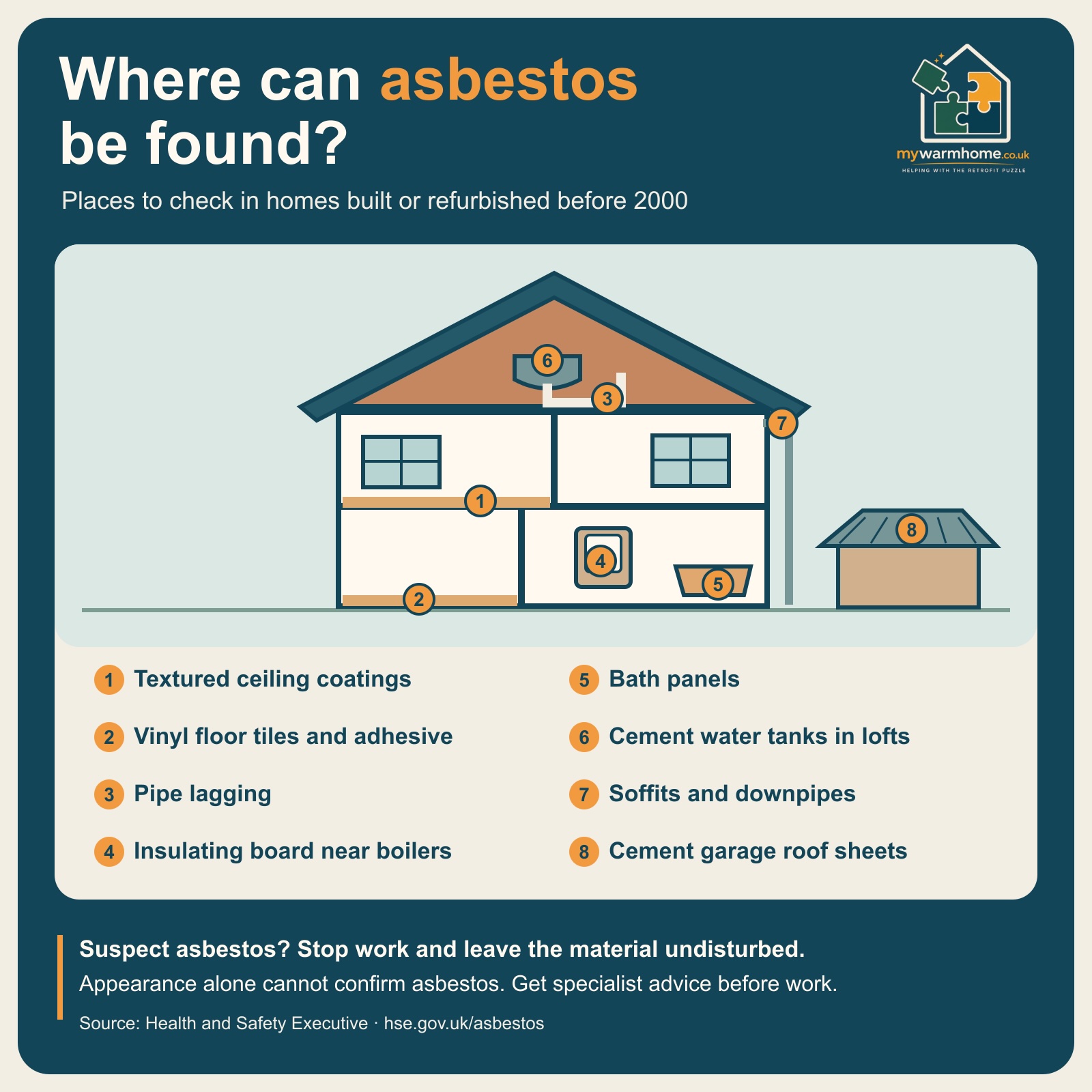
If your home was built or refurbished before 2000, asbestos may be present. It can be hidden behind newer finishes. You cannot confirm asbestos by appearance alone.
What to do
- Leave suspect material undisturbed. Pause work that could drill, cut, sand, scrape or remove it. Tell anyone planning work in the area.
- If material is damaged or dust has been released, stop work, leave the affected area and keep others out. Avoid spreading dust. Do not sweep, vacuum or take samples yourself. Contact a competent asbestos specialist promptly.
- If you rent, tell your landlord or housing provider. For surveys and laboratory analysis, check UKAS accreditation. A specialist can advise whether the material can stay safely in place and whether any work requires a licensed contractor.
Photo placeholder · Old flue, floor tiles or garage roof
HSE · where asbestos can occur · HSE · accidental disturbance · UKAS · find an accredited organisation
Electrical safety at home
Who can work on fixed wiring?
In England and Wales, fixed electrical work must meet Part P of the Building Regulations and be carried out competently. A registered electrician can self-certify notifiable work covered by their registration. If using another route, agree it with building control before the work starts. Changing a bulb or plug is different from working on fixed wiring.
In England, new circuits, replacement consumer units and additions or alterations to existing circuits in defined special locations generally require notification. In Wales, notification can also apply to certain work in kitchens and outdoors. Ask for the relevant electrical test certificate and, for notifiable work, the Building Regulations compliance documentation.
Warning signs and emergency isolation
Scorching, burning smells, crackling, hot plugs, loose sockets, exposed wiring and repeated tripping all warrant attention. Stop using the affected equipment and arrange an electrician.
- If the route and consumer unit are dry, intact and safe to approach, turn its clearly marked main switch to OFF. Leave the covers in place. Keep away from the meter and incoming service fuse.
- If there is fire, smoke, water around the unit, visible damage or suspected gas, keep away. Get out if there is immediate danger. Call 999 for fire or serious injury. For damaged incoming supply equipment or other network emergencies, call 105 in Great Britain.
- If someone is still in contact with electricity, do not touch them. Call 999 and follow the call handler’s instructions. Cut the power only if safe.
- Keep the supply off until it has been checked. Solar PV, batteries and backup generators can leave parts energised. Tell the electrician or emergency responder about any other supply.
Photo placeholder · Closed consumer unit showing the main switch
England · Approved Document P · Wales · building regulations for electrics · Find a registered electrician · Electrical Safety First · electric shock
Gas leaks and carbon monoxide
If you smell gas or suspect a leak
- Avoid flames and smoking. Leave electrical switches, plugs, doorbells and appliances alone. Use your phone outside.
- If it is safe without delaying your exit, open doors and windows. Turn off the gas at the meter only if it is safe and readily accessible. Stay out of cellars and basements if gas is suspected there.
- Get everyone outside. For mains gas in Great Britain, call 0800 111 999 from outside. For LPG, call the supplier’s emergency number. Call 999 if there is a fire or immediate danger to life.
- Follow the emergency service’s instructions. Stay outside until told it is safe to return and leave affected appliances off until advised they can safely be used.
If a CO alarm sounds or you suspect carbon monoxide
Get everyone into fresh air and stay outside. Carbon monoxide has no smell. Headache, dizziness and nausea are possible symptoms. Call 999 if anyone has difficulty breathing, sudden confusion, chest or muscle pain, weakness or loss of consciousness. For other suspected exposure symptoms, contact NHS 111 for urgent advice. For a suspected mains gas appliance incident, also call the gas emergency service.
Keep combustion vents clear, use and test suitable CO alarms according to their instructions, and arrange regular servicing by a Gas Safe registered engineer qualified for the appliance and fuel. Check the categories on the engineer’s ID card.
Photo placeholder · Gas meter shut-off or CO alarm
National Gas · emergency contacts · NHS · carbon monoxide poisoning · Gas Safe Register · check an engineer
For surveyors and retrofit professionals
Confirm the scope, plan safe access and ask the occupant about known defects before starting. Record observations, immediate actions, limitations and who is responsible for follow-up.
Asbestos surveys · Bathroom zones · Boiler flues · Working at height
Asbestos during a survey
Check building age, alterations, existing asbestos information and the area affected by the proposed work. The duty to manage applies to non-domestic premises and common parts of domestic premises. Employers and contractors can still have asbestos duties when working inside individual dwellings.
- A routine retrofit or condition survey can flag suspected materials. A management asbestos survey supports normal occupation and maintenance. Before work likely to disturb hidden materials, obtain a refurbishment or demolition survey scoped to the affected area. Check what it excluded.
- If suspect material could be disturbed or blocks access, stop that part of the inspection. Keep intrusive inspection and sampling within a properly commissioned specialist survey. Record inaccessible areas and refer the concern.
- If there is accidental disturbance, withdraw, keep others away and follow your incident procedure. Report immediately and get specialist advice on contamination, clothing and equipment. Record the location, activity, who was told and the condition for restarting.
Photo placeholder · Redundant loft flue viewed from a safe position
Bathroom electrical zones
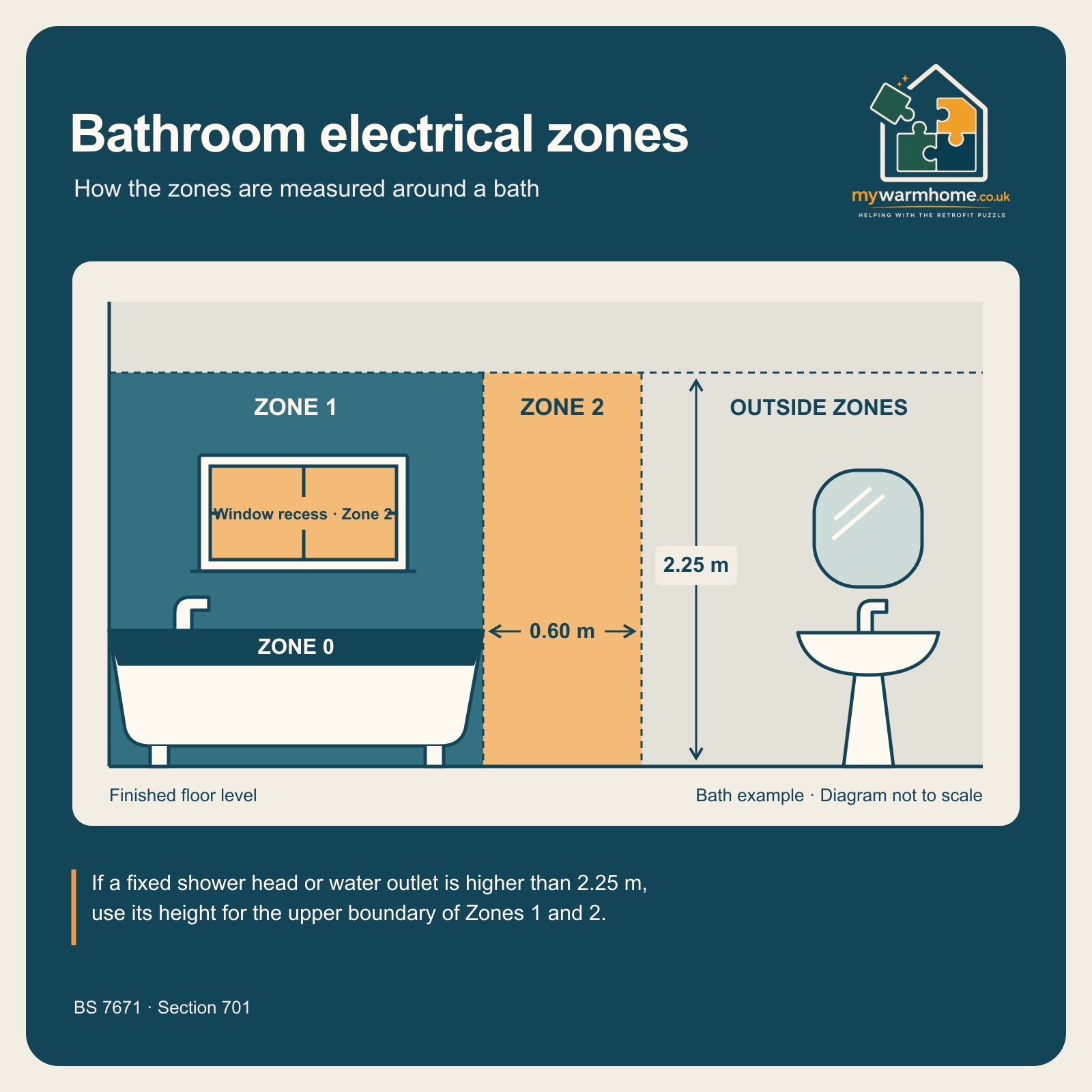
Use BS 7671 Section 701 and the edition applicable to the work. Record the bath or shower layout, fixed water outlets, partitions and electrical fittings. An electrician should confirm zone boundaries, permitted equipment and protection before a fan, light or heater is specified.
- Zone 0 is inside the bath or shower tray. Trayless showers have a defined low-level zone. Equipment needs to be specifically suitable, with at least IPX7 protection and supply restrictions.
- Zone 1 typically extends over the bath or tray to 2.25 m above the finished floor or the highest fixed water outlet if higher. For a trayless shower, the horizontal extent is generally 1.2 m from the fixed outlet.
- Zone 2 generally extends 0.60 m horizontally beyond zone 1 around a bath or tray. Trayless showers follow different rules. Consider fixed partitions and the actual layout.
- Equipment in zones 1 and 2 generally needs at least IPX4, or IPX5 where water jets are likely. Check 30 mA RCD protection, manufacturer instructions and shaver-unit rules. Ordinary socket outlets generally require at least 2.5 m horizontally from the zone 1 boundary.
Record visible defects and inspection limitations. Leave covers in place and refer electrical inspection or testing to a competent electrician.
IET · current wiring regulations · Electrical Safety First · technical wiring guidance
Boiler flue terminals
Record the appliance make and exact model, flue type and terminal, any plume management kit, and relevant measurements from safe access. Include proposed replacement windows, external insulation, new vents and carports in your review.
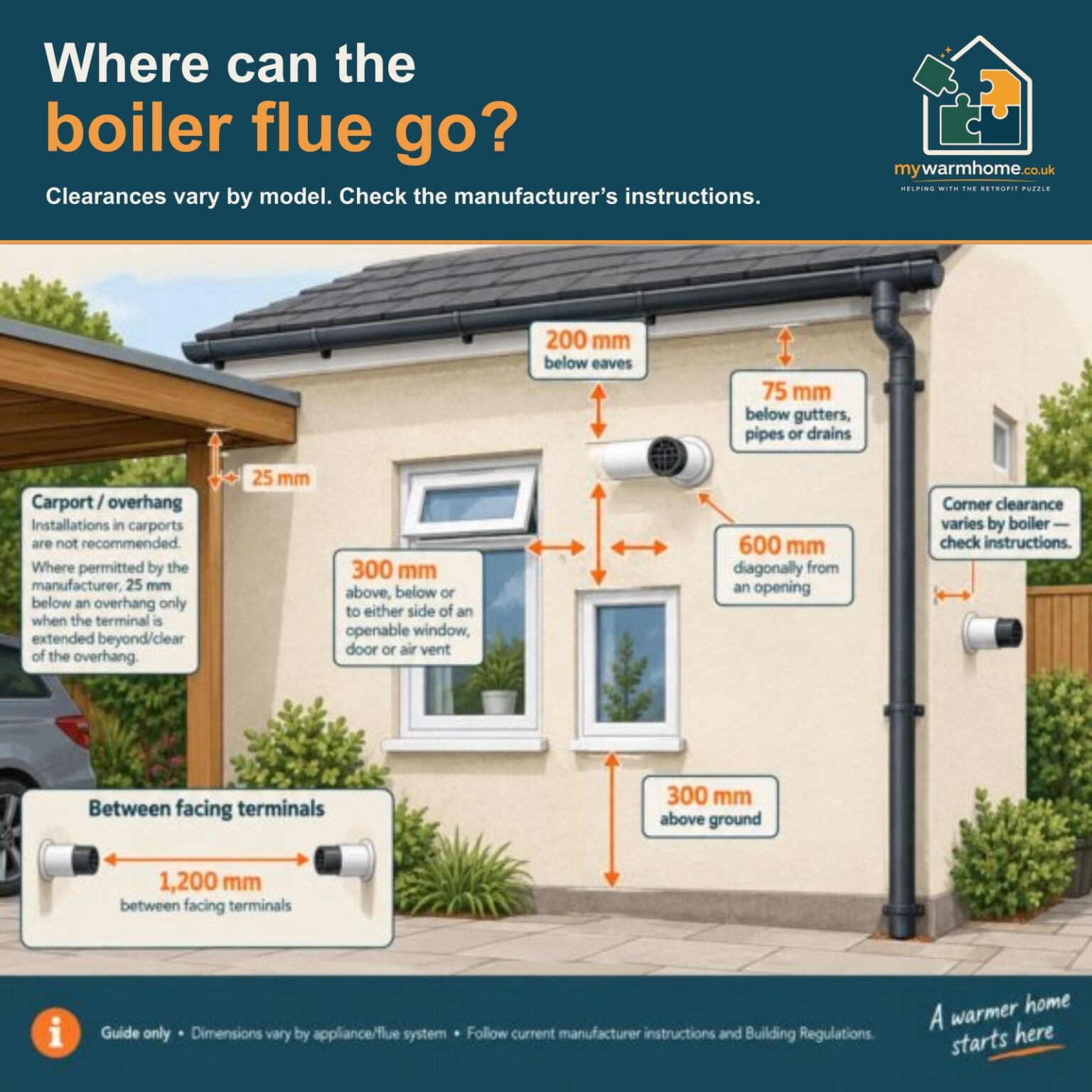
- Worcester Bosch Greenstar 4000 combi · manual 6 720 891 161 (2021/10), figure 31. The layout at position 11 shows 300 mm above, below or to either side of an opening. Other layouts in the same figure give different distances. The manual gives 75 mm below gutters and 200 mm below eaves, and advises against carport installations.
- Vaillant ecoTEC plus LPG · manual 0020239015_05, appendix G. The selected entries show 300 mm directly below an opening, 75 mm below temperature-sensitive components such as plastic gutters, 200 mm below eaves or carport roofs, and 1,200 mm from a carport opening into the dwelling.
- Also check boundaries, opposing walls and openings, corners, roof and ground levels, guarding, plume nuisance, air intakes and access to inspect concealed flues. Refer uncertainty or suspected defects to a Gas Safe registered engineer qualified for the appliance and fuel.
Use the exact appliance and approved flue kit instructions, applicable Building Regulations guidance and relevant gas standards. Special arrangements and reductions depend on the manual and site conditions.
Photo placeholder · Actual terminal near an opening, gutter or carport
Worcester Bosch · Greenstar 4000 combi manual · Vaillant · ecoTEC plus LPG manual · England · Approved Document J · Wales · Approved Documents
Working at height
Avoid work at height where reasonably practicable. Try ground-level evidence or a pole camera. If work at height is necessary, prevent falls with a safe place of work or suitable equipment. Where risk remains, minimise the distance and consequences of a fall. Give collective protection priority.
- Assess the surface, weather, lighting, overhead services, falling objects, safe transfer, people below and emergency arrangements. Check equipment condition and user competence.
- Use ladders when the risk assessment identifies them as suitable for low-risk work and more suitable equipment is unjustified. Secure the ladder, maintain three points of contact where possible and avoid overreaching. At a loft hatch, check the handhold, landing and supported route. Keep off ceiling plasterboard.
- Stop if you cannot establish safe access. Record what could not be inspected, why, and what equipment or specialist help is needed. Agree lone-working check-ins and ask the occupant about unsafe hatches or other known defects.
Photo placeholder · Loft ladder, hatch and safe landing