
MYWARMHOME / HEATING EXPLAINED
How heat pumps work
A heat pump uses electricity to collect heat from outside and move it into your home. Here is the four-step cycle, how the warmth reaches your rooms, and what makes a good installation.
01 / The simple idea
Move heat, then raise its temperature
The outdoor heat source can feel cold to us and still contain energy a heat pump can collect.
Cold air still contains usable heat. The refrigerant can be colder than the air around it, so heat flows into it even when the weather feels chilly.
A heat pump works much like a fridge in reverse. A fridge moves heat out of its cabinet; a heat pump gathers heat from the air, ground or water and moves it into the heating system. Electricity powers the compressor and circulation.
02 / The refrigeration cycle
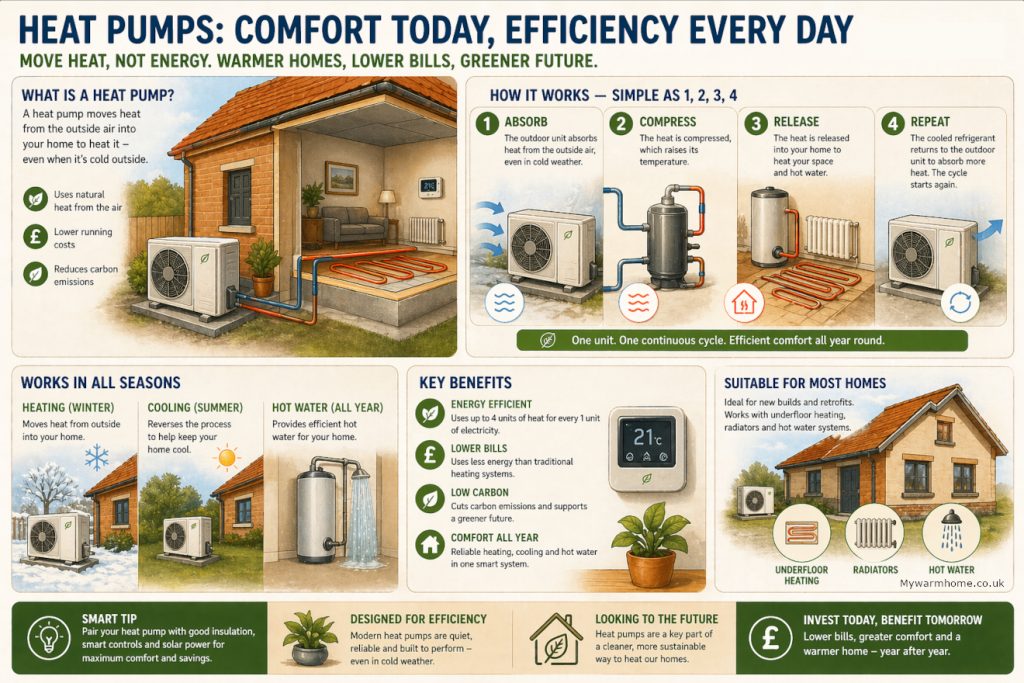
Four steps that keep repeating
The refrigerant circulates inside a sealed circuit. Your radiators receive heat through the heating water; refrigerant does not flow through them.
Step 01
Collect
A refrigerant absorbs low-temperature heat at an outdoor heat exchanger and evaporates into a gas.
Step 02
Compress
An electric compressor raises the refrigerant’s pressure and temperature.
Step 03
Release
At another heat exchanger, the hot refrigerant transfers heat to water for radiators, underfloor heating or a hot-water cylinder.
Step 04
Reset
An expansion valve reduces its pressure and temperature. The refrigerant returns to collect more heat.
03 / Sources and emitters
Different sources. The same core idea.
Air, ground and water systems collect heat differently. The indoor system must then deliver the right amount of warmth to every room.
Air source
Heat from outside air
An outdoor unit draws warmth from the air. Air-to-water systems pass this heat to central-heating water.
Ground source
Heat from the ground
Pipes buried horizontally or in boreholes collect heat from the ground for a heat pump indoors.
Water source
Heat from water
A suitable body of water can provide the heat source, subject to the site, permissions and system design.
How the heat reaches your rooms
Heat delivery
Radiators
Existing radiators can sometimes stay. A room-by-room calculation shows whether each one supplies enough heat at the proposed water temperature.
Heat delivery
Underfloor heating
A large floor area can deliver comfortable heat using lower water temperatures when the floor construction and design suit it.
Heat delivery
Fan convectors
Fan-assisted units are another option where a compact emitter needs to deliver more heat.
Hot water is part of the design too. Many air-to-water and ground-source systems use a hot-water cylinder. The right arrangement depends on the home, available space and demand.
Hybrid systems combine a heat pump with another heat source, such as a boiler. Whether that arrangement makes sense depends on the property and a proper system design.
04 / From idea to installation
Good design makes the difference
A heat pump can work in many kinds of home. The survey and design determine the right size, heat emitters, hot-water setup and controls.
01 / Survey
Measure heat loss
Assess the building fabric and ventilation, then calculate heat loss room by room so the heat pump and emitters can be sized.
02 / Emitters
Check radiators and pipework
Compare each radiator’s output with its room’s heat loss at the proposed flow temperature; inspect pipework and circulation requirements.
03 / Hot water
Plan the cylinder
Check space for a cylinder, hot-water demand and how the system will heat and store domestic hot water.
04 / Operation
Set up controls
Plan location, noise, controls and weather compensation. The installer should explain schedules and sensible temperature settings.
What do COP and SCOP mean?
These figures describe the ratio of useful heat delivered to electricity used. Real running costs also depend on the home, system design, controls and energy tariffs.
At one test point
COP
Coefficient of Performance compares heat delivered with electricity used under a defined set of conditions.
Across a season
SCOP
Seasonal Coefficient of Performance estimates the same ratio across a heating season and a range of conditions.
Before you commit
An online guide is a useful first check; it cannot replace a property survey and a room-by-room heat-loss calculation. Ask for a clear design showing the proposed flow temperature and the heat each room’s emitter will deliver.
Read more about heating controls and COP and SCOP.
Manufacturer links from the original page
A starting list for comparing products. Ask the designer or installer to explain which model meets your home’s heat loss, hot-water and system requirements.