

HEAT PUMPS • EFFICIENCY
Understanding
COP & SCOP.
Two numbers that help explain heat pump efficiency — but they don’t tell you exactly the same thing.
01
What is COP?
02
What is SCOP?
03
The calculation
04
Heating curve
Heat pump efficiency doesn’t need to be complicated.
When looking at heat pumps, you’ll often see the terms COP and SCOP. These are ways of describing the relationship between the electricity a heat pump uses and the heat it delivers.
The important thing is understanding what each number represents. COP describes performance at a particular operating point or set of conditions. SCOP looks at performance across a heating season.
COP
Coefficient of Performance
A snapshot of efficiency at a particular operating point or under specified conditions.
SCOP
Seasonal Coefficient of Performance
A broader indication of efficiency across an entire heating season.
01 — COP
What does COP actually mean?
COP — Coefficient of Performance — compares the heat being delivered by the heat pump with the electrical energy being used under particular operating conditions.
SIMPLE EXAMPLE
1 kWh electricity → 4 kWh heat
In this example, the heat pump is operating at a COP of 4.
But that does not mean the heat pump will operate at COP 4 all day, every day. Conditions change.
Outdoor temperature, required water temperature and the way the system is operating can all affect performance. That is why one COP figure should not be treated as a complete picture of how a system will perform across the year.
02 — SCOP
Real life happens across a season.
Outdoor temperatures rise and fall, heating demand changes and the heat pump operates under different conditions. SCOP — Seasonal Coefficient of Performance — provides a seasonal measure rather than looking at only one operating point.
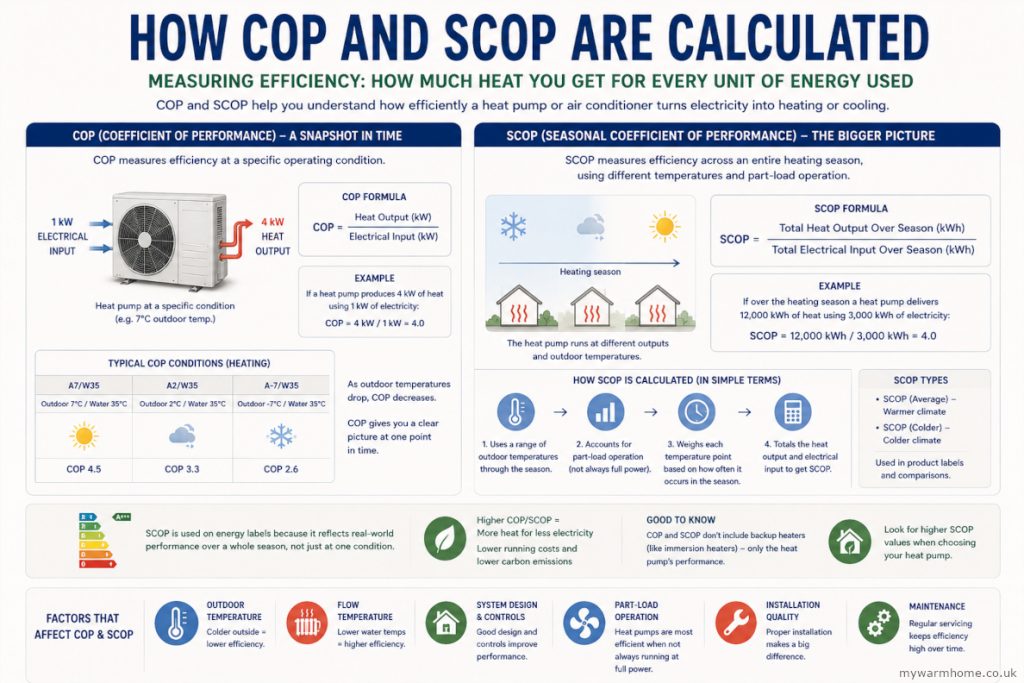
Seasonal performance considers changing operating conditions.
01
Changing weather
Outdoor temperatures change throughout the heating season.
02
Defrost & standby
Energy use is not limited to the moments when useful heat is being delivered.
03
Different loads
The heat pump operates at different outputs as the heating demand changes.
COP is a snapshot. SCOP looks across the season.
That distinction is useful when comparing figures. Always understand what conditions a performance figure represents rather than looking at the number in isolation.
03 — THE CALCULATION
How is SCOP calculated?
At its simplest, SCOP describes the relationship between useful heat output and electrical energy input over the relevant seasonal period.
THE SIMPLE PRINCIPLE
SCOP = Heat Output ÷ Electricity Input
A simple example
If a heat pump delivers the equivalent of 4 kWh of heat for each 1 kWh of electricity over the period being considered, that represents a performance ratio of 4.
1 kWh
Electricity in
→
Heat is moved
4 kWh
Heat delivered
So is that “400% efficient”?
You will sometimes see a COP or SCOP of 4 described as “400% efficiency”. It is a useful shorthand, but a heat pump is not creating four units of energy from one.
It uses electricity to move existing heat from the air, ground or water into the home. That is why the useful heat delivered can be several times the electrical energy consumed by the heat pump.
04 — HEATING CURVE
Where the heating curve comes in.
One of the most important heat pump settings is the heating curve. It helps the system adjust the heating water temperature as outdoor conditions change.
Getting this relationship right can help the home remain comfortable while avoiding unnecessarily high heating water temperatures.
MILD WEATHER
Lower heat demand
When less heat is needed, the system can generally operate with a lower heating water temperature.
COLDER WEATHER
Higher heat demand
As outdoor temperature falls and the home loses more heat, the required heating water temperature may increase.
The aim isn’t simply to make the water as hot as possible.
A well-set-up system aims to provide the heat the property needs without unnecessarily increasing the operating temperature. Understanding this relationship can help homeowners make better sense of COP, seasonal performance and heat pump controls.
Efficiency is about more than one number.
COP helps describe performance under particular conditions. SCOP gives a broader seasonal picture. In the home, good design, sensible operating temperatures and appropriate controls all contribute to how efficiently the system performs.