A warm, energy-efficient home only works properly when:
insulation + heating + ventilation all work together.
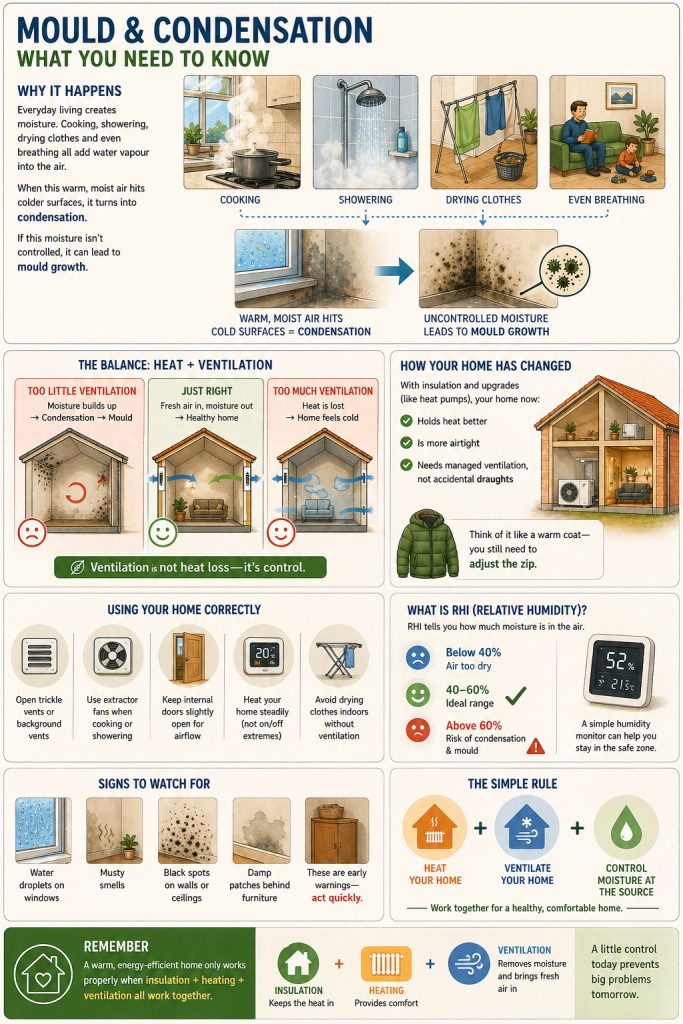
Cooking, showering, drying clothes and even breathing all add water vapour into the air.
When this warm, moist air hits colder surfaces, it turns into condensation.
If this moisture isn’t controlled, it can lead to mould growth.
The Balance!
- Too little ventilation = Moisture builds up → Condensation → Mould.
- Too much ventilation = Heat is lost → Home feels cold.
- Just right, Fresh air in = moisture out → Healthy home.
Ventilation is not heat loss, it’s control.
How retrofit changes our home..
With insulation and heating upgrades, your home now:
- Holds heat better.
- Is more airtight.
- Needs managed and controlled ventilation, not accidental draughts.
Think of it like wearing a warm coat, you still need to adjust the zip if you gret too warm..
USING YOUR HOME CORRECTLY
✔ Open trickle vents or background vents.
✔ Use extractor fans when cooking or showering.
✔ Keep internal doors slightly open for airflow.
✔ Heat your home steadily (not on/off extremes).
✔ Avoid drying clothes indoors without ventilation.
Understanding what goes on behind the scenes!
Interstitial condensation is the formation of liquid water inside the hidden, internal layers of a building’s structure (walls, roofs, or floors) rather than on the visible surface. It occurs when warm, moist air penetrates the building envelope and reaches a cold surface (dew point) within insulation, brickwork, or behind cladding, often causing structural damage, rot, and reduced insulation performance. This is extremely important when internal wall insulation is installed as any failures in design will cause weak points, This allows moisture to venture behind and out of sight. This is why ventilation and attention to design and detail is paramount.
What is Relative Humidity (RH)?
RH tells you how much moisture is in the air.
Take a look at the video below to show you what 100% humidity is like.
- Below 40% → Air too dry.
- 40–60% → Ideal range .
- Above 60% → Risk of condensation & mould .
A simple humidity monitor can help you stay in the safe zone.
Signs to watch out for.
- Water droplets on windows.
- Musty smells.
- Black spots on walls or ceilings.
- Damp patches behind furniture.
What is the Dew Point?
The dew point is the temperature to which air must cool down to become fully saturated with water vapor and start producing dew, fog, or condensation. A higher dew point means more moisture in the air, making it feel stickier and more uncomfortable outside.
Dew point and Relative Humidity (RH) are linked because they both measure moisture in the air, but they do so in different ways: dew point measures the actual amount of moisture, while RH measures how “full” the air is with moisture compared to its capacity at a specific temperature.
REMEMBER.
A warm, energy-efficient home only works properly when:
insulation + heating + ventilation all work together.