Should UK Heat Pumps Be Installed with a Cooling Cycle?
Heat pumps are usually promoted in the UK as an alternative to gas or oil heating. However, many heat pumps can do something else that is becoming increasingly valuable: they can reverse their operation and cool the home during hot weather.
With warmer summers and more homes experiencing overheating, should reversible heating and cooling become a standard consideration when installing a heat pump?
In my opinion, it should at least be discussed during the design process.
A heat pump and an air conditioner are closely related.
A heat pump does not create heat in the same way as a boiler. It uses a refrigeration cycle to collect heat from one place and transfer it somewhere else.
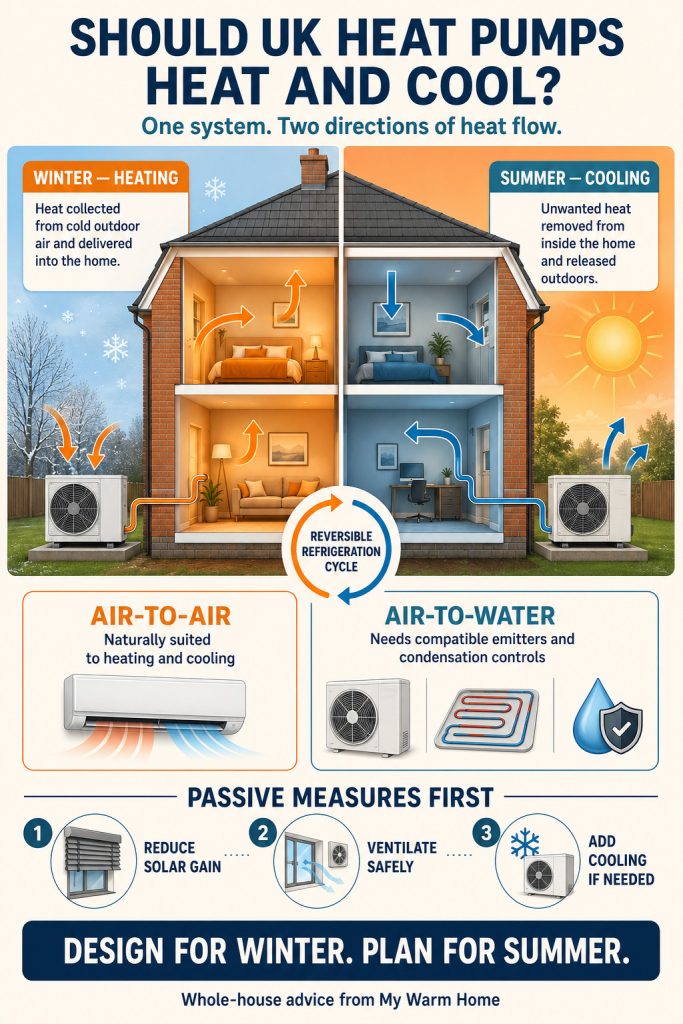
During winter, an air source heat pump collects heat from the outside air and transfers it into the home. A reversible heat pump can change the direction of this process during summer. It then collects unwanted heat from inside the property and releases it outdoors.
This is effectively an air-conditioning cycle.
The technology is not particularly new or unusual. Air-to-air heat pumps commonly provide both heating and cooling. Some air-to-water and ground source heat pumps can also operate in a cooling mode, provided the complete system has been designed for it.
UK homes are beginning to overheat
The UK has traditionally concentrated on keeping homes warm. Insulation, airtightness and improved glazing all help reduce winter heat loss, but summer comfort has not always received the same attention as we have never really had great summers to talk about!
This is changing.
The English Housing Survey found that approximately 2.9 million households reported their homes becoming uncomfortably hot during 2023–24. Overheating was reported in properties of different ages, not only modern homes. English Housing Survey: climate-resilient homes
Highly insulated and airtight homes can retain unwanted summer heat if solar gain, ventilation and shading have not been properly considered. Flats, converted roof spaces, homes with large areas of glazing and properties where windows cannot safely be left open may be particularly vulnerable.
Installing a new heating system without considering how the same property will perform during summer feels increasingly short-sighted.
Does this mean every home needs air conditioning?
No.
Mechanical cooling should not be used as a substitute for good building design. The first stage should always be to reduce the amount of unwanted heat entering the home and provide a safe way for excess heat to escape.
This may include:
- External shutters, blinds or solar shading
- Appropriate glazing and solar-control glass
- Secure night-time ventilation (not leaving a window open)
- Cross-ventilation
- Correctly designed mechanical ventilation
- Insulation that reduces heat transfer through the roof and walls
- Reducing unnecessary internal heat gains
Approved Document O, which applies to new residential buildings in England, follows this general approach. It expects practical passive measures to be considered before mechanical cooling is adopted. Approved Document O: Overheating
However, passive measures will not solve every situation. Some homes cannot be adequately ventilated because of external noise, pollution, security concerns or their physical layout. Vulnerable residents may also require greater control over indoor temperatures.
In these circumstances, carefully designed cooling can be a sensible part of a whole-house comfort strategy.
Air-to-air heat pumps are naturally suited to cooling
Air-to-air heat pumps deliver warmed or cooled air through indoor units. They are closely related to split air-conditioning systems and can normally change between heating and cooling without needing a separate heating circuit.
They can be particularly useful in:
- Flats and apartments
- Smaller homes
- Properties without an existing wet central-heating system
- Bedrooms and converted lofts
- Homes that regularly experience summer overheating
Air-to-air systems do not normally provide domestic hot water, so a separate hot-water system may still be required.
The BUS scheme introduced Air to Air as part of its funding, more info here.
Cooling with an air-to-water heat pump is more complicated
An air-to-water heat pump normally supplies warm water to radiators or underfloor heating. Simply purchasing a heat pump with a cooling setting does not mean the existing heating system can safely or effectively cool the property.
Ordinary radiators provide very little useful cooling. They can also develop condensation if their surface temperature falls below the dew point of the surrounding air.
A properly designed air-to-water cooling system may require:
- Fan-assisted radiators or fan-coil units
- Cooling-compatible underfloor or ceiling circuits
- Dew-point and humidity controls
- Insulated distribution pipework
- Condensate collection and drainage
- Suitable controls and zoning
- Separate heating and cooling design calculations
Underfloor cooling can provide gentle temperature reduction, but it must be carefully controlled. If the floor becomes too cold, condensation may form on its surface or within the construction.
Cooling must therefore be designed as part of the system from the beginning. It should not be treated as a setting that can simply be switched on later.
What do MCS standards say?
Current MCS heat-pump design standards include reversible systems capable of providing both heating and cooling. However, the system must still be designed and optimised for heating. MCS Heat Pump Design Standard MIS 3005-D
That is an important distinction.
A UK heat pump must be capable of meeting the property’s calculated winter heat loss efficiently. Cooling capability should be an additional benefit, not an excuse to compromise the heating design or oversize the equipment.
The heating requirement and cooling requirement should be assessed separately.
Cooling will use electricity
Cooling is not free. Running a heat pump during summer increases electricity consumption, and unnecessary use could create additional costs and increase peak demand on the electricity network.
Good controls are therefore essential.
Cooling should be used to maintain a safe and comfortable temperature rather than trying to turn a UK home into a refrigerator. Solar panels may help supply some of the electricity because cooling demand often coincides with periods of strong sunshine, but generation and demand will not always match perfectly.
Homeowners should understand how to operate the system sensibly and be made aware of the likely running costs before installation.
Our view.
Reversible heat pumps should not automatically be installed in every UK property, but cooling should become a standard question during heat-pump and retrofit assessments.
Before selecting a system, the designer should consider:
- Does the property currently overheat?
- Is overheating likely to increase after insulation or airtightness improvements?
- Can shading and ventilation control the problem?
- Are any occupants particularly vulnerable to high temperatures?
- Is the proposed heat pump capable of reversible operation?
- Can the heat emitters, controls and pipework safely provide cooling?
- Are the homeowner’s expectations and likely running costs understood and affordable?
Where cooling may be required, specifying a reversible heat pump and compatible distribution system during the original installation could be considerably easier than trying to modify the property later.
The future of domestic comfort is not simply about heating homes efficiently in winter. It is about creating homes that remain healthy, comfortable and affordable throughout the year.
A correctly designed heat pump can potentially be part of both solutions, but only when heating, cooling, ventilation, insulation and solar gain are considered together as part of a whole-house plan.