
ENERGY BILLS · HOMEOWNER GUIDE
Updated 25 November 2026. For households in England, Scotland and Wales. Tariff examples use a London comparison snapshot dated 24 November 2026.
Energy prices will rise again on 1 January 2027. Here is what is changing, why it is happening and how to compare fixed deals without overlooking the daily charges.
The change at a glance
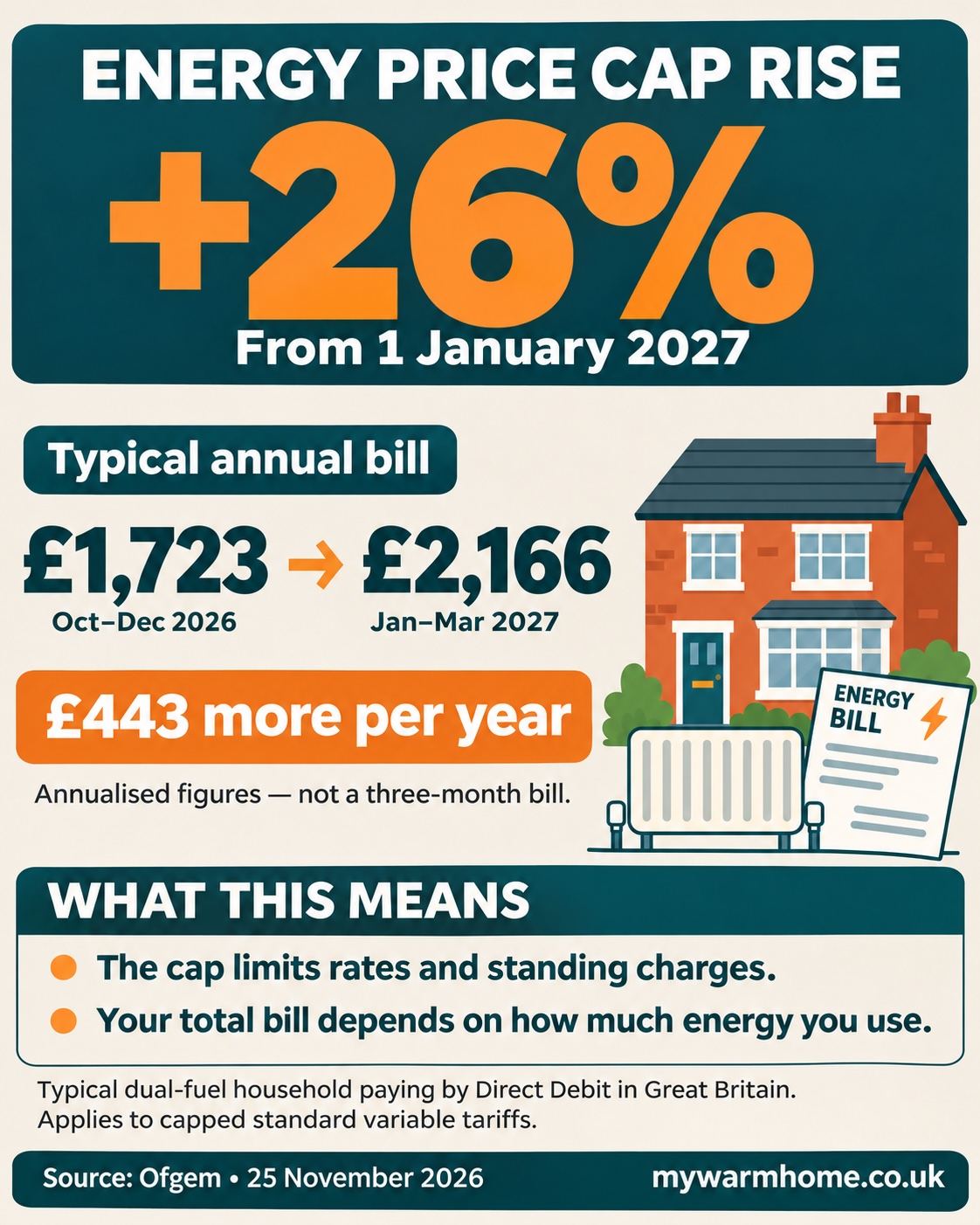
Ofgem has confirmed a 26% increase, taking the typical annualised Direct Debit bill from £1,723 to £2,166 for January to March 2027 — a difference of £443 a year at typical consumption.
The price cap limits rates on covered variable tariffs. It does not limit your total bill. Using more energy means paying more, and the £443 is an annualised comparison, not an extra charge for the three-month period.
Source: Ofgem — confirmed rates and standing charges
What is actually going up?
The main increase is in the price of each unit of energy. Average daily standing charges are almost unchanged.
| Direct Debit average | October–December 2026 | January–March 2027 |
|---|---|---|
| Electricity per kWh | 26.32p | 32.69p |
| Electricity standing charge per day | 54.83p | 54.77p |
| Gas per kWh | 7.97p | 10.96p |
| Gas standing charge per day | 29.68p | 29.65p |
These figures include 5% VAT on gas. Electricity has temporary zero VAT until 30 June 2027.
Why are energy prices rising?
Higher wholesale energy costs are the main driver. Suppliers buy energy before delivering it to households, so wholesale increases feed into bills with a delay.
EDF links the pressure to events in the Middle East and lower-than-expected European gas storage. Gas prices also influence electricity prices because gas is used to generate electricity.
January’s cap reflects wholesale prices assessed during the preceding months. A short-term fall in market prices therefore does not immediately reduce household rates.
Sources: EDF — wholesale market pressures and MoneySavingExpert — how the cap assessment works.
Which companies offer two-year fixed deals?
The examples below use the same London comparison basis: dual fuel, Direct Debit and a single-rate electricity meter. They are regional examples, not nationwide quotes. Availability and tariff versions can change.
Each supplier has separate electricity and gas standing charges. Both are payable every day while those supplies remain connected, even on days when you use no energy.
| Supplier and tariff | Term | Electricity p/kWh | Electricity p/day | Gas p/kWh | Gas p/day | Exit fee: both fuels |
|---|---|---|---|---|---|---|
| So Energy — So Otter 24m | 24 months | 28.19 | 40.51 | 9.16 | 30.21 | £190 |
| British Gas — Fix and Fall Nov28 v3 | 24 months | 28.35 | 40.29 | 9.80 | 28.15 | £250 |
| EDF — Simply Fixed 2Yr Nov28v5 | 25 months | 28.85 | 42.92 | 9.33 | 35.45 | £200 |
| Ecotricity — EcoFixed 2 Year November 26 v1 | 24 months | 27.32 | 46.10 | 9.88 | 29.44 | £195 |
| E.ON Next — Next Fixed 24m v87 | 24 months | 32.74 | 42.92 | 10.78 | 29.52 | £200 |
Shorter alternatives in the same snapshot included Octopus’s 18-month fix at 27.01p/kWh electricity and 9.23p/kWh gas, and Fuse’s 16-month fix at 27.81p and 9.83p respectively. Compare their standing charges and exit fees too.
Source: EnergyPlus — regional tariff snapshot and current comparison
A two-year contract does not always mean fixed prices
A fixed tariff normally fixes your unit rates and standing charges for the agreed term. A tracker can have a two-year contract while its prices continue to change. Check the tariff type as well as its end date.
Your total bill still changes with consumption. Tax changes may also affect what you pay: check how the contract treats the scheduled return of electricity VAT.
Source: Which? — fixed tariffs, trackers and contract conditions
How to compare the cost for your home
Find your last 12 months of electricity and gas consumption in kWh. Use those figures rather than comparing monthly Direct Debits, which can also reflect estimated consumption, account credit or debt.
For each fuel:
Annual cost in pounds = (annual kWh × unit price in pence ÷ 100) + (daily standing charge in pence × 365 ÷ 100).
Add electricity and gas together. Use the tax-inclusive rates on your quote and allow for any scheduled tax change when estimating the full contract cost.
A lower standing charge can help a household that uses little energy. A lower unit rate becomes more valuable as consumption increases. Compare the total using your own figures.
Before you choose a fixed deal
- Get a quote for your postcode, meter and payment method.
- Compare annual costs using the same consumption for every tariff.
- Check the exact end date, exit fees and eligibility conditions.
- Check any exit charge on your existing contract.
- If you have a heat pump, electric vehicle, solar panels or a battery, compare suitable specialist tariffs too.
Fixing can provide useful certainty, but it cannot guarantee the lowest cost over two years. Weigh the quoted price against the length of commitment and the cost of leaving early.
Start with your bill. Then look at your home.
A better tariff can reduce the price you pay for energy. Understanding why your home needs so much heat is another part of controlling costs. Look at its condition, insulation, ventilation, heating and controls together before choosing improvements.
Price note: Supplier figures are a dated comparison snapshot, not personalised offers or a complete market ranking. Recheck rates, tax treatment, availability and terms before switching.