Category: mywarmhome

  • Solar in Depth.

    Solar in Depth.

    The light energy frees electrons, creating a Direct Current (DC) flow of electricity.

    A photovoltaic system consists of PV cells, which are grouped into modules (solar panels) and arranged into arrays.

    They contain cells, usually made of silicon, that release electrons when hit by sunlight, creating a flow of electricity. An inverter converts this power into the standard electricity used for appliances, helping lower energy bills

    Solar PV basics.

    Solar panels provide an eco-friendly and sustainable method for power generation, as they harness sunlight and produce no direct greenhouse gas emissions during use. They are utilized globally to lower electricity costs, reduce dependence on fossil fuels, and minimize the carbon footprint associated with energy production.

    Over the past 20 years, solar power has seen significant advancements in both affordability and technology, including improved energy transfer and storage capabilities. For solar energy to be truly beneficial in the UK, it is essential to either store the generated energy using batteries or feed the excess power back into the grid through energy providers.The system gathers that heat, boosts it, and releases it indoors.

    Different types of solar panels.

    Solar PV (Photovoltaics).
    This is the technology that converts sunlight directly into electricity using photovoltaic cells. These cells are typically made from semiconductor materials, such as silicon, which absorb photons from sunlight and release electrons. This flow of electrons generates direct current (DC) electricity, which can be converted to alternating current (AC) using an inverter for use in homes.
    Solar PV systems can vary in scale from small residential rooftop installations to large solar farms. They are a key component of renewable energy strategies, helping to reduce reliance on fossil fuels and decrease greenhouse gas emissions.

    Solar thermal. This is the technology that harnesses sunlight to produce heat, which can be used directly for heating our water, it can be used commercially to generate steam for industry, but we are looking at domestic systems here. 
    Solar thermal technology is valued for its efficiency in directly using the sun’s energy for heating applications, contributing to lower energy bills and reduced reliance on conventional fuel sources.
    The panels used either have a dark absorbing surface made from polymers or evacuated tubes which look like fluorescent tubes. The evacuated tubes are more efficient in cold climates but can overheat if too hot.

    Installation Guide.

    For any renewable heating or solar project, whether funded privately or through a UK grant scheme, the current best practices, manufacturer’s instructions and relevant building regulations should be strictly adhered to.
    If installed on a UK grant scheme then a quality assurance program that certifies small-scale renewable energy systems and installers need to be followed, currently this is supplied by MCS.

    It is also advised to use MCS installers to mitigate any problems with planning and safety compliance.

    Other companies like the IAA offer microgeneration guarantees too. Most of the time when applying for renewable funding the installation company usually has the mechanism to set up the funding and this should be explained from the start.

    You should NOT have to pay anything upfront or post install unless extras are quoted and agreed. 

    These extras could be, for instance, extra panels, battery connected inverter’s, batteries and possibly EV chargers.
    Get your installers to confirm the process of connecting to your grid supply, which is detailed below. 

    Currently, there are various funding streams, but are typically means tested.
    Have a look at the funding area of the site for more information.

    To achieve effective solar panel installation in line with best practices, MCS standards, and building regulations, please review the following installation and operation guidelines.

    Pre-install.

    Before connecting a solar power system, you must submit a DNO application to the relevant distribution network operator.
    This ensures they can assess and manage the required *electricity capacity. The documentation needed depends on the system’s size, larger systems generally require more paperwork before installation.
    For solar power systems, the standard threshold is 16 amps per phase, determined by the inverter’s AC output. If you’re unsure of the amp rating, consult the installation company’s electricians for guidance.

    Systems with an AC output under 16 amps per phase (less than 3.68kw) can be registered with a G98 form, usually allowing immediate installation. 
    Systems exceeding 16 amps per phase (more than 3.68kw)are classified as large and require prior approval and a G99 form from the DNO before installation.

    Informing your supplier.

    If you’re trying to set up a Smart Export Guarantee with a supplier, they will require documentation like a DNO letter, they may also want a G98 or G99 approval and MCS certificate, They will require an export MPAN (they can usually request this from your DNO). Email your electricity supplier to inform them of the solar installation, give them the exact date of installation even if you have not received your MCS or other documentation. They will then confirm in return and hopefully guide you with the process.

    What is an export MPAN?
    An export Meter Point Administrator Number (MPAN) is an industry reference for a unique 12 or 13-digit reference number to identify where electricity is fed into the grid. It helps to ensure exported electricity is measured accurately and payments/credits owed are assigned to the correct account. This can take your supplier many weeks to retrieve from your DNO. This number is different from your standard MPAN 21-digit number on your bill. We have a section in the blog to explain more.
    More details here.

    Post-install.

    All DC and AC solar cables and isolators Should be labelled throughout the installation. This is a MCS guideline, which we know is not a regulation, but any good installer should complete all the tasks mentioned. 
    Ask the installers if your supplier is being informed. The installers may inform your supplier and pass on the necessary documentation but personally contact your energy supplier by email to confirm.
    PV cables under the panels. These should be secured, so the wiring is not touching the roof. This is to prevent failure, snagging and build up of debris.
    Safe lockable isolation at inverter. DC (black) and AC (red)
    Correct fixing of inverter. Manufactures will state surface mount requirements (fireproof etc).
    Clear diagrams of system to be placed near inverter (schematic diagram). This shows the setup of the system for maintenance and electrical circuits.
    Solar on roof label to be close to main fuse. This is mainly to inform emergency services that DC exists on the roof.
    Monitor meter. Should be installed in a location for ease of access and allow the occupier to be able to monitor the system to check for generation and faults (can be installed into consumer unit). The generation meter light should be blinking in the daylight, if not could be failure, check for warning on inverter. Some inverters are remotely monitored for failure, this should be explained and monitoring contact information left on site.
    Check that your meter is suitable for selling on excess energy. This usually has to be a smart meter and your energy supplier can guide you.
    Panel position. Solar panels should be installed to optimize daylight and eliminate shading, this is typically at a 35° angle facing south. Panels should not extend more than 200 mm from the roof surface and be minimum 400mm from the edge to prevent uplift, latest regulations, MCS guidance and manufacturer installation information should be followed. Flat roofs and pitched roofs have different installation techniques and parameters.
    Solar wizard, a good place to start to check orientation.
    Panel Type. Ask what configuration panels are.
    They could be in series or parallel.
    Protection. Panels may need to be protected from nesting birds or vermin.
    Labels. Cables should be labelled with DC warnings, and this should ideally be visible on each internal and external run.
    All meters and isolation switches should be labelled.
    Ground Panels. If panels are ground mounted, then cables to inverters should be safely and securely routed and labelled. Typically, in ground trenches at a minimum 500 mm. Ground mounted panels should be secured to prevent wind lift. Weighted and secured.
    Earth wires (bonding). Should be fitted to gas meters and water stopcocks. To prevent any electrical current moving to uninsulated pipework in case of failure or damage to the system.
    Planning permission. Typically, not required for domestic solar panel installations. However, planning permission may be required for listed buildings and conservation areas. If using an MCS registered installer, this should be verified for you.

    Series or Parallel.

    Series connection. 

    • Increases voltage, but keeps amperage the same
    • Suitable for high-voltage applications
    • Optimal output at the beginning and end of the day
    • Easier to work on, and requires less expensive wire
    • Sensitive to shading
    • A disruption in a series connection affects the entire system

    Parallel connection.

    • Increases amperage, but keeps voltage the same
    • Suitable for systems with high current requirements
    • Better shading tolerance
    • Panels continue to work independently of each other
    • May require larger cables and additional equipment
    • May increase upfront costs for materials and installation

    Batteries.

    Solar batteries store the extra electricity generated by solar panels, much like how car batteries hold the charge produced by alternators. These batteries allow homeowners to keep surplus energy for later use, increasing energy independence and reliability. They can power household appliances and charge electric vehicles, providing a convenient and sustainable energy solution. Batteries come in different sizes and make-ups. The most popular are lithium-ion, which uses lithium mined from countries like Argentina and Brazil. These batteries have a longer lifespan, store more power in a smaller space and are very efficient.

    Lead-acid batteries can be used, but due to size and poor efficiency, we don’t really see them now on UK systems.
    A new kid on the block is the saltwater batteries, which are an eco-friendly option but have lower power density compared to chemical batteries.

    Benefits.
    When your solar panels produce more electricity than your home or building needs, the excess energy flows into the solar battery instead of being sent back to the grid. This stored energy can be drawn upon when the panels aren’t generating enough power. While the initial cost of solar batteries can be high, they can offer long-term savings by reducing the need to buy electricity from the grid, making them a worthwhile investment if within budget.

    Solar battery systems are usually paired with hybrid inverters, which manage the flow of energy between the solar panels, batteries, and the grid. While initially more costly, they offer significant long-term savings and resilience, particularly valuable in areas prone to outages or with fluctuating energy cost.

    Under the new P63100 standard regarding battery location, the basic premise is that the best place for storage batteries is outside the dwellings and away from habitable rooms. Where it is not practicable to locate batteries outdoors, some basic requirements are provided in P63100
    Batteries shall not be installed in any of the following locations:

    • rooms in which persons are intended to sleep
    • routes used as a means of escape that are not defined as protected escape routes including landings, staircases, and corridors
    • corridors, shafts, stairs, or lobbies or protected escape routes
    • firefighting lobbies or staircases
    • storage cupboards, enclosures, or spaces opening into rooms which persons are intended to sleep;
    • outdoors within 1m of escape routes, doors, windows, or ventilation ports
    • voids, roof spaces or lofts
    • within 2m of stored flammable materials and fuel storage tanks or cylinders; and
    • cellars or basements that have no access to the outside of the building

    Power diverters.

    A power diverter is a device used in solar energy systems to redirect surplus electricity generated by solar panels to power specific appliances in your home, rather than sending it back to the grid. This allows you use of the solar power you generate by directing it to energy-intensive devices. 

    How it works.
    When your solar panels produce more electricity than your home is currently using, the power diverter detects this excess energy and automatically redirects it to a designated appliance (most commonly an immersion heater for hot water).

    This prevents surplus energy from being exported to the grid, where compensation rates can be lower than the cost of grid electricity. Power diverters are usually affordable and easy to install compared to batteries, making them a popular choice for homeowners who want to improve their solar energy efficiency without a large upfront investment like batteries.

    1. Heat is collected from outside (air, ground, or water).
    2. That heat is compressed to raise its temperature.
    3. The warmed heat is delivered to radiators, underfloor heating, blower units, or hot water.
    4. The cycle repeats, quietly and continuously.

    Electrical certificates.

    The two types of electrical certificates you will come across as a customer who is having any electrical work as part of installing EEM’s (energy efficient measures)

    • Electrical Installation.
    • Minor Works Certificate.

    Electrical Installation Certificate.

    An electrical installation certificate is the type of certificate a customer receives after an electrician has installed one or more new circuits. Other examples include a complete rewire, a replacement consumer unit or an additional consumer unit. Generally, any time electrical work is done at the consumer unit, a new installation certificate will be issued.

    Minor Works Certificate.

    A minor works certificate is issued after an electrician has made an alteration to an existing circuit. Minor works certificates are often used to certify work such as adding additional sockets to an existing circuit or increasing the number of light fittings in a room. It can also be where a fused spur has been installed for an appliance or boiler connection.

    Click here for more on regulations.

    Health and safety.

    You may need specialist advice from tradespeople and professionals regarding things like,
    Nesting. Bees, wasps, bats.
    Vermin. Rats, mice, squirrels
    Asbestos. Flues, guttering, facia boards etc.
    If squirrels, rats, or pigeons etc have the potential to nest or shelter under panels then protection will be required. Not only can they damage the panels, but they also tend to gnaw and pull on cables.

    Some older houses may contain asbestos, which only a trained eye can recognise. Never disturb anything you’re unsure about. The health and safety section has more details.

    Your property will have ladders and possibly scaffolding during installation of solar panels so it’s crucial for safety guidelines to be in place, warning signs, pavement ramps etc. Contractors should always explain the dangers and inform you of any changes. 
    If you have close neighbours, then permissions may be needed for access and also approval for works in regard to noise and nuisance during installation (always polite anyway). Gas appliances and ventilation requirements should be carefully considered during the work, especially vertical flues and tile vents for loft ventilation. 

  • Gas Boilers

    Gas Boilers

    Heating systems make warmth.
    Insulation keeps it.
    Controls decide how wisely it’s used.

    Clear, independent advice for a efficient home.

    Heating systems are becoming smarter. Regulations are tightening. Energy-saving technology is evolving rapidly.

    Boilers have provided reliable heating and hot water in the UK for many years, some run on natural gas and some on oil but in principle they all perform the same besides hot water delivery.
    Combination (combi) boilers are the most common.

    Fan. Creates airflow at set values to mix with the gas creating a safe mixture for the burner to operate.

    Gas Valve. The intake mechanisim to make sure the correct amount of gas is supplies to the burner.

    Heat exchanger. This is what makes our heating and hotwater. We have a primary heat exchanger which makes our radiators get warm and with a combi we usually have a plate heat exchanger which uses the central heating water to heat our hotwater but they never mix.

    PCB. The brain, this controlls all the signals from thermostats, gas valves, dials, sensors, apps etc.

    Sensors. Lots of different ones dotted around the boiler. These sense air flow, temperature on different pipes to name a few.

    Hot water storage. Can be basic copper tank that water is supplied via seperate water tanks (vented) or modern sealed unit that works under pressure (unvented)

    Programmers/Thermostats/Controls. From hard wired to wireless to app connected. some are all in one and some stand alone. (tado, nest etc). They tell our radiators, hotwater and our boilers when to come on and off, what temperature to heat up to and modern controls can fault find.

    Zone Valves. Can control the heating in different zones, ie upstairs and downstairs.

    We have a fault finding section so take a look if troubleshooting. remember only a Gas Safe engineer can work on gas appliances.

    Boiler Types.

    All boilers provide heating the same way.
    Water is pumped around our radiators or underfloor heating.
    The hotwater demand is different for each of the common UK boiler types.

    1. Combi. Delivers heating and hot water from one unit. Pumps etc inside the main unit.
    2. System. Will have seperate hotwater storage but pumps etc inside the main unit
    3. Regular (conventinal). Will have seperate hotwater storage, pumps, valves and controllers are external from main unit.

    A Combination (Combi) Boiler can delivers both central heating and hot water directly from the mains, working much like a high-powered, on demand kettle.

    It heats water almost instantly whenever a tap is opened, removing the need for a separate hot water cylinder or cold-water storage tank.

    Pros.

    • Saves space
    • Easier to install than regular or system
    • All components within one unit
    • Huge amount of manufactures and options

    Cons.

    • Hot water delivery can be slow due to system and property design
    • They need good mains pressure
    • They don’t have an immersion heater as backup
    • They don’t usually work with power or older type showers
    • They don’t usually let you use multiple showers or taps at the same time.*

    Operation. Combi boilers work by the use of demand switches and valves (typically flow switches or diverters) for the hot water, so when a hot outlet is opened (tap, shower) a sensor recognises a flow and puts the boiler into hot water operation.

    The heating side is controlled either by external room thermostats, individual radiator thermostats or built in controls. 

    Many people assume combi boilers provide “instant” hot water, but that’s not truly the case.
    Heat loss, water wastage due to long pipe runs, and pre-heat settings can all affect performance and perceived efficiency.

    A System Boiler can deliver both heating and hotwater but the hot water side of the system is seperate.

    It heats water via a stored hotwater tank, the main components like the pump, diverter valves etc, are within the boiler unit.

    Pros.

    • Excellent for homes with multiple bathrooms and high hot water needs*
    • No need for a cold water tank in the loft
    • An electric immersion heater can be installed in the tank, providing hot water even if the boiler breaks down
    • Some models can work with solar thermal
    • Easier to install than regular boiler
    • All main components within one unit.

    Cons.

    • Requires a dedicated space for the hot water tank.
    • Hot water can run out if the cylinder is emptied, requiring a 20-30 min reheat time.*
    • Higher installation cost compared to combi boilers.
    • Less suitable for homes with limited space

    Operation. System boilers work by the using valves, sensors and switches to recognise flow, so when a hot water setting is chosen the boiler begins to heat up the stored hot water. The hot water can take a bit of time to get up to temperature if the household has high demands. The heating is controlled via thermostats/programmers externally or built into the unit.

    A Regular Boiler can heat external stored water and will have same components but may not be pressurised. It will have external componants like pumps, diverter valves and expansion vessels.

    It heats water via a stored hotwater tank, the main components like the pump, diverter valves etc external of the boiler unit.

    Pros.

    • Supplies hot water to multiple taps or showers simultaneously without significant pressure drops.
    • Works well in areas with low mains water pressure.
    • Excellent for older properties with existing traditional heating systems.
    • An electric immersion heater can be installed in the tank, providing hot water even if the boiler breaks down.
    • Easily integrated with solar thermal energy systems

    Cons.

    • Needs space for a hot water cylinder (usually airing cupboard) and a cold-water storage tank in the loft.
    • Hot water is limited to the capacity of the cylinder; if it runs out, you must wait for it to reheat.*
    • Hot water stored in the cylinder can lose heat if not properly insulated, leading to higher energy bills.*
    • Takes time to reheat water after the cylinder empties.
    • More complex and costly to install due to additional tanks and pipework.

    Operation.

    Regular boilers work by the use of external diverter valves (2 port or 3 port depending on design), so when a hot water setting is chosen the boiler begins to heat up the stored water. Depending on household demands, design is a major factor of having enough stored hot water to satisfy needs*.
    The heating is controlled via external thermostats/programmers or built into the unit.

    *As with any heating system, real efficiency depends on the quality of the design and installation.

    *Whenever stored hotwater is part of the system then a real life design has to be taken into account, this will look at factors like occupation, showering and bathing habits, work patterns and demand. With modern systems an anti bactarial function is incorperated into the design.

    Handy Notes.

    Combi boiler.
    The flow rate will dictate the hot water delivery.

    If you have more than 1 Hot Water outlet that will be used simultaneously (2 showers for example) then look for a boiler with a higher flow rate (litres per minute).

    The KW of combi boilers is down to hot water demand.

    Its not always the size of house! If more than one bathroom then more hot water delivery may be required.

    The rule of thumb in the trade is to treat each radiator as an average 1.5kw, so 10 radiators would need a 15KW boiler at minimum!

    Hot water on a combi takes precedence over heating.

    A diverter valve is present that fully switches when a tap or shower is used, meaning the heating is in off mode.

    Combi boilers are pressurised, so think pressure cooker! It has a safety pipe (fed by a safety valve) that comes out of the back to the outside (usually a little copper pipe externally behind the boiler location) or into a tundish. This will let off excess pressure if a build up happens, just like a pressure cooker does, remember hot water expands and boilers are sized to handle a general expansion, this may need to be upgraded on the system depending on number and size of radiators.

  • Calculator For Radiator Sizing.

    Calculator For Radiator Sizing.

    UK Radiator Selector Tool (we have used stelrad radiators for this)

  • Complications of controls

    For someone used to a simple dial thermostat, navigating icons, settings, and scheduling interfaces can feel unnecessarily complex.

    Controls for modern heating systems are often designed with flexibility in mind—but that flexibility can come at the cost of usability, particularly for older homeowners. Many systems now rely on layered menus, small touchscreens, or app-based controls that assume a level of digital confidence that not everyone has. For someone used to a simple dial thermostat, navigating icons, settings, and scheduling interfaces can feel unnecessarily complex. Even basic adjustments like increasing the temperature can become frustrating if they’re buried behind multiple steps.

    There’s also a strong reliance on smartphones and apps, which doesn’t always reflect reality. A significant number of older people either don’t use smartphones at all or use them in a very limited way. Small screen sizes, poor contrast, and fiddly controls can make apps difficult to read and operate—especially for those with reduced eyesight or dexterity. On top of that, concepts like Wi-Fi connectivity, accounts, and software updates can create barriers that simply don’t exist with traditional controls. When heating becomes dependent on an app, it can leave some users feeling locked out of their own system.

    Technology awareness plays a big role too. Many modern interfaces assume familiarity with common digital behaviours, swiping, tapping icons, navigating menus, but these aren’t universal skills.
    For older users, there can be a lack of confidence in “trying things,” especially when there’s a fear of pressing the wrong button and causing a problem. This often leads to systems being left on default settings, or worse, used incorrectly, impacting both comfort and efficiency.

    So what’s available? Encouragingly, there are still more accessible options. Some manufacturers offer simplified thermostats with large buttons, clear displays, and minimal menus, focusing only on core functions like temperature up/down and on/off.
    Others provide wired controls that stay in a fixed location, avoiding the need for apps altogether. There are also programmable thermostats with physical buttons and high-contrast screens, designed specifically with readability in mind. In more advanced systems, it’s sometimes possible to pair a smart setup with a basic user interface for day-to-day use, leaving the more complex controls to installers or family members if needed.

    Ultimately, good design should work for the person using it, not the other way around. When specifying heating controls, it’s just as important to consider usability as it is efficiency. A system that’s easy to understand and operate will always perform better in real life than one packed with features that never get used.

  • Technical side of Heat Pumps.

    Technical side of Heat Pumps.

    Heat pumps move energy so we can heat our homes and provide hot water.

    Consider a heat pump to be a heat mover, not a heat maker.

    The technical side of heat pumps can be somewhat confussing as grasping the idea that we create heat from cold air still baffles most of us. Hopefully this section will shed some light and hep with understanding. We also include some regulations and the “best practices”.

    The Science.

    To understand how heat pumps work, we need to cover some basic physics. At a temperature of 0°C (273 K) and a pressure of 1 atmosphere (average sea level pressure), water freezes.

    This condition is known as “Standard Temperature and Pressure (STP)”. While temperatures can drop below 0°C, the theoretical lowest possible temperature is called absolute zero.

    At absolute zero (0°K*, -273.15°C, or -460°F), there is no molecular motion and no heat energy within the medium.

    This understanding highlights an important fact: even when it feels freezing outside, the air, water, and ground still contain heat energy. 

    The key is finding a way to extract that heat and transfer it to a usable medium, such as radiators.
    This is where refrigerants come into play. Instead of water circulating within the heat pump (like we would have in a gas boiler), a refrigerant (see below) is used.

    These refrigerants absorb heat from the outside environment, even at low temperatures, and their temperature increases as they change state.

    Heat pumps come in three main types:

    Air Source. (ASHP)

    Water Source. (WSHP)

    Ground Source. (GSHP)

    How it works! All heat pumps. 

    Heat pumps move heat from the selected source into a building through a refrigeration cycle. Whether its air, ground or water they all work on the same principe but with different installation techniques.
    ASHP use units outside that look like air condition units (they basically are).
    WSHP use coils or matts submerged in water and GSHP use horizontal loops spread over a open space at a depth of around 2m or vertical loops bored deep at around 100m.
    The heating side is the same and designed to suit the property and personal preferences.

    Properties need to be well insulated to reap the full benefits and cost savings. Radiators should ideally be a size and rating to match the system and property requirements. The delta rating of radiators is becoming more important in the system design.
    Most new builds and retrofitted properties opt for underfloor heating systems, as they naturally run at a lower temperature.

    Now that you know a bit about Delta T, you can see how important it is to size a heating system correctly for your home.
    If the heat pump is too small, it will have to work too hard and may struggle to keep up.
    If it’s too large, it will use more electricity than necessary.
    The aim is to find the right balance between comfort and running costs, something that’s possible with good design and by using the system the right way.

    It works a bit like a fridge in reverse:

    • A fridge pulls heat out of food and dumps it into your kitchen
    • A heat pump pulls heat from outside and dumps that heat it into your home (that’s why the back of a fridge is always warm)

    How it actually warms your house.

    1. Heat is collected from outside (air, ground, or water).
    2. That heat is compressed to raise its temperature.
    3. The warmed heat is delivered to radiators, underfloor heating, blower units, or hot water.
    4. The cycle repeats, quietly and continuously.

    You may ask how can heat energy be in cold water, the ground or cold air? Well thats the confussing part that can be hard to understand. Heat is always around us, even when it feels cold. The air, the ground and water all contain natural heat energy because they’ve absorbed warmth from the sun and the earth over time. Even on a chilly day, there is still energy in the air, it’s just at a low temperature.
    Modern heating systems like heat pumps don’t create heat from scratch; they simply collect this existing, low-level warmth and concentrate it to a higher temperature that can be used to heat your home. So instead of making heat, we’re just capturing and upgrading the heat that’s already there.

    Some heat pumps can be 400% efficient.

    When people say a heat pump is “400% efficient”, it doesn’t mean it’s magically creating energy. It means for every 1 unit of electricity you put in, you get about 4 units of heat out. Abbreviations like “SCOP (seasonal coefficient of performance” and “COP (coefficient of performance)” are used and this is where the % comes from.

    • COP = today’s efficiency
    • SCOP = the yearly average efficiency

    SCOP is the number that really matters for running costs.

    The Different Types of Heat Pumps.

    To determine if a heat pump is suitable for your property, you can consult the UK government’s suitability guide.
    The MCS best practice is here.

    The primary types of heat pumps used in the UK include:

    • ASHP: Air Source Heat Pumps.
    • WSHP: Water Source Heat Pumps.
    • GSHP: Ground Source Heat Pumps.

    A hybrid system is another option to consider, where a fossil fuel-powered boiler (like gas) works alongside a heat pump. This setup can help meet increased heating demands during the colder winter months while still reducing overall reliance on non-renewable energy sources

    Although all heat pumps work on the same principle, they collect heat in different ways:

    • Air Source Heat Pumps (ASHP)
      These draw heat from the outside air using a unit that looks similar to an air conditioner — because it almost is one, just working the other way around.
    • Water Source Heat Pumps (WSHP)
      These collect heat through coils or mats placed under the surface of a pond, lake, or river.
    • Ground Source Heat Pumps (GSHP)
      These use long loops of pipe buried in the ground — either horizontally about 2 metres deep or vertically down boreholes reaching around 100 metres.

    This technology is new to many of us, and it needs to be used a little differently.

    During the heating season, it’s best to control your home’s temperature rather than demand it. In other words, let the system maintain a steady temperature instead of turning it off and on all the time. It’s more efficient (and cheaper) to let the heat pump gently adjust the temperature up or down.

    Most modern systems use outdoor temperature sensors to help with this. These sensors measure the air temperature outside and tell the heat pump how much heat your home is likely to need. On mild days, the system runs at a lower level; when it’s colder, it automatically increases output. This helps your heat pump work in tune with the weather — keeping your home comfortable while using less energy overall.

    Things to consider ASHP (other heat pumps in main section).

    Position

    Away from sleeping and noise-sensitive areas. (newer ASHPs are very quiet).
    Making sure the area around the heat pump is to manufacturers guidance to allow optimum airflow and service needs.

    Condensation removal. 

    Water will come from the unit and can pool. It’s not the same as gas boiler condensate, which can be acidic, so just basic removal to soak away or drain, depending on the manufacturer’s instructions.

    Radiator sizes and pipework. 

    Heat pumps work at lower temperatures, so a bigger surface area, ideally underfloor heating, is beneficial. (see delta T in technical area)

    Insulation of property. 

    The better the wall and loft (or room in roof) insulation, the less heat loss.

    Uninsulated pipework. 

    Bathroom supplies and central heating pipework at the plant should all be insulated. All external pipework should be insulated with a class 0 UV protected insulation.

    Maintenance requirements. 

    Please refer to manufacture guidance as maintenance period may affect warranties. In a ideal world you shoul get external ASHP serviced every year after the heating season. A good clean and check that the unit is in good condition is a must.

    Running costs. 

    What is the average yearly cost to run the heat pump! This can be really important, and research and information from your installer is a must. 

    Heat Pump Running Cost Calculator

    Heat Pump Running Cost

    Daily Cost: £0.00

    Solar matching. 

    As heat pumps operate differently through the seasons, the same goes for solar. If you are having solar PV installed thinking the panels will run the heat pump, then think again. You could try to match the solar generation to the heat pumps output, which could help with running costs.

    Understanding Heat Pump Efficiency: SCOP and COP.

    When looking at heat pumps, you’ll often see the terms COP and SCOP. These are simply ways of measuring how efficiently your system turns electricity into heat.

    COP — Coefficient of Performance.

    For example, a COP of 4 means that for every 1 unit of electricity the heat pump uses, it provides 4 units of heat.
    However, real life isn’t always perfect — temperatures change, systems switch on and off, and conditions vary throughout the year. That’s where SCOP comes in.

    It takes into account:

    • Changing outdoor temperatures as the weather warms and cools.
    • Energy used during standby and defrost cycles.
    • How efficiently the system runs at different power levels.

    In short, SCOP tells you how efficient your heat pump is across the whole year, not just in ideal lab conditions.

    How is SCOP Is Calculated?

    SCOP compares how much heat energy your system produces with how much electricity it uses:

    Example.

    If your heat pump has a SCOP of 4, that means for every 1 kWh of electricity it uses, it provides 4 kWh of heat.
    That’s why people often say a heat pump can be “400% efficient” — it’s not creating energy, just moving it very efficiently.

    Privately installed or funded?

    For any renewable heating project, whether funded privately or through a UK grant scheme, the current best practices, manufacturer’s instructions and relevant building regulations should be strictly adhered to.
    If installed on a UK grant scheme then a quality assurance program that certifies small-scale renewable energy systems and installers need to be followed, currently this is called MCS if insulation is being carried out at the same time and as part of the funding then it must meet the current PAS

    Have a look at the funding area of the site for more information especially the changes to the ECO scheme.

    Installation Guide.

    The manufacturer’s instructions will highlight any regulations that are required. Currently, all electrical regulations need to be followed and documented, as is the MCS checklists if installed on government scheme. Requirements are that properties are well insulated prior to the installation (fabric first approach) and full heat loss calculations are carried out to provide information to install the system to best practice.

    If hot water is being heated in storage tanks by the heat pump then steps need to be taken to protect from bacterial growth. Stored hot water systems connected to heat pumps have cycles to heat the water at given times and a given temperature to stop the growth of Legionella bacteria.

    Electrical certificates.

    The two types of electrical certificates you will come across as a customer who is having any electrical work as part of installing EEM’s (energy efficient measures)

    • Electrical Installation.
    • Minor Works Certificate.

    Electrical Installation Certificate.

    An electrical installation certificate is the type of certificate a customer receives after an electrician has installed one or more new circuits. Other examples include a complete rewire, a replacement consumer unit or an additional consumer unit. Generally, any time electrical work is done at the consumer unit, a new installation certificate will be issued.

    Minor Works Certificate.

    A minor works certificate is issued after an electrician has made an alteration to an existing circuit. Minor works certificates are often used to certify work such as adding additional sockets to an existing circuit or increasing the number of light fittings in a room. It can also be where a fused spur has been installed for an appliance or boiler connection.

  • Health and Safety.

    Health and Safety.

    Where qualified professionals are appointed, their crews should hold the appropriate UK certifications

    Health and safety Basics.

    Health and safety must always be the foremost consideration in any building or home-improvement project. This helps safeguard all individuals on site and protects the property and its surroundings. You should always refer to the most up-to-date UK regulations and statutory requirements, including the Health and Safety at Work etc. Act 1974, the Construction (Design and Management) Regulations (CDM), and relevant Building Regulations, as needed.

    Where qualified professionals are appointed, their crews should hold the appropriate UK certifications, follow industry best practice, and comply with all current legal duties and standards.

    Below, we outline guidance on the typical requirements for both privately funded and government-funded installations.

    Asbestos.

    Asbestos is a naturally occurring mineral that was commonly used in building materials due to its heat resistance, durability, and insulating properties. It can be found in homes built before the 1980s, though it was used in construction and renovation well into the 1990s in some areas. Asbestos is typically found in materials like insulation, roofing, flooring, ceiling tiles, pipes, and even some adhesives.

    When intact and undisturbed, asbestos poses little risk to health. However, if it is damaged or disturbed, such as during renovations or repairs, tiny asbestos fibres can be released into the air. Inhalation of these fibres can lead to serious health issues, including lung cancer, asbestosis (a scarring of the lung tissue), and mesothelioma (a rare form of cancer linked to asbestos exposure).

    If you suspect that your home contains asbestos, it’s crucial not to disturb it and to contact a professional for testing and safe removal if necessary. Below image and reference from the HSE.

    Inside. 

    Asbestos insulating board (shortened to AIB)

    A. AIB around boiler.
    B. Toilet cistern.
    C. Vinyl floor tiles backed with asbestos paper and bitumen adhesive.
    D. AIB or asbestos cement bath panels.
    E. AIB ceiling tiles.
    F. AIB airing cupboard and/or sprayed insulation coating boiler.
    G. Pipe lagging.
    H. AIB partition wall.
    I. Asbestos cement water tank.
    J. AIB behind fuse box.
    K. Textured decorative coating, for example Artex.
    L. Loose fill insulation.
    M. AIB behind fire.
    N. AIB or asbestos cement interior window panel.

    Outside.

    Asbestos insulating board (shortened to AIB)

    1. AIB or asbestos cement soffits and fascias.
    2. Roofing felt.
    3. Asbestos cement roof tiles/slates.
    4. Asbestos cement panels.
    5. Profiled asbestos cement sheeting.
    6. AIB or asbestos cement exterior window panel.
    7. Gutters and asbestos cement downpipes.

    Gas and open flued appliances.

    If the fabric of the property is being improved and open-flued gas appliances exist, then a gas spillage test should be carried out on each appliance by a suitably competent operative. 
    Rules exist that give an average unimproved property a certain amount of leakiness (adventitious air) to allow open-flued appliances to operate safely.
    This all depends on how much fuel burns over a period of time, for example: 7.5kw/hr, 9kw/hr, 6.9kw/hr. You will see this on the data badge of the appliance (gas rating of an appliance here.).

    The more fuel used, the more leakiness is needed. Multifuel appliances are treated in roughly the same way but do not come under gas safe legislations. HETAS and building regulations govern multifuel installations and ventilation.

    This is the reason combustion ventilation is sometimes needed. This allows the air to be replenished (with an open flued appliance we are burning the oxygen in the room that we use to breathe)

    With the introduction of insulation, extraction ventilation should be installed as part of the process, we now have a different factor to add in with gas safety. Extraction fans either pulling or pushing air (PIV) can now effect the performance of the appliance.

    Open flued gas appliances should be checked to prove they are not spilling products of combustion into the property. This is verified by performing a spillage test.

    Part J states. “Extract fans lower the pressure in a building, which can cause the spillage of combustion products from open-flued appliances. This can occur even if the appliance and the fan are in different rooms”.
    Any funded insulation work now includes ventilation upgrades as part of the current PAS, so extract ventilation will be installed. This should have been factored in as part of any ventilation work carried out.
    competent person is required to perform spillage tests.

    Part B, 8(1) of the Gas Safety (Installation and Use) Regulations 1998 states that no person can make any changes to a premises that contains a gas fitting or storage vessel if the changes would compromise the safety of the fitting or vessel.
    This basically means if the fabric of the building (walls, floors, roofs) are being insulated then appliances need to be checked by a suitably competent and qualified person. 

    Electrical.

    Electrics within insulation need to be protected in a way set out by the current regulations. Any high-powered cables that enter insulation either through walls, under floors or within lofts need to be verified as being safe to pass through. If they cannot deem to meet regulations, then they need to be removed out of the insulation or derated. Usually the most common high-powered cables you will find on domestic insulation work will be from main fuse board or through loft space to supply electric showers, electric storage heaters and cooking appliances. Non-fire rated downlights can’t be covered directly with insulation, so fire retardant covers may be required.

  • Thermal Values explained.

    Thermal Values explained.

    Some quick values.

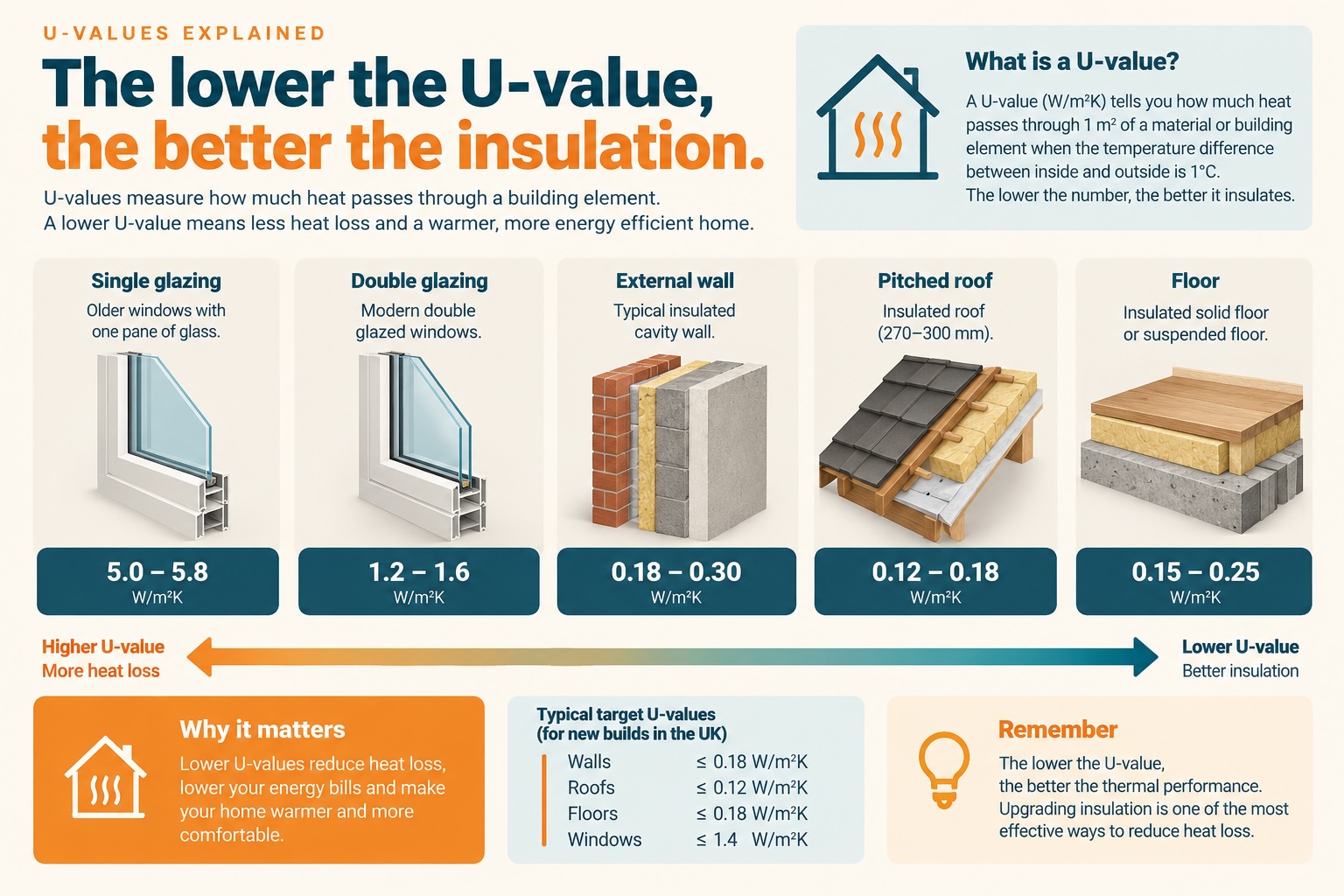
    U-values for existing dwellings.

    • Roofs: 0.16 W/m²K
    • Walls: 0.30 W/m²K
    • Floors: 0.25 W/m²K

    U-values for windows and doors.

    • Doors with over 60% glazing: 1.2 W/m²K
    • Other doors: 1.0 W/m²K, with a limiting value of 1.6 W/m²K
    • Replacement windows: 1.4 W/m²K or a B for its window energy rating (WER)

    Insulation basics.

    When insulating our homes, there are crucial factors to consider, ensuring optimal energy efficiency, comfort, maintaining moisture balance and compliance with building regulations.
    Effective insulation can significantly reduce energy costs, enhance indoor comfort, and contribute to environmental sustainability. However, selecting the right insulation involves more than just picking a material off the shelf.

    Key considerations include understanding thermal values, moisture control, wall types, historical context and the specific properties of different insulation materials.

    By carefully evaluating these aspects, homeowners can make informed decisions that suit their unique needs and conditions, ultimately creating a well-insulated, energy-efficient living space. 

    The first approach to make our homes warmer and more sustainable is to insulate before we install or upgrade to a new heating system, this not only allows us to save money* but approaches the property as our own personal ecosystem that we need to understand and maintain. If employing a contractor to install insulation then make sure they have the right qualifications, assurances, insurances and ideally be a member of the National Insulation Authority.

    *Reducing the escape of heat from our properties, reduces the heating load, thus saving on fuel.

    Types of insulation.

    Insulation comes in all different shapes, sizes and composition, each performs to a required need and development is ongoing as we try to become more sustainable.

    Below is a very brief list. Each section throughout the site goes into more details.

    • Wall insulation. Can be applied, sprayed, filled, fixed and even wall papered! 
    • Floor insulation. Can be fitted, laid, filled and even sprayed by robots.
    • Loft insulation. Can be fitted, sprayed or rolled.
    • Pipe insulation. Can be pre fitted, wrapped, sleeved, waterproof and fireproofed.
    • Flat roof insulation. Can be laid, sprayed.

    Insulation can come as closed cell and open cell. Each section will go into more detail.

    Thermal Values.

    All insulation should have details of its R-value either on its packaging or specification information.
    By having the details of the R-Values, you can work out the U-values, which you usually need for calculating the building regulation compliance thresholds.

    R-Value.

    Definition. The R-value measures the resistance of a material’s thermal resistance. It’s very much like a TOG value we have with sleeping bags and duvets! 
    Higher Is Better. The higher the R-value, the better the material insulates.
    Usage. Used to rate the effectiveness of insulation materials. Commonly seen in products like fibreglass batts, loft roll insulation, foam boards, and spray foam insulation.
    Units. Typically, measured square meters Kelvin per watt  (m²·K/W)

    U-Value.

    Definition. The U-value, also known as thermal transmittance, measures how well a material or building element conducts heat (or insulates). It is the rate of heat transfer through combined materials or a structure.
    Lower Is Better. The lower the U-value, the better insulation.
    Usage. Used to rate the effectiveness of combined insulation and materials.
    Units. Typically measured in watts per meter per degree Kelvin (W/m²·K).

    K-Value.

    Definition. The K-value, also known as Lambda (λ) measures how well a material conducts heat. It is the rate of heat transfer through specific materials.
    Usage. Used to rate the effectiveness of materials, mainly used by material scientists and designers of products used in the building industry. 
    Units. Typically measured in watts per meter per degree Kelvin (W/m·K).

    Why is R-Value Important?

    Higher R-value means better insulation, which helps keep your home warmer in the winter and cooler in the summer. This can lead to lower energy bills because heating and cooling systems don’t have to work as hard.

    Comparing two insulations examples: 

    • 100mm mineral loft roll: Has an R-value of 2.50. (earthwool etc)
    • 100mm PIR rigid board: Has an R-value of 4.30. (kingspan etc)

    Rigid PIR boards can be installed at a reduced thickness, it insulates better because it has a higher R-value.

    Why is U-Value Important?

    The U-value, also known as thermal transmittance, measures how well a material or building element conducts heat.
    It is the rate of heat transfer through combined materials or a structure. The U-value is expressed in units of watts per square meter per degree Kelvin (W/m²·K).

    The U-value represents the overall heat transfer coefficient of an element, whether it be insulation, building fabric, or even air. It is calculated as the *reciprocal of the total thermal resistance (R-values) of all layers within the element.
    Lower U-values indicate better insulation performance. When we look at building regulations, it is usually the U-Value that needs to be met.

    Choosing Insulation.

    For a space with limited depth, like a suspended timber floor with 125mm joists we need to look at insulation products with a higher R value but a consideration to thickness, PIR boards would be a better choice for underfloor insulation because it provides better insulation in a thinner layer and would fit within the 125mm joists to meet regulations.
    If there’s more space, let’s say 250mm joists, mineral wool could be a good option, even though it needs to be thicker to meet the same insulation standards, it’s easier to fit and cheaper. 

    We may not be able to physically fit insulation around window reveals and doorways due to openings and possibly fire regulations, so thinner materials may need to be used like Aerogel. The insulation choice will usually be determined by cost and system design, but also by the makeup of the space we are trying to insulate, especially with older traditional buildings. 

    Understanding Heat Resistance.

    Everything around us has some resistance to heat transfer. The R-value is a way to measure this resistance, helping us choose the right materials to keep our homes comfortable and energy-efficient.

    How to calculate.

    To calculate the U-value of a building element, sum up the R-values of each layer and then take the reciprocal of the total resistance: 

    This process applies to all insulation materials, although U-value calculations can become more complex with multiple materials and if external / internal temperatures are involved.
    For example, walls and floors consist of various *layers with differing properties, these will require consideration of each layer’s R-value and any air gaps present. Additionally, noticeable temperature differences in different parts of the country must also be taken into account. A basic bit of maths should give you an idea what should and could be installed.

    * different layer examples are, wood, plasterboard, plaster coat, brick, thermal brick, air etc.

    Practical Example.

    Let’s consider insulating under a suspended floor to meet a regulation that specifies a U-value of 0.25 W/m²K.
    Using mineral loft roll with an R-value of 2.25 W/m²K and rigid PIR with an R value of 4.30 W/m²K.


    With 100mm of loft roll: 𝑈 value = 1 / 2.25=0.44 W/m²·K (not meeting regulations)
    With 150mm of loft roll: 𝑈 value = 1 / 3.40=0.29 W/m²·K (not meeting regulations)
    With 200mm: 𝑈 value = 1 / (2.25+2.25)=0.22 W/m²·K (exceeding building regulations)
    With 100mm of PIR between joists: 𝑈 value = 1 / 4.30=0.22W/m2KU (meeting building regulations)

    U value calculators are available from most suppliers, some are listed and linked below. Our own will be coming soon.
    Kingspan
    Knauf
    Ecotherm
    Superglass

    Pipe insulation.

    Pipe insulation is applied to pipes for the purpose of the following:
    Regulate temperature. Prevent heat loss or gain.
    Reduce energy costs. Pipework for heating and hot water loves to give off heat, so adding insulation reduces the heat loss, thus saving fuel.
    Frost protection. Pipework in unheated areas and condensate pipework.

    Pipe insulation is commonly used in residential, commercial, and industrial settings, with materials ranging from foam and rubber to fibreglass and mineral wool, tailored to specific applications and environmental conditions. We are only concerned with the pipe insulation we would use in our homes.

    Polyethylene foam pipe insulation.

    (Climaflex)

    Polyethylene foam pipe insulation is a lightweight, flexible material used to insulate pipes. It is made from closed-cell polyethylene foam. This type of insulation is commonly used in residential and commercial plumbing systems to reduce heat loss or gain, lower energy costs, and help prevent pipe corrosion.

    Polyethylene foam pipe insulation is easy to install, typically available as pre-slit tubes that can be wrapped around pipes, and comes in various diameters and thicknesses to suit different pipe sizes and insulation needs. It is particularly well-suited for indoor applications.

    Applications.
    Internal hot and cold water supplies, central heating.

    Class “O” Foam Rubber Insulation.

    (Kaiflex, Armaflex, NMC, Thermaflex)

    Class O foam rubber insulation is a type of flexible insulation material designed for thermal and acoustic applications. It is made from nitrile rubber or similar closed-cell materials, offering excellent thermal resistance, moisture control, and fire safety properties.

    Thermal Insulation. It provides effective thermal resistance, reducing heat loss or gain in pipework, ductwork, and equipment.

    Moisture Resistance. The closed-cell structure prevents water vapour penetration, reducing the risk of condensation and corrosion under insulation (CUI).
    Durability. It can be resistant to UV, ozone, and mechanical damage, ensuring long-term performance in both indoor and outdoor environments. Some products come with full UV protection and some need to be coated.

    Applications.
    Hot water storage pipework, domestic plant rooms, heat pump circuits (internal and external), and external condensates.

    EPDM Foam Rubber.

    (Kaiflex, Armaflex, Zotefoam, Insul-tube by NMC)

    EPDM rubber insulation is ideal for outdoor, high temperature and solar pipework use. The insulation has an in-built UV protective layer, meaning it can be installed outside without any further treatment or coverings.  This insulation is also suitable for high-temperature pipework (up to 150 degrees Celsius), making it ideal for use on solar heating systems.  The insulation is available in 2 metre unsplit tube lengths, long coils and flat sheets in a range of thicknesses.
    Applications.
    Heat pump external pipework, external condensate, solar.

    Other insulations include.

    Mineral Fibre Insulation. Foil Coated – Rock wool (HVAC and ducting)
    Phenolic Foam Insulation.  Foil Covered – Kingspan Kooltherm (HVAC and ducting)
    Thermal ducting made from EPP material is a system of ducts and fittings for domestic mechanical ventilation with heat recovery (MVHR)

    Regulations.

    In the UK, insulation is covered by Part L of the Building Regulations, which focuses on the conservation of fuel and power

    Click here for more on regulations

    PAS 2035 is a comprehensive standard and not a regulation. It was introduced in 2019 as part of the UK government’s commitment to improving energy efficiency in buildings. If work being carried out on a UK funded scheme then the current PAS should be followed aswel as building regulations.

    Click here for more on current PAS

  • Technical Monitoring.

    Technical Monitoring.

    Technical Monitoring. Why It Matters for Your Home.

    If you’re considering or had insulation, a heat pump, or upgrades through schemes like ECO4 or the Boiler Upgrade Scheme, you’ve probably (or have been) told how much warmer and cheaper your home will be to run.

    At mywarmhome.co.uk, we’ve seen first-hand that the difference between a great upgrade and a problematic one often comes down to one thing technical monitoring.

    What Is Technical Monitoring?

    Technical monitoring is simply having an independent expert check that the work being done in your home is actually correct to current regulations and best practices..

    Not just:

    • “Has a boiler been installed?”
    • “Has insulation been fitted?”

    But:

    • Has the heating system been installed to regulations?
    • Has the insulation been installed to best practices?
    • Are any health and safety breeches?

    But even technical monitoring has failed in its own way!

    Where technical monitoring has often fallen short is in how inspections are structured. Many schemes rely on rigid, “one-size-fits-all” checklists built around simple pass/fail questions. While this approach creates consistency on paper, it doesn’t reflect the complexity of real homes or installations.

    In practice, these standardised question sets can limit the effectiveness of technical monitoring agents. Instead of applying professional judgement or exploring site-specific risks, inspectors are often confined to ticking boxes. That means nuanced issues, like early signs of moisture risk, poor system design choices, or interactions between measures can be overlooked simply because they don’t neatly fit into the checklist.

    A more effective approach would allow for flexibility and technical discretion, enabling monitoring agents to follow the evidence, investigate anomalies, and record observations beyond predefined questions. Without that freedom, technical monitoring risks becoming a compliance exercise rather than a genuine safeguard for quality.

    What it should be is;

    • Is it the right system for your home that has been installed?
    • Have all warranties/Insurances been set up and are in place?
    • Have all controlling bodies and expectations been met? (MCS, Solar registered with energy supplier etc)
    • Have all regulations been met?
    • And most important…Has the installation been performed in a professional and to a decent standard.

    Why Homeowners Should Care.

    Energy upgrades can be transformative, but when they go wrong, they go very wrong.

    Without proper oversight, issues we regularly see include:

    • Insulation trapping moisture, leading to damp and mould.
    • Heat pumps that are too large or too small, inefficient and expensive to run.
    • Poor ventilation, condensation and unhealthy air.
    • Properties that should not have been retrofitted.
    • Systems installed to meet targets, not your home’s needs.
    • Poor workmanship that will fail over time.
    • Destruction of architectural features without discussions with occupiers. (coving, door frames, picture rails etc)
    • Destruction of furnishings due to lack of care and respect.

    Below is a tiny selection of some fails over the years.

    Technical monitoring has uncovered a significant number of issues over the years. However, if monitoring agents had greater freedom to investigate more thoroughly, many more failings would likely have come to light. The reality is that only a small fraction of problems have been identified across a vast number of installations, largely because inspections cover such a limited percentage of the overall work.

    What Good Monitoring Looks Like.

    For homeowners, good technical monitoring isn’t complicated, it just means someone is asking the right questions at the right time:

    Before installation.

    • Has your home been properly assessed?
    • Are the proposed measures suitable?

    During installation.

    • Is the work being carried out to a good standard?
    • Are corners being cut?

    After installation.

    • Does everything actually work as intended?
    • Are there any risks (e.g. ventilation, moisture, system performance, health and safety)?

    This is especially important for measures like:

    • Solid wall insulation.
    • Heat pumps.
    • Whole-house retrofits.

    Who Is Actually Checking the Work?

    There are frameworks in place, such as TrustMark and standards linked to MCS, and they do include inspections.

    However:

    • Not every job is checked.
    • Some checks are paperwork-based.
    • Many happen after installation is complete.

    That means problems can still slip through.

    The Gap: Why More Monitoring Is Needed.

    • Current schemes rely heavily on sampling, only a percentage of homes are inspected.
    • From a homeowner’s perspective, that creates a simple risk:
    • What if your home isn’t one of the ones that gets checked?
    • As schemes scale up, the pressure to deliver volume can sometimes outweigh the focus on quality.
    • That’s why independent, homeowner-focused technical monitoring is becoming more important than ever.

    What You Can Do as a Homeowner to help yourself as you may never get inspected!

    You don’t need to be a technical expert, but you do need to be informed.

    Here are a few practical steps.

    • Request copies of assessments and designs from installers.
    • Take photos before, during, and after installation.
    • Don’t be afraid to question anything that doesn’t feel right.
    • Get an independent opinion if something seems off.

    The Bottom Line

    Energy efficiency schemes have huge potential, they can make homes warmer, healthier, and cheaper to run.

    But quality isn’t guaranteed.

  • Whats Behind Mold and Condensation?

    Whats Behind Mold and Condensation?

    A warm, energy-efficient home only works properly when:
    insulation + heating + ventilation all work together.

    Cooking, showering, drying clothes and even breathing all add water vapour into the air.
    When this warm, moist air hits colder surfaces, it turns into condensation.

    If this moisture isn’t controlled, it can lead to mould growth.

    The Balance!

    • Too little ventilation = Moisture builds up → Condensation → Mould.
    • Too much ventilation = Heat is lost → Home feels cold.
    • Just right, Fresh air in = moisture out → Healthy home.

    How retrofit changes our home..

    With insulation and heating upgrades, your home now:

    • Holds heat better.
    • Is more airtight.
    • Needs managed and controlled ventilation, not accidental draughts.

    Think of it like wearing a warm coat, you still need to adjust the zip if you gret too warm..

    USING YOUR HOME CORRECTLY

    ✔ Open trickle vents or background vents.
    ✔ Use extractor fans when cooking or showering.
    ✔ Keep internal doors slightly open for airflow.
    ✔ Heat your home steadily (not on/off extremes).
    ✔ Avoid drying clothes indoors without ventilation.

    Understanding what goes on behind the scenes!

    Interstitial condensation is the formation of liquid water inside the hidden, internal layers of a building’s structure (walls, roofs, or floors) rather than on the visible surface. It occurs when warm, moist air penetrates the building envelope and reaches a cold surface (dew point) within insulation, brickwork, or behind cladding, often causing structural damage, rot, and reduced insulation performance. This is extremely important when internal wall insulation is installed as any failures in design will cause weak points, This allows moisture to venture behind and out of sight. This is why ventilation and attention to design and detail is paramount.

    What is Relative Humidity (RH)?

    RH tells you how much moisture is in the air.
    Take a look at the video below to show you what 100% humidity is like.

    • Below 40% → Air too dry.
    • 40–60% → Ideal range .
    • Above 60% → Risk of condensation & mould .

    A simple humidity monitor can help you stay in the safe zone.

    Signs to watch out for.

    • Water droplets on windows.
    • Musty smells.
    • Black spots on walls or ceilings.
    • Damp patches behind furniture.

    What is the Dew Point?

    The dew point is the temperature to which air must cool down to become fully saturated with water vapor and start producing dew, fog, or condensation. A higher dew point means more moisture in the air, making it feel stickier and more uncomfortable outside.