
Insulation • Thermal performance
Sometimes in life,
it’s better to lower your values.
U-values, R-values and thermal conductivity can look technical. In reality, they are simply different ways of describing how easily heat moves through materials and building elements.
01
R-value
How strongly a material resists heat flow. Higher is better.
02
U-value
How much heat passes through a building element. Lower is better.
03
Lambda λ
How readily an individual material conducts heat. Lower is better.
04
Thickness
The same material performs differently depending on how much of it is installed.
In short
Thermal values tell us how easily heat escapes.
When insulating a home, the material, thickness, building construction, moisture balance and the way different layers work together all affect the finished thermal performance.
R-values help describe resistance to heat flow. U-values describe the overall thermal transmittance of a building element. Lambda values describe the conductivity of an individual material.
The simple rule
R-value: higher is better. U-value: lower is better. Lambda: lower is better.
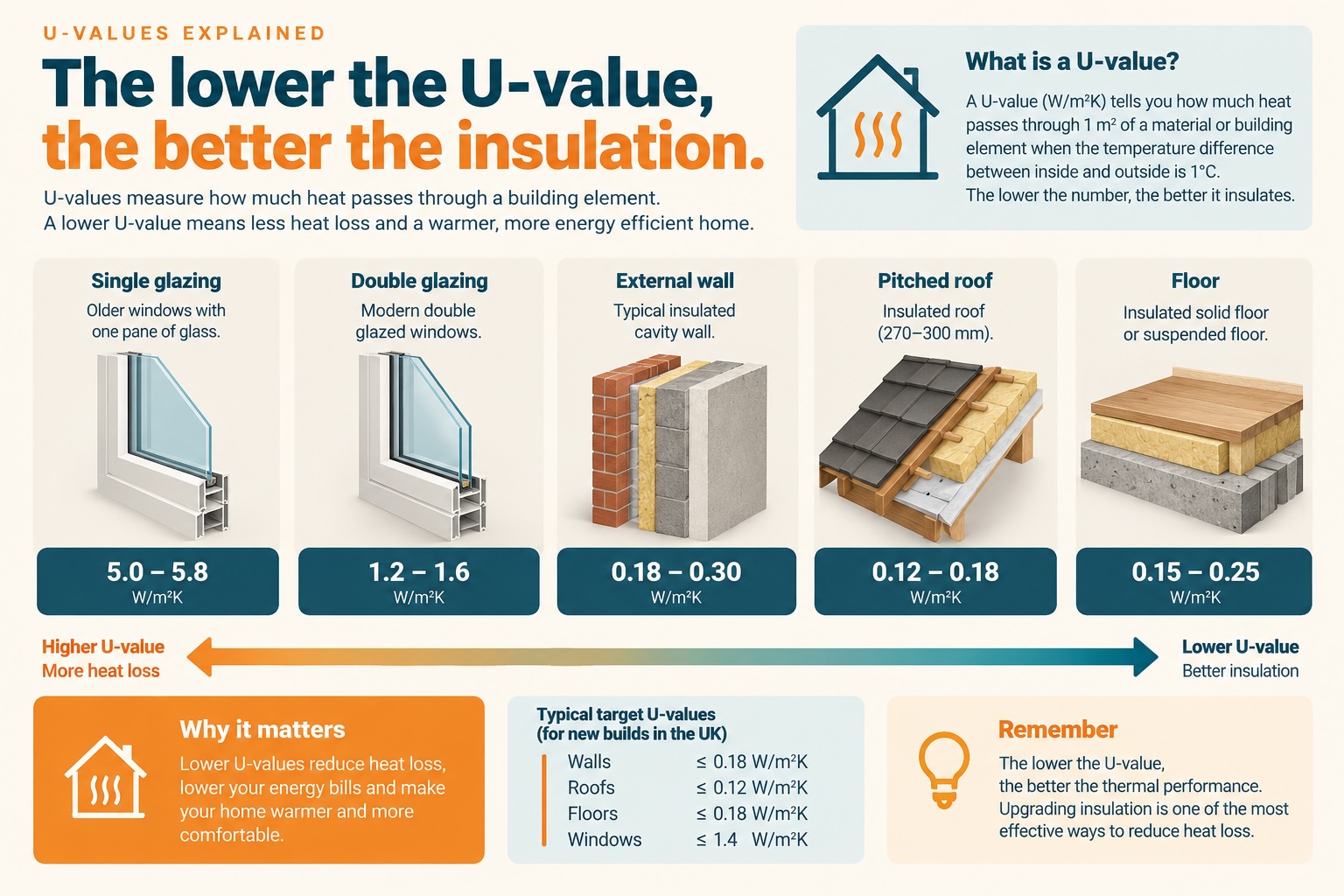
Typical U-value targets you may see
These are illustrative figures retained from the original article, not universal requirements for every project. Applicable limits depend on the work, building element and current regulations.
Roofs
0.16
W/m²K
Walls
0.30
W/m²K
Floors
0.25
W/m²K
Replacement windows
1.4 W/m²K or a B Window Energy Rating.
Doors over 60% glazed
1.2 W/m²K.
Other doors
1.0 W/m²K, with a limiting value of 1.6 W/m²K.
Insulation basics
Effective insulation can reduce heat loss and improve comfort, but choosing the right product involves more than simply picking a material from a shelf.
Thermal performance, moisture control, wall or floor construction, property age and the characteristics of the insulation all need to be considered together.
A fabric-first approach means reducing unwanted heat loss before upgrading or replacing the heating system. Less heat escaping from the building means the heating system has less work to do.
Three values. Three different jobs.
R-value
Resistance
The R-value measures the thermal resistance of a material. The higher the R-value, the greater its resistance to heat transfer.
Unit: m²K/W
U-value
Transmittance
The U-value describes heat transfer through a complete building element or combination of materials. Lower U-values indicate better thermal performance.
Unit: W/m²K
Lambda λ
Conductivity
Lambda describes the thermal conductivity of an individual material. Lower conductivity means the material transfers heat less readily.
Unit: W/mK
Why R-value matters
Higher thermal resistance means the insulation is better at slowing heat transfer. That can help a home retain heat in winter and reduce unwanted heat gain in summer.
Comparing two 100mm insulation products
- 100mm mineral loft roll: R-value around 2.50 in the example used on the original page.
- 100mm PIR rigid board: R-value around 4.30 in the example used on the original page.
This is why a higher-performance insulation product may achieve a similar thermal result at a smaller thickness. Cost, moisture behaviour, detailing and suitability still need to be considered alongside the thermal number.
Why U-value matters
The U-value is used to describe the overall rate of heat transfer through a building element. A wall, roof or floor is normally made from several layers, so each layer contributes to the total thermal resistance.
Basic relationship
U = 1 ÷ total R
The original page uses the reciprocal relationship as a simple way to explain why increasing total resistance lowers the U-value.
Real building-element calculations can involve several materials, surface resistances, repeating thermal bridges, air spaces and product-specific data, so manufacturer or professional calculation tools are normally used for final design and compliance checks.
Choosing insulation
Space often determines what can realistically be installed. A suspended timber floor with limited joist depth may need a product that achieves a higher thermal resistance at a smaller thickness. Where more depth is available, a different material may be practical and more economical.
Window and door reveals can also be difficult because there may be very little room for insulation. Thinner specialist products may be considered where conventional insulation cannot physically fit.
Do not choose on thermal performance alone
Cost, available space, moisture behaviour, fire considerations, installation method and the construction of the existing building can all influence the final choice.
Practical example
The original MyWarmHome example considers insulation beneath a suspended floor with a target U-value of 0.25 W/m²K.
100mm loft roll
Example U-value: 0.44 W/m²K
Does not meet the example target.
150mm loft roll
Example U-value: 0.29 W/m²K
Does not meet the example target.
200mm loft roll
Example U-value: 0.22 W/m²K
Meets the example target.
100mm PIR
Example U-value: 0.22 W/m²K
Meets the example target.
Try it yourself
Simple U-value calculator
Add material layers and thicknesses to get a simple indicative result. For final specification or Building Regulations compliance, use the relevant manufacturer or professional calculation method.
| Material | Thickness (mm) | Lambda λ (W/mK) | R-value (m²K/W) |
|---|
This simplified calculator assumes fixed internal and external surface resistances (0.13 and 0.04 m²K/W). It does not account for repeating thermal bridges, orientation-specific resistances or detailed air-gap behaviour. Indicative only, not a compliance calculation.
Other U-value calculators
Manufacturers also provide calculation tools for their own insulation systems and product ranges.
MyWarmHome view
The number matters. The building matters more.
Thermal values help compare materials and estimate performance, but a home is not a laboratory sample. Junctions, moisture, workmanship, ventilation, existing construction and available space can all change what is sensible to install.
Use the values to understand the options — then look at how the whole building works before making the final choice.
Keep exploring
Thermal performance makes more sense when you connect it to the actual insulation measure and the building it is going into.