
HEALTH & SAFETY / mywarmhome.co.uk
Who you gonna call.
A practical guide for surveyors, retrofit assessors, heating engineers and other trades working in people’s homes.
01
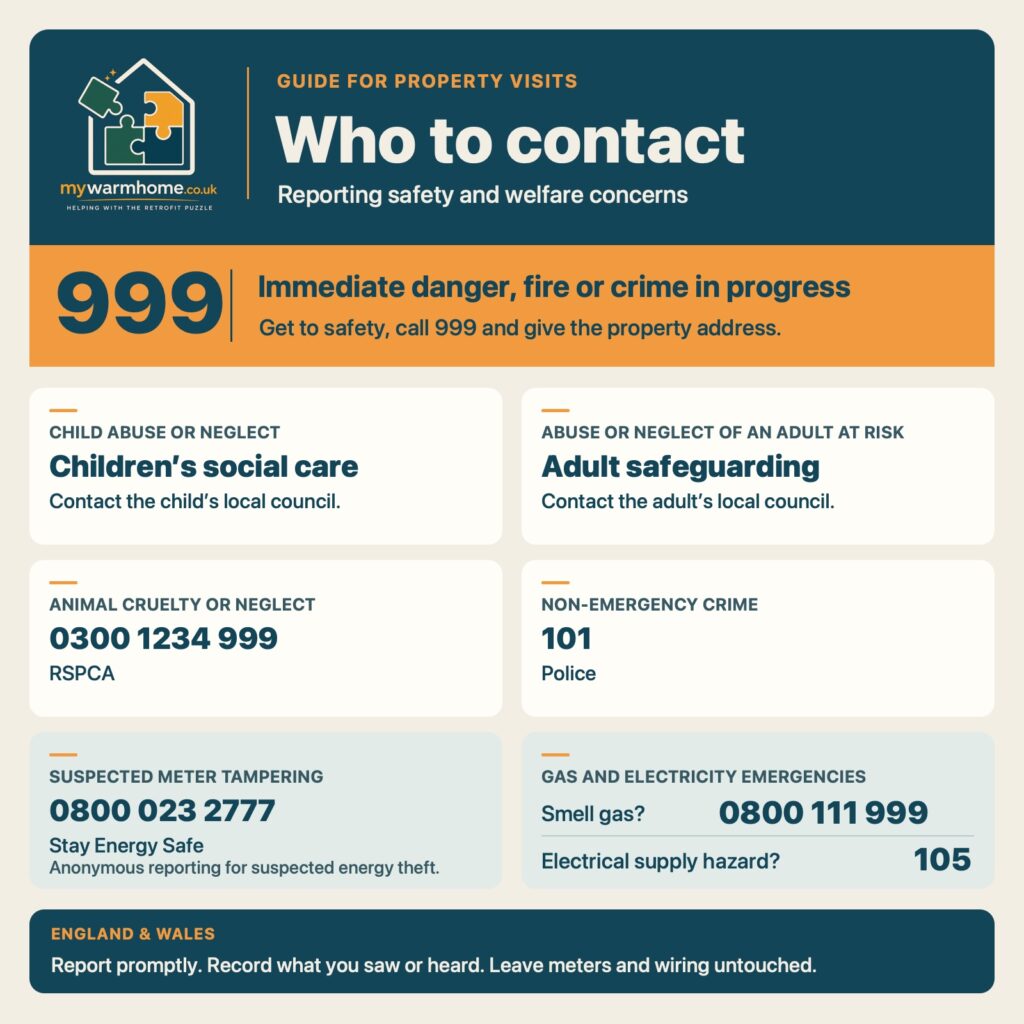
999
Immediate danger, fire or a serious crime in progress.
02
101
Non-emergency police reports.
03
Safeguarding
Contact the relevant council if you’re concerned about a child or an adult at risk.
04
Supply hazards
Call 105 for an electrical supply hazard or 0800 111 999 for a suspected gas escape.
IN SHORT
Get to safety and call 999 if there’s immediate danger.
Give the property address and explain what’s happening. Make the emergency call before contacting your office or completing the survey.
You’re there to survey a loft, inspect a boiler or measure up for insulation. Then a child says something that concerns you, an older resident tells you someone is taking their pension, or you see damaged wiring around an electricity meter.
You can act on a genuine concern from a single visit. Ask whether anyone is in immediate danger, record what you actually saw or heard, and contact the appropriate service. This guide covers England, with a note for visits in Wales.
Who to contact.
Non-emergency crime. Call 101 or report it to the police online.
Child abuse or neglect. Contact children’s social care at the local council.
Abuse or neglect of an adult at risk. Contact the local council’s adult safeguarding team.
Animal cruelty or neglect. Use the RSPCA’s Report cruelty service.
Suspected energy theft. Report it promptly to Stay Energy Safe on 0800 023 2777. Anonymous reports are accepted.
Immediate electrical supply hazard. Keep clear and call 105. Call 999 for fire, serious injury or immediate danger to life.
Suspected gas escape. Move to safety and call the National Gas Emergency Service on 0800 111 999.
If you suspect criminal activity.
If you witness an assault, hear a credible threat or feel unsafe, end the visit and move somewhere safe. Call 999 for a serious crime in progress or that has just happened. For a non-emergency, call 101 or report online. Give the address, the time and what you directly saw or heard. Leave confrontation, searches and evidence gathering to the police.
If you’re worried about a child.
A child might tell you they’re being hurt, or you might see a young child left alone in circumstances that put them at risk. Listen calmly and take them seriously. Explain that you may need to tell someone who can help. Avoid leading questions or asking the child to repeat their account. Record their words as accurately as you can and contact children’s social care promptly. You can report a concern without proof.
A cold or cluttered home can have many explanations. A failed boiler, unaffordable energy bills or an outstanding repair may explain what you see. Record the conditions, any harm or risk to the child, and what the household told you.
What the law says.
Section 47 of the Children Act 1989 places the duty to make enquiries on the local authority where it has reasonable cause to suspect significant harm. The Crime and Policing Act 2026 sets out a specific reporting duty for suspected child sexual offences linked to defined activities in England. Check the applicable commencement provisions and whether the defined activities cover your role. Follow your safeguarding procedure promptly whenever a concern arises.
If you’re worried about an older resident or another adult at risk.
An older resident might say someone is taking their pension, withholding medication or leaving them without essential care. They may also be struggling to meet their own basic needs. If it’s safe to speak privately, listen and ask what help they want. Respect their wishes and avoid assuming they lack capacity because of their age or disability. If someone appears to be under pressure, others may be at risk, or the danger is serious, seek safeguarding advice promptly even if the person declines help.
What the law says.
Section 42 of the Care Act 2014 requires an English council to make or arrange enquiries where it reasonably suspects an adult has care and support needs, is experiencing or at risk of abuse or neglect, and cannot protect themselves because of those needs. This includes financial abuse.
If you’re worried about an animal.
If you see an animal being hurt, notice an apparently untreated injury or find an animal confined in conditions that cause concern, report it to the RSPCA. Give the address, what you observed, when you saw it and whether the animal appears to be in immediate distress. Keep yourself safe and leave handling or removing the animal to those responding.
What the law says.
In England and Wales, section 4 of the Animal Welfare Act 2006 covers unnecessary suffering. Section 9 requires the person responsible for an animal to take reasonable steps to meet its welfare needs.
If you suspect an electricity meter has been bypassed.
Damaged seals, exposed wiring or scorch marks are reasons to stop work in that area. They can indicate damage or a fault as well as possible tampering. Keep clear and leave the meter and wiring untouched. Use 105 or 999 for an immediate electrical hazard as appropriate. Report suspected energy theft separately to Stay Energy Safe on 0800 023 2777. If you smell gas, leave the area, avoid operating electrical switches and call 0800 111 999 from a safe place.
What the law says.
Section 13 of the Theft Act 1968 makes it an offence in England and Wales to dishonestly use electricity without due authority, or dishonestly cause it to be wasted or diverted. The condition of a meter alone cannot establish who damaged it or why.
What to put in your visit notes
Where and when. Record the address, date, time and relevant location within the property.
What you saw or heard. Distinguish your observations from information someone gave you. Use their exact words where possible.
What you did. Record who you contacted, when and any reference number or instructions you received.
What you could safely inspect. Record the survey limitation and keep sensitive safeguarding details in your secure reporting system.
Example visit note
Meter casing damaged and wiring visible from the doorway. Inspection stopped at 10.15 am. Condition reported to the electricity network operator.
Follow your safeguarding procedure where applicable. If your role requires a direct referral, make it as well as any internal report. Share only what’s necessary with the appropriate people and use an appropriate lawful basis. See the government guidance on sharing information to safeguard children.
Visits in Wales
Use the safeguarding route for the Welsh council responsible for the property. The Social Services and Well-being (Wales) Act 2014 sets out duties for specified bodies to report adults at risk and children at risk. The gas and electricity emergency numbers above also apply in Wales.
References checked for the original article on 21 November 2026.