
Rules checked 16 November 2026.
01
800W AC
Maximum rated output at the socket.
02
One kit
One plug-in solar device per home under current network rules.
03
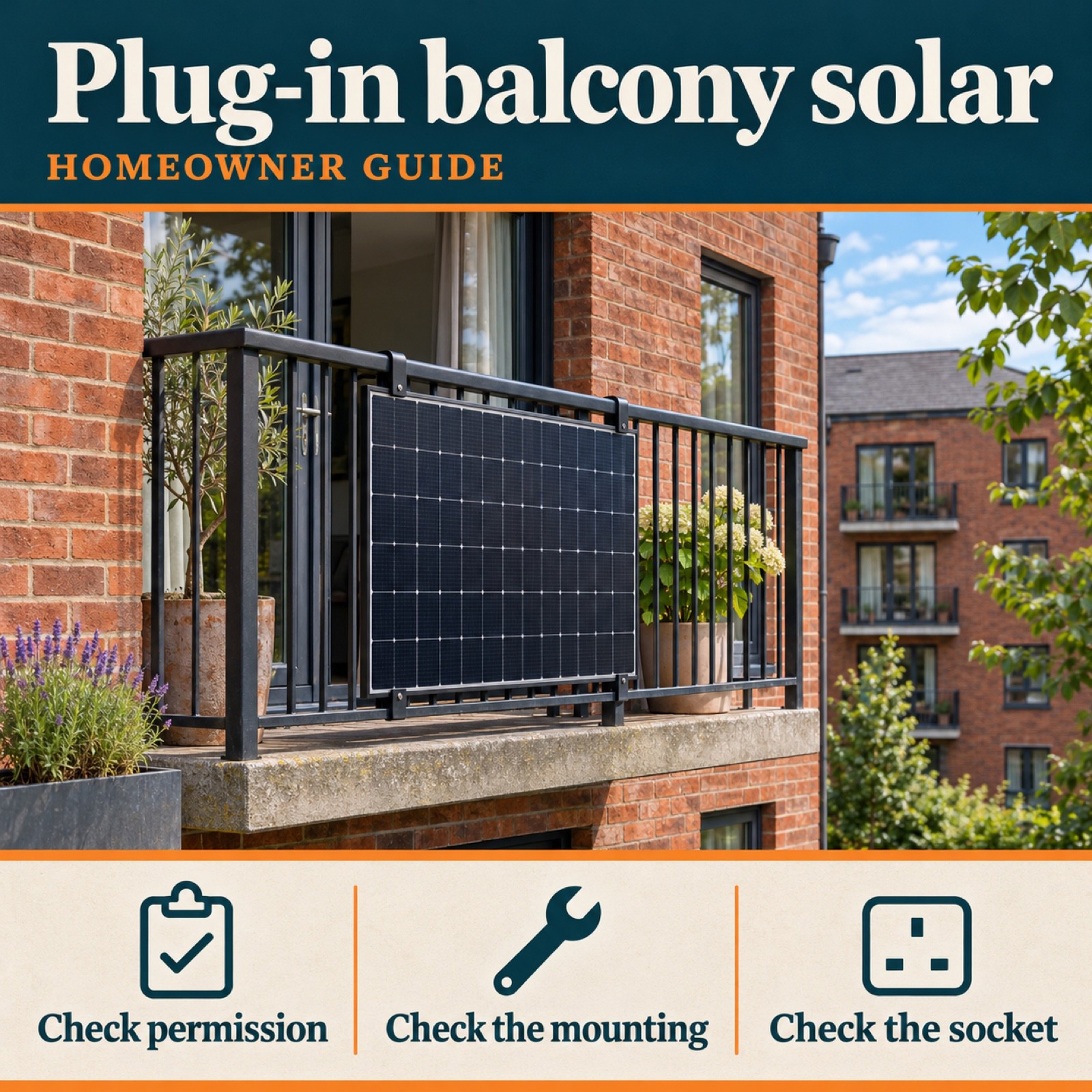
Get permission
Check who is responsible for the balcony and the building exterior.
04
Register first
Register your compliant device before you use it.
Could your balcony help cut your bills?
A plug-in kit can cover some of your daytime electricity use. Since 27 August 2026, compliant kits can be connected in England, Scotland and Wales under the new rules. For flats, check permission, wind exposure and the socket before you order. The same socket connection route is currently unavailable in Northern Ireland. Great Britain plug-in solar regulations.
How does plug-in solar work?
A solar panel makes direct current (DC) in daylight. A microinverter turns it into alternating current (AC) and feeds it into your home’s wiring through the supplied UK plug. If your home is using 500W and the panels are producing 300W, the grid supplies the remaining 200W. Any surplus may flow out to the grid. A compliant kit shuts down during a power cut.
Panel ratings and socket output measure different things. A kit sold as 920W may contain two 460W panels and an inverter capped at 800W AC. The limit applies to the inverter’s rated AC output. Energy Saving Trust’s plug-in solar guide.
What are the rules for a balcony or flat?
Check the exact kit and register it
Check that the exact model and mounting version are marked Compliant in the Plug-in Solar category on the ENA Connect Direct register. Check the whole kit, including its mount and supplied plug. The current network rules allow one device per home, which can have several panels. Use the Plug-in Solar Registration portal before first use.
The plug-in specification excludes kits with integrated batteries. If you already have rooftop solar or battery storage, ask a qualified electrician or your installer to check the combined system and whether the network operator requires further notification.
Get permission and check planning
If you rent or own a leasehold flat, get written permission from whoever controls the building exterior. This may be your landlord, freeholder or building manager. Send them the kit details, proposed cable route and how you intend to fix the panels. Ask about fire safety and building insurance, especially on taller buildings or where there is external cladding. Energy Saving Trust’s buying and safety checklist.
In England, the relevant permitted development rights for flats exclude plug-in solar on wooden walls, balconies or enclosures and timber-clad parts of the exterior. Restrictions can also apply to listed buildings and in conservation areas. In Scotland and Wales, check with your local planning authority. England’s permitted development amendment.
How do you install and use it safely?
- Check the mounting. Ask the supplier to confirm that the bracket suits the railing or surface, the installation height and the expected wind exposure. Get professional advice if the structure is uncertain or a falling panel could reach a pavement, entrance or shared area. Use safe access for work at height.
- Check the socket. Connect the supplied UK plug directly to a suitable fixed socket. Avoid extensions, multiway adaptors, travel adaptors and altered plugs. Use a suitable weatherproof socket outdoors. The socket circuit must be suitable and separate from lighting or hardwired appliances such as a boiler or cooker.
- Get electrical advice where needed. Ask a qualified electrician if the wiring is old or unknown, there are rewireable fuses, a new socket is needed or the combined panel rating exceeds 960W DC.
- Plan the cable route. Follow the manual. Keep cables clear of sharp edges, door and window pinch points, and walkways. Keep shared escape routes clear. Register the device before switching it on.
Energy Saving Trust’s buying and safety checklist.
Manufacturers and kits to compare
These examples are based on supplier listings. Confirm the exact kit and mounting configuration on the ENA Connect Direct register before ordering.
- Perlight Solar / Plug In Solar Ltd. PowerPlug MAX 500W single-panel kit with APsystems EZ1-M microinverter. The supplier lists an adjustable balcony, wall or floor mount. Ask what fixings you need. Supplier product details.
- Marstek / PowerXpress. Model 90012 with two 460W panels and an 800W microinverter. The supplier lists ENA reference POWEZA/21077/V1/A1. Check the mounting configuration and space for both panels. Supplier product details.
- DMEGC Solar / Hoymiles. HiFlow 950W, City Plumbing part 348142 and supplier model DME-950W-BW-1. The retailer lists Fastensol hardware for balconies, walls and gardens. Confirm which fixings are supplied for your site. Supplier product details.
How much could you save?
Savings depend on how much solar electricity you use as it’s generated. A bright balcony can help cover daytime demand from a fridge, router or home office. Shade from the balcony above, trees or nearby buildings can reduce generation. East- and west-facing panels can still help where their output coincides with your electricity use.
Energy Saving Trust modelled around £70–£100 a year for an 800W system in Manchester. Its example used unshaded, south-facing panels angled at 30° from horizontal. If your home uses 250 kWh of solar electricity a year at 26p per kWh, that’s £65 off the electricity you buy. Include export income only if your supplier confirms your kit is eligible. Currently Octopus offer panels with export payments.